
BalanceMaster Animal Mass — The kg on Screen Is for Show: 32 Hidden Masses and Measured Tilt Speeds

A 180 kg turtle on the left,
a 44 kg tiger on the right
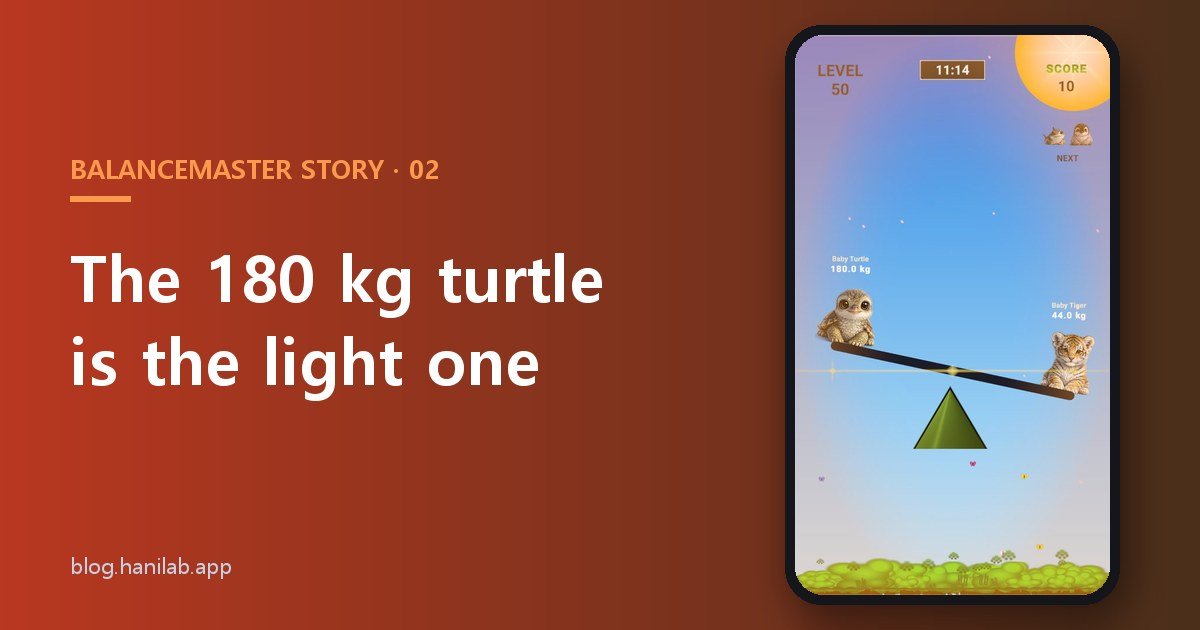
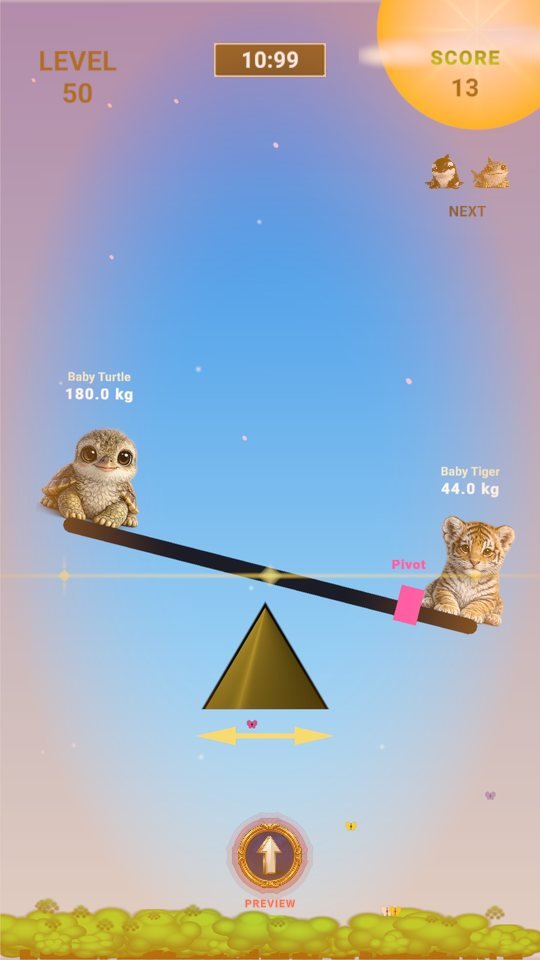
Level 50. On the left end of the plank sits a baby turtle labeled 180.0 kg; on the right, a baby tiger at 44.0 kg. Your hand drifts toward the heavy turtle all by itself. But leave the triangle in the middle and the plank goes down on the tiger’s side. This is a story about BalanceMaster animal mass — why the number over an animal’s head isn’t the number the plank uses, and how that gap shows up in a round, measured by putting a lot of pairs on the plank.

In BalanceMaster you drag a triangle fulcrum to level the plank with two baby animals on its ends. A name and a weight float above each animal, but what tilts the plank isn’t that weight — it’s a balance mass stored separately in the game data. The complete guide already told you to “ignore the weight on screen”; here we go one step further. The question of BalanceMaster animal mass comes down to this: how different are they, which pairs fool you most, and what changes in a round — all checked with numbers from the real game.
Every round is Level 50 (no weather, no special mode, no jumps, no surprise drops) with the pair of animals fixed in advance. A capture rig used a virtual finger to hold the fulcrum at a set position and logged the plank’s angle every 0.1 s — so these are machine measurements, not a human hand. I use the tilt rate (°/s) in the 0.3–0.5 s after the start, before the plank’s automatic wobble kicks in. The plank has only just started moving then, so readings come out at about 80–100% of the theoretical value. Each pair was measured once, so expect roughly ±0.5°/s of wobble.
Two numbers — the kg on screen vs. the plank’s mass
Every animal carries two numbers. ① The weight above its head (weightKg) is just text — “30 g” below 1 kg, “180.0 kg” and the like above — and ② the balance mass (mass) goes into the plank’s torque calculation. In the code the split is simple: when two animals are seated on the plank, only the mass is passed on as load, and a separate display component draws the weight label. So the two numbers have nothing to do with each other.
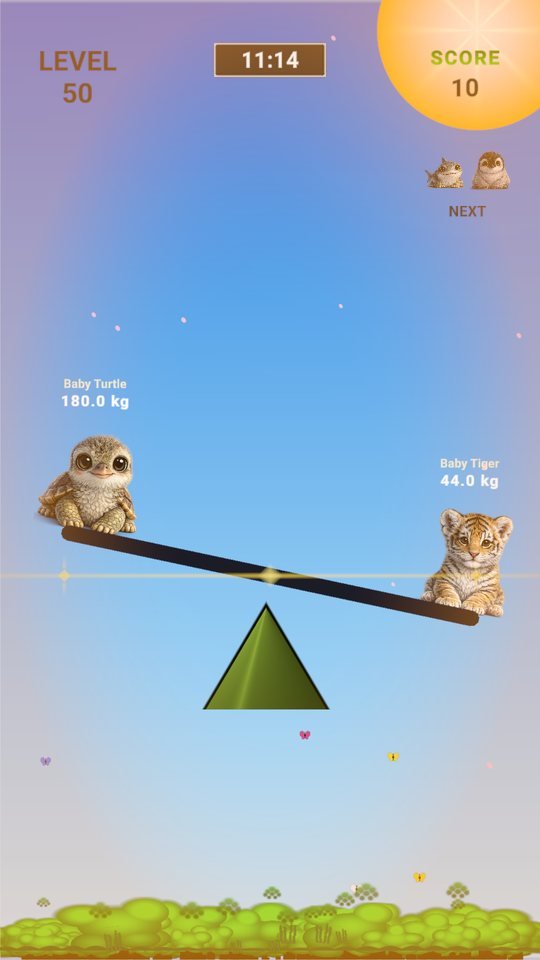
The first scene. With the fulcrum at the center (0), 0.9 s in, the left side with the 180 kg turtle has gone up and the right side with the 44 kg tiger has gone down. The triangle is shifting from green toward yellow.
- The turtle’s balance mass is 0.3, the tiger’s is 2.0. The tiger is 6.7 times heavier.
- The balance point is +0.69 toward the tiger — you’d have to send the fulcrum almost 70% of the way to the plank’s right end to level it.
- The screen says the turtle is 4 times heavier. It’s the opposite direction, too.
The animals where screen weight and mass disagree most
I ranked all thirty-two animals twice — by on-screen weight and by balance mass (equal masses share a rank). If the two ranks match, you can trust the screen for that animal; the wider the gap, the bigger the trap.
| Animal | Screen weight | Balance mass | Screen rank | Mass rank | How to read it |
|---|---|---|---|---|---|
| Baby Turtle | 180.0 kg | 0.3 | 7th | 27th | A light animal with a big number — same mass as the cat |
| Baby Gorilla | 12.0 kg | 3.5 | 21st | 3rd | A heavy animal with a small number — same mass as the giraffe and horse |
| Baby Koala | 1.6 kg | 1.0 | 29th | 18th | Near last on screen, but the same mass 1.0 as the bear and monkey |
| Baby Shark | 33.0 kg | 3.0 | 15th | 7th | Same mass 3.0 as the rhino, camel and calf |
| Baby Monkey | 3.8 kg | 1.0 | 26th | 18th | A much sturdier mass of 1.0 than the screen suggests |
| Baby Kangaroo | 4.3 kg | 1.5 | 25th | 17th | Labeled almost the same as the cat (5.0 kg), but its mass is 5 times larger |
| Baby Rhino | 405.0 kg | 3.0 | 1st | 7th (tied) | First on screen, but the mass leaders are the elephant and hippo (4.0) |
* Ranks are the game data’s display weights and balance masses sorted as they are. There’s exactly one animal where the two agree at the extreme — Baby Sparrow (30 g · 0.15) is last on both.
The numbers in the stat row come from this table. On screen the weights are 405 kg vs. 30 g, which looks like a gap of more than 13,000 times, but the mass the plank actually feels is 4.0 vs. 0.15, about 27 times. If you read “this pair will lean toward the sparrow” off the screen weights, you’re wrong by orders of magnitude.
Pairs I put on the plank — four where the screen guesses wrong
I paired animals whose screen weight and mass disagree, opened a round, and measured which way and how fast the plank tipped with the fulcrum at the center (0). “Guess from the screen” means the side that looks heavier on screen goes down.
| Left / Right | Screen weight | Mass | Guess from the screen | Side that actually went down | Balance point | Measured °/s |
|---|---|---|---|---|---|---|
| Turtle / Tiger | 180 / 44 kg | 0.3 / 2.0 | Left | Right (tiger) | +0.69 | 16.3 |
| Gorilla / Calf | 12 / 185 kg | 3.5 / 3.0 | Right | Left (gorilla) | −0.07 | 4.5 |
| Koala / Penguin | 1.6 / 16 kg | 1.0 / 0.4 | Right | Left (koala) | −0.40 | 5.5 |
| Kangaroo / Cat | 4.3 / 5.0 kg | 1.5 / 0.3 | Nearly level | Left (kangaroo) | −0.62 | 12.0 |
* The balance point is a value normalized to the plank’s half-width (left end −1, right end +1), recorded exactly as the game computed it.
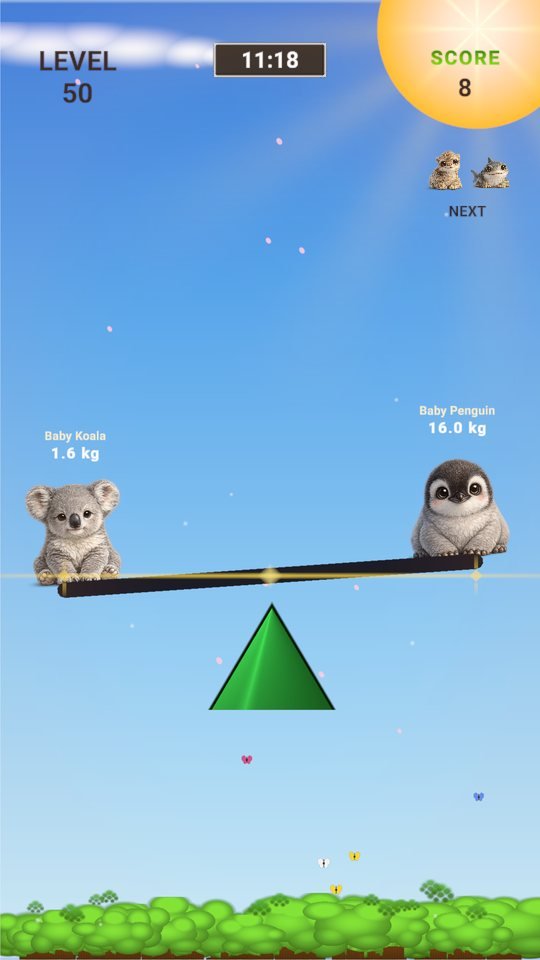


The most fun pair is gorilla / calf. The screen weights are 15 times apart, but the masses are 3.5 vs. 3.0, so the balance point is −0.07 and you barely have to move the fulcrum. On the other hand kangaroo / cat look alike at 4.3 kg vs. 5.0 kg, but the masses are 1.5 vs. 0.3 and the balance point goes all the way to −0.62. Two pairs that look equally “evenly matched” — one you can leave alone, the other needs a big move of your hand.
The glowing band that shows the true weight
When a pair is unfamiliar, the surest tool is the PREVIEW item. A pink band and a Pivot label appear over the plank, and that spot is the exact balance point. Used on turtle / tiger, the band lands right under the tiger, near the plank’s right end.
- Don’t get fooled by the screen weights — read the side with the band as the side with more mass.
- Watch one ad and an item pass opens, giving unlimited use of items for 5 minutes (details in the complete guide).
You can read it without the band, too. When a round opens, put the fulcrum in the middle and wait just 0.3 s. The side that tips is the heavy side. I read turtle / tiger this way, sent the fulcrum straight toward the tiger, and the plank leveled out quickly.
 Fulcrum moved toward the tiger (around +0.69) and the plank is level — the triangle is green again
Same pair, different fulcrum — 10 × mass sum × error
How fast the plank tips is proportional to how far the fulcrum is from the balance point. The plank’s viscosity (damping) and the torque multiplier set a terminal speed of roughly 10 × (sum of the two masses) × |fulcrum − balance point| °/s. To check the formula against real rounds, I moved only the fulcrum for lion 2.5 / tiger 2.0 (mass sum 4.5, balance point −0.103, and on screen the weights are 36 kg vs. 44 kg, so the tiger looks heavier).
| Fulcrum position | Distance from balance point | Formula value | Measured | Plank |
|---|---|---|---|---|
| Left end (−1) | 0.90 | 40.4°/s | 36.5°/s | The right side (tiger) goes down |
| Center (0) | 0.10 | 4.6°/s | 4.5°/s | The left side (lion) goes down |
| Balance point (−0.10) | 0.00 | 0°/s | 0.5°/s | Practically stops |
| Right end (+1) | 1.10 | 49.6°/s | 43.3°/s | The left side (lion) goes down |
Formula and measurement agree at 80–100% within 0.5 s. The two end rows fall a bit short because the plank hasn’t reached terminal speed yet (only 0.5 s since it started moving). Two things are worth noticing.
- The ratio of the left-end and right-end speeds matches the ratio of the errors. Measured 36.5 vs. 43.3 (1.19x), error 0.90 vs. 1.10 (1.23x) — miss in either direction and the speed scales honestly with the error.
- At the balance point it nearly stops. With the fulcrum on the balance point the plank moved 0.5°/s — less than half a degree in half a second. That’s why this game is about finding “exactly that spot.”
At fulcrum 0, the speed depends only on the mass difference
Work the formula through and an interesting fact falls out. With the fulcrum at 0, the error is the balance point itself, and balance point = 0.93 × (right − left) ÷ (sum), so the sum cancels out.
speed (°/s) ≈ 9.3 × |right mass − left mass| — the sum of the two masses doesn’t matter, only the difference. Light pair or heavy pair, the same mass difference gives the same starting speed.
| Pair | Mass | Difference | 9.3 × difference | Measured (fulcrum 0) |
|---|---|---|---|---|
| Cat / Puppy | 0.3 / 0.6 (sum 0.9) | 0.3 | 2.8 | 2.2 |
| Dolphin / Giraffe | 3.2 / 3.5 (sum 6.7) | 0.3 | 2.8 | 2.5 |
| Koala / Penguin | 1.0 / 0.4 (sum 1.4) | 0.6 | 5.6 | 5.5 |
| Gorilla / Calf | 3.5 / 3.0 (sum 6.5) | 0.5 | 4.7 | 4.5 |
| Kangaroo / Cat | 1.5 / 0.3 (sum 1.8) | 1.2 | 11.2 | 12.0 |
| Turtle / Tiger | 0.3 / 2.0 (sum 2.3) | 1.7 | 15.8 | 16.3 |
| Sparrow / Hippo | 0.15 / 4.0 (sum 4.15) | 3.85 | 35.8 | 35.0 |
The top two rows are the proof. Cat / puppy (sum 0.9) and dolphin / giraffe (sum 6.7) have sums more than 7 times apart, yet with the fulcrum at 0 they tip at the same speed — 2.2 and 2.5°/s. When a sparrow meets a hippo the plank goes 35° per second and hits the 25° maximum in under a second.
Same mistake, different price — light pairs and heavy pairs
So where does the sum make a difference? When the fulcrum is off the balance point. For the two pairs just above (cat / puppy and dolphin / giraffe) I set the fulcrum wrong by 0.2 from the balance point — 20% of the plank’s half-width.
| Pair | Mass sum | Fulcrum / balance point | Formula value | Measured |
|---|---|---|---|---|
| Cat / Puppy | 0.9 | 0.51 / 0.31 | 1.8°/s | 1.0°/s |
| Dolphin / Giraffe | 6.7 | 0.24 / 0.04 | 13.3°/s | 12.5°/s |


With the same 0.2 mistake the tilt was 1°/s vs. 12.5°/s — the ratio of the mass sums (7.4x) by the formula, 12x as measured (the light pair was only just starting to move in the first 0.5 s, so it reads slower and the gap looks wider). A light pair keeps a plank fine even if you misplace the fulcrum by a full 20%; a heavy pair tips more than 12° in a second for the same slip.


Real game — cat / puppy on the left, dolphin / giraffe on the right. The fulcrum is set the same 0.2 off the balance point, 1.4 s
A light pair forgives fulcrum mistakes, but it takes the plank’s constant automatic wobble (around ±3°/s) just the same. The 1.8°/s from a 0.2 error on cat / puppy is buried in that wobble, so if you take your hand off completely it slowly drifts out. A heavy pair is the reverse — you can ignore the wobble, but one slip is urgent. The bigger the sum, the more you want “small and often” instead of “one big move.”
As levels rise, what unlocks is ‘faster pairs’
Each time an animal unlocks, the fastest starting speed possible at that level (lightest animal meeting heaviest animal, fulcrum 0) goes up. Together with the order in which the thirty-two unlock, it looks like this.
| Unlock | Newly unlocked animal (mass) | Pool | Lightest / heaviest | Max starting speed |
|---|---|---|---|---|
| From the start | Cat 0.3 · Puppy 0.6 | 2 | Cat 0.3 / Puppy 0.6 | 2.8°/s |
| Level 2 | Owl 0.2 | 3 | Owl 0.2 / Puppy 0.6 | 3.7°/s |
| Level 3 | Koala 1 · Sparrow 0.15 | 5 | Sparrow 0.15 / Koala 1 | 7.9°/s |
| Level 4 | Rabbit 0.4 | 6 | Sparrow 0.15 / Koala 1 | 7.9°/s |
| Level 5 | Tiger 2 · Snake 0.25 | 8 | Sparrow 0.15 / Tiger 2 | 17.2°/s |
| Level 6 | Crocodile 0.5 | 9 | Sparrow 0.15 / Tiger 2 | 17.2°/s |
| Level 7 | Lion 2.5 · Parrot 0.18 | 11 | Sparrow 0.15 / Lion 2.5 | 21.9°/s |
| Level 8 | Panda 0.45 | 12 | Sparrow 0.15 / Lion 2.5 | 21.9°/s |
| Level 9 | Eagle 0.35 | 13 | Sparrow 0.15 / Lion 2.5 | 21.9°/s |
| Level 10 | Rhino 3 | 14 | Sparrow 0.15 / Rhino 3 | 26.5°/s |
| Level 11 | Monkey 1 | 15 | Sparrow 0.15 / Rhino 3 | 26.5°/s |
| Level 12 | Giraffe 3.5 | 16 | Sparrow 0.15 / Giraffe 3.5 | 31.2°/s |
| Level 13 | Bear 1 | 17 | Sparrow 0.15 / Giraffe 3.5 | 31.2°/s |
| Level 15 | Elephant 4 | 18 | Sparrow 0.15 / Elephant 4 | 35.8°/s |
| Level 17 | Pig 2 | 19 | Sparrow 0.15 / Elephant 4 | 35.8°/s |
| Level 20 | Deer 2 | 20 | Sparrow 0.15 / Elephant 4 | 35.8°/s |
| Level 22 | Zebra 2.6 | 21 | Sparrow 0.15 / Elephant 4 | 35.8°/s |
| Level 25 | Shark 3 | 22 | Sparrow 0.15 / Elephant 4 | 35.8°/s |
| Level 28 | Dolphin 3.2 | 23 | Sparrow 0.15 / Elephant 4 | 35.8°/s |
| Level 30 | Calf 3 | 24 | Sparrow 0.15 / Elephant 4 | 35.8°/s |
| Level 33 | Penguin 0.4 | 25 | Sparrow 0.15 / Elephant 4 | 35.8°/s |
| Level 35 | Turtle 0.3 | 26 | Sparrow 0.15 / Elephant 4 | 35.8°/s |
| Level 37 | Kangaroo 1.5 | 27 | Sparrow 0.15 / Elephant 4 | 35.8°/s |
| Level 40 | Ostrich 2 | 28 | Sparrow 0.15 / Elephant 4 | 35.8°/s |
| Level 42 | Gorilla 3.5 | 29 | Sparrow 0.15 / Elephant 4 | 35.8°/s |
| Level 44 | Camel 3 | 30 | Sparrow 0.15 / Elephant 4 | 35.8°/s |
| Level 47 | Horse 3.5 | 31 | Sparrow 0.15 / Elephant 4 | 35.8°/s |
| Level 50 | Hippo 4 | 32 | Sparrow 0.15 / Elephant or Hippo 4 | 35.8°/s |
* Unlocks are based on the highest level reached. The max starting speed is a theoretical value computed as 9.3 × (heaviest mass in the pool − lightest mass), and sparrow / hippo (Level 50) was measured directly above at 35.0°/s.
- The speed ceiling is already reached at Level 15. The moment Baby Elephant (4.0) unlocks, 35.8°/s for sparrow / elephant becomes possible, and even after all 32 are open by Level 50 that value stays the same. The difficulty of the later levels comes from time, weather and a narrowing plank, not from the animals.
- That pair is unlikely to show up in a real round. Animals are drawn one after another from a bag mixing the pool, so extreme pairs are occasional, and you meet them most often when a wildcard slips in the lightest or heaviest animal (next chapter).
- Level 2 rises a little from 2.8 to 3.7, and Level 4 doesn’t change it at all. The first leap is Sparrow and Koala at Level 3 (7.9), the second is Tiger at Level 5 (17.2).
Equal masses · the 3% wildcard — rounds that start level
When two animals of equal mass meet, the plank is level from the start. To prevent that, the game swaps in an unlocked animal of a different mass whenever the pair is the same animal or has the same mass. So even animals from the same mass class (for example koala · monkey · bear, or tiger · pig · deer · ostrich) get their right-hand partner replaced with a different mass. Nearly equal masses aren’t blocked — put Baby Parrot (0.18) and Baby Sparrow (0.15) together and I measured 0.0°/s: the plank didn’t move for the first 0.5 s (balance point −0.085, and the sum is so small that even moving the fulcrum gives a theoretical value of only 0.3°/s).
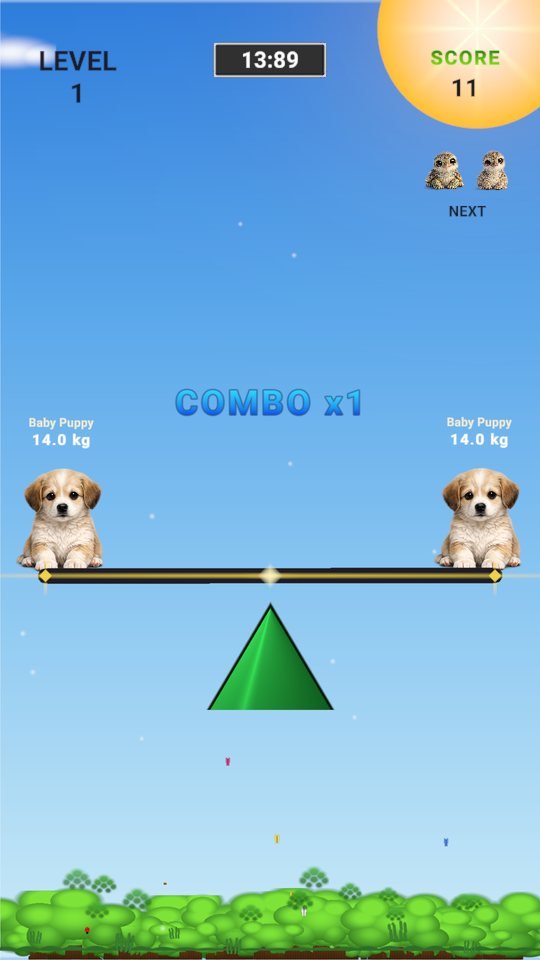
But the wildcard rolls after that check, which leaves a gap. This is the order in the code.
- Draw the left and right animals from the bag of unlocked animals.
- If the masses are equal, swap the right one for an animal of a different mass.
- Then, with 3% probability, replace one side with the heaviest (50%) or the lightest (50%) animal in the pool.
Because step 3 comes last, if the replacement has the same mass as the animal on the other side, the round starts level as it is. The photo is this situation, set up by the capture rig, which swapped both animals for puppies (14.0 kg), and the plank is level in this frame.
The Level 1 pool is only cat and puppy, so the animal a wildcard picks is one of those two as well. Half of the 3% — a puppy put in the cat’s spot, or a cat in the puppy’s — means about 1.5% of rounds start level (two of the same animal). That’s calculated from the order in the code, not measured. The bigger the mass gap, the scarier the wildcard side gets — after Level 15, a sparrow or an elephant / hippo can cut in on one side.
The mass class chart — memorize only this
The thirty-two animals have only nineteen balance masses. Animals in the same row behave identically on the plank, so it’s easier to memorize them by class. Forget the screen weights and read from this chart.
| Mass | Animals | Screen weight |
|---|---|---|
| 0.15 | Sparrow | 30 g |
| 0.18 | Parrot | 400 g |
| 0.2 | Owl | 2.7 kg |
| 0.25 | Snake | 250 g |
| 0.3 | Cat · Turtle | 5.0 kg · 180.0 kg |
| 0.35 | Eagle | 4.9 kg |
| 0.4 | Rabbit · Penguin | 2.5 kg · 16.0 kg |
| 0.45 | Panda | 17.0 kg |
| 0.5 | Crocodile | 6.0 kg |
| 0.6 | Puppy | 14.0 kg |
| 1.0 | Koala · Monkey · Bear | 1.6 kg · 3.8 kg · 30.0 kg |
| 1.5 | Kangaroo | 4.3 kg |
| 2.0 | Tiger · Pig · Deer · Ostrich | 44.0 · 102.0 · 32.0 · 63.0 kg |
| 2.5 | Lion | 36.0 kg |
| 2.6 | Zebra | 120.0 kg |
| 3.0 | Rhino · Shark · Calf · Camel | 405.0 · 33.0 · 185.0 · 170.0 kg |
| 3.2 | Dolphin | 60.0 kg |
| 3.5 | Giraffe · Gorilla · Horse | 332.0 · 12.0 · 245.0 kg |
| 4.0 | Elephant · Hippo | 323.0 · 250.0 kg |
- Read the names first and skip the numbers. Recall the two animals’ masses from the chart above and decide which side is bigger. For an unfamiliar pair, put the fulcrum in the middle and watch for 0.3 s — the side that tips is the heavy side.
- The balance point is on the heavy side, and nearer the end the bigger the mass difference. Turtle (0.3) / tiger (2.0) is +0.69, sparrow / hippo is +0.86, gorilla / calf is −0.07.
- For small differences (balance point near 0) the start is slow, so don’t rush; for big differences, go to the balance point in one move right after the start. The fulcrum-0 speed is 9.3 × the mass difference.
- Heavy pairs (big sums) make the same mistake up to 7 times as costly, so move your finger in small, frequent steps. For light pairs it’s the opposite: place the fulcrum once and just absorb the occasional automatic wobble.
- If you have the PREVIEW item, just line the triangle up with the pink band. And if the balance point you guessed from the screen weights disagrees with the band, the band is right.
Mid-round balance-point movers — surprise drops and jumps — plus weather and special modes are covered in the BalanceMaster complete guide. What I confirmed today comes down to one thing — the plank moves by the name and the mass chart, and the kg on screen is a number for show.
A 180 kg turtle is as light as a cat,
and a 12 kg gorilla is as heavy as a giraffe.
The triangle knows those numbers.

Play BalanceMaster now
Playing it is much faster than reading about it.
Find the other Master Series games all in one place at hanilab.app.

More from this game
 “Caster, the triangle is on the move!” Reading one BalanceMaster round as a broadcast script
 BalanceMaster Game Over: 7 Ways You Lose When the Animals Never Fall
 BalanceMaster Level 1 vs Level 500: Is It the Same Game? Timer 15 s to 8.5 s, Plank 90% to 52%
 BalanceMaster Weather and Special Modes — Rain, Snow, Lightning and 20 Modes, Measured
🌌 Universe stories
 Roddy Universe, Part 2 — Fallen Down, Only One Step Back at the Roadside
 Roddy Universe, Part 1 — One Beat Before Crossing, the Empty Road Between the Cars
 Bombi Universe, Part 2 — Behind You: The Reaper That Walks Through Walls
Try other games
 FlipMaster
 WordMaster
 TapMaster