

BalanceMaster Surprise Events: Jumps, Sky Drops and NICE SAVE!, Measured in One Second

A board on COMBO x5
can hit 25° in one second
Keep the plank level for just 1.6 seconds and the BalanceMaster surprise events begin. A lion suddenly goes weightless, an elephant drops out of the sky, and on some rounds the plank slams to its limit the moment two animals jump together. There is no warning text at all. This post is a record of those moments triggered in the real game, with the angle measured every 0.1 seconds: how far each event tips the plank, and where and how fast you have to move the triangle to survive.

The full rules are in the Complete Guide, the animals’ hidden masses are in the animal-mass post, and the balance-point formula and fulcrum error are in the lever-physics post. Here we take all that as known and look only at the four BalanceMaster surprise events that change the balance in the middle of a round.
Every round was opened at level 12 (plank width 90%, target 14 s, grace period 2.8 s). Natural weather, special modes, jumps and drops were stripped out, and then the capture rig called the game’s own functions to trigger each event. The finger is not a person either, it is a virtual touch: the “reaction time” is a value we set in the rig, and the hand speed was fixed at a normalized 4 per second (about 900 px/s on screen, a fairly fast swipe). The pairs are Lion 2.5 / Tiger 2.0 (sum 4.5), Cat 0.3 / Dog 0.6 (sum 0.9), Rhino 3.0 / Elephant 4.0 (sum 7.0), Koala 1.0 / Penguin 0.4 (sum 1.4) and so on, all the baby versions. Each condition was measured once, so expect about ±1° of wobble.
Animal jump: the one that wobbles is the one left behind
Jumps start at level 5, and the game rolls the dice once per round. The chance is 20% up to level 10, 25% up to 20, 30% up to 50, 35% up to 100, 40% up to 200, and a random 25-50% from 201 on. If the roll hits, the jump fires the moment the combo reaches 2 (the moment you have stacked 1.6 seconds of level time). So the better you play, the more you get interrupted. While the animal is in the air (0.8 s) its mass drops to 0.01, and it comes back when it lands.
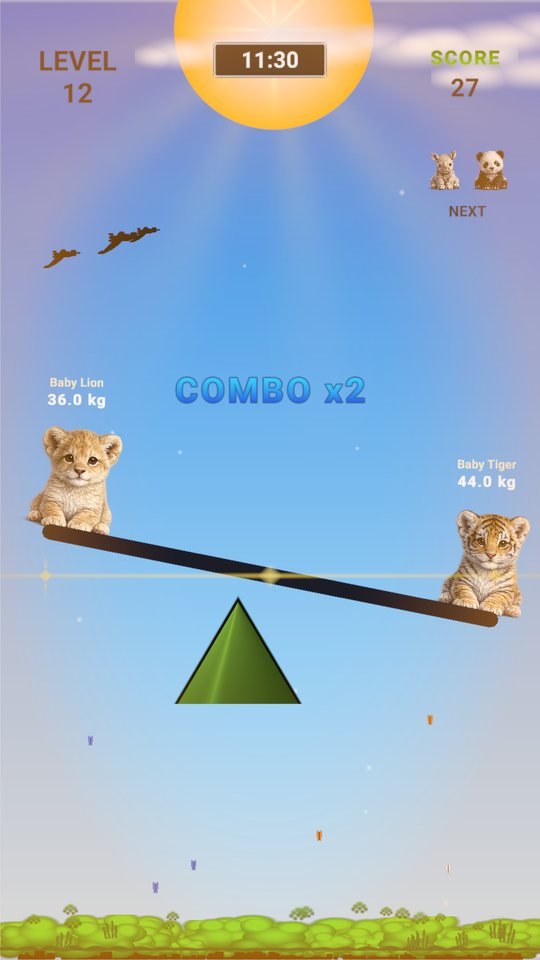
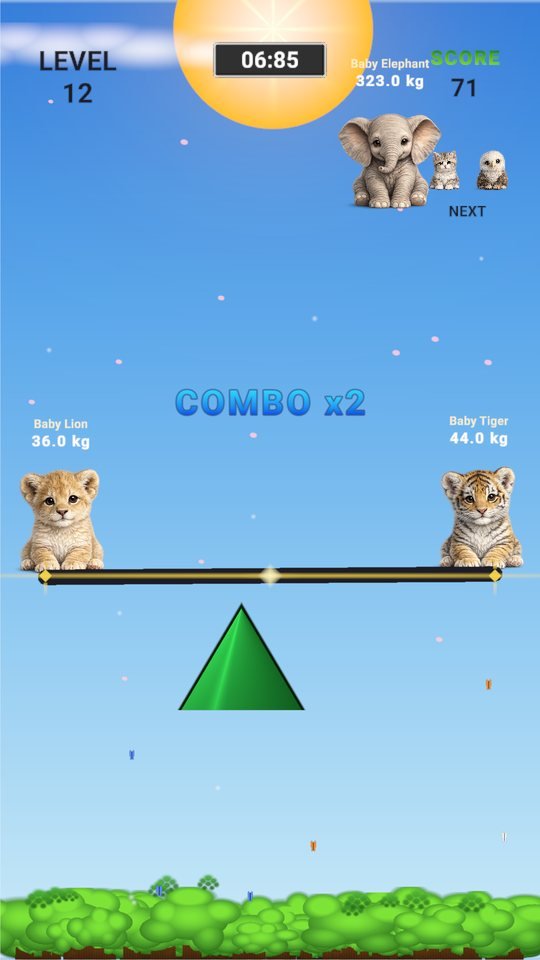
Level 12, a lion and a tiger in balance, 0.7 s after the lion jumped. The plank has tipped toward the tiger, and the triangle has started to turn from green toward yellow.
- You never see the animal jump. In this game the animals are attached to the plank (their position is reset every frame), so there is no hop on screen, just a plank that swings. The only signal of a jump is a plank that suddenly tilts.
- There is no warning text either.
Why does it swing? When the jumper’s mass becomes 0.01, the balance point runs off to the end of the animal that stayed (±0.92). The fulcrum has not moved but the balance point is now far away, so the tilt speed is 10 × (remaining mass) × (distance the balance point moved). For the same jump, the heavier the animal left behind, the bigger the tilt. The results below come from holding the triangle still on the balance point (hand fixed) and triggering the jump.
| Pair (mass) | Jumper | Mass left | Tilt just after landing | Time to exceed 4° | Reading |
|---|---|---|---|---|---|
| Lion / Tiger (2.5 / 2.0) | Lion (left) | 2.0 | −14.5° | 0.4 s | Swings to the right |
| Tiger (right) | 2.5 | +18.8° | 0.3 s | The heavier one stays, so it tilts more | |
| Rhino / Elephant (3.0 / 4.0) | Rhino (left) | 4.0 | −23.6° | 0.3 s | Passes 22.5° at 0.9 s |
| Elephant (right) | 3.0 | +25.0° | 0.2 s | Hits the maximum angle | |
| Cat / Dog (0.3 / 0.6) | Cat (left) | 0.6 | −1.4° | Never | Practically harmless |
| Dog (right) | 0.3 | +5.1° | 0.8 s | Barely over | |
| Sparrow / Hippo (0.15 / 4.0) | Sparrow (left) | 4.0 | −1.0° | Never | The balance point barely moves |
| Hippo (right) | 0.15 | +4.5° | 0.9 s | Weak even when the heavy one jumps |
* Tilt values are taken around 0.9-1.0 s after the jump starts. For a pair like Sparrow / Hippo, where the balance point already sits at the end (+0.86), a jump hardly moves it, and when the heavy hippo jumps only 0.15 of mass is left, so no speed builds up. Two large masses that are close to each other are the dangerous case.
After landing, the plank does not come back
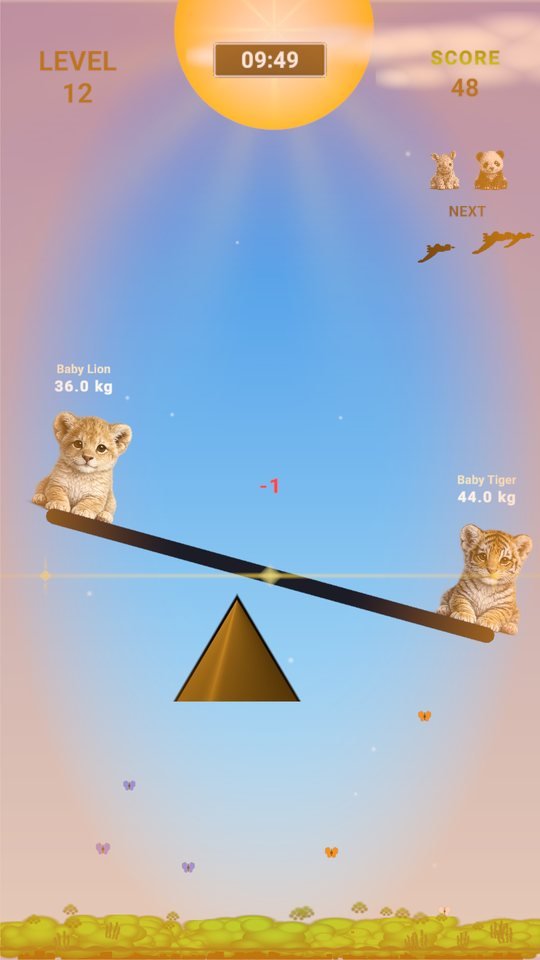
The plank has no force of its own that pulls it level. When the jump ends and the mass returns, only the speed of the tilt drops to zero; the angle stays. The photo below is the same lion jump, 1.7 seconds after landing: the lion has already settled and the plank is still tilted. To undo it you have to send the triangle past the balance point.

Where to move the triangle, and how fast
During a jump the balance point sits at the end of the remaining animal (+0.92 for Lion / Tiger). We made the hand follow the balance point in real time, and froze it for exactly as long as the simulated reaction delay after the jump.
| Pair · jump | Hand reaction | Max tilt | Time to come back inside 4° |
|---|---|---|---|
| Lion / Tiger · lion jumps | Hand fixed | −14.5° | Never |
| After 0.3 s · 4 per second | −7.7° | 1.0 s after the jump starts | |
| After 0.3 s · 8 per second | −7.6° | 1.0 s | |
| After landing (1.0 s) · 4 per second | −14.5° | 1.5 s | |
| Rhino / Elephant · rhino jumps | Hand fixed | −23.6° | Never |
| After 0.3 s · 4 per second | −12.0° | 1.1 s | |
| After 0.2 s · 8 per second | −7.2° | 0.9 s |
- Reaction beats speed. In the lion jump, 4 per second and 8 per second both ended near −7.6°. The moment the hand starts to move decides the result.
- If you move after you see the jump, you are late. A pair with a sum of 4.5 passes 4° in 0.4 seconds. On a round where a jump can happen (just before combo 2), keep your hand on the triangle.
- Sending the hand toward the balance point keeps the plank still during the jump. But when the animal lands the balance point snaps back to where it was, so the hand has to snap back just as quickly.
When two animals jump together, one is left at 0.01 for good
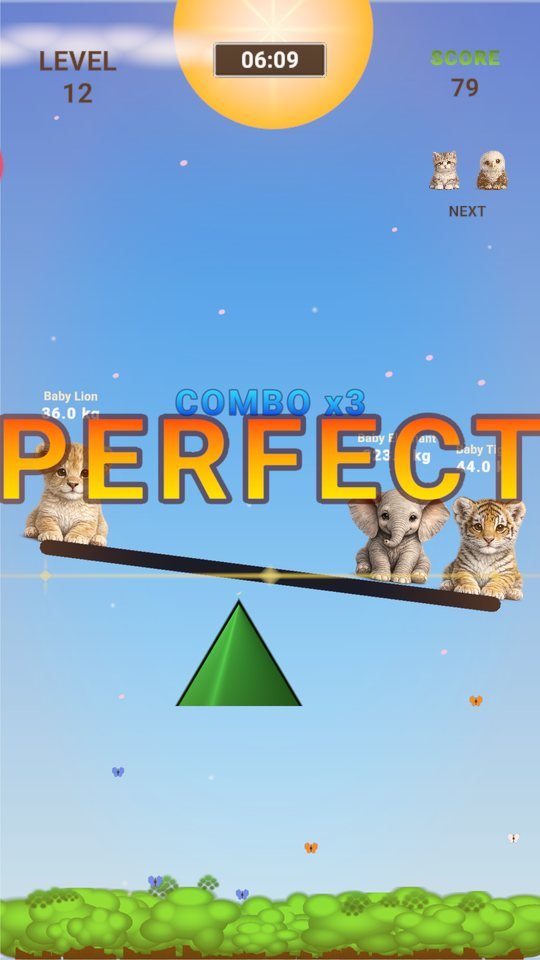
In one quarter of the jump rounds, two animals jump at the same time. The intuition goes like this: both masses become 0.01, the sum is nearly zero so the plank does not budge, and when they land everything returns to normal. The earlier photo (just after landing) shows the first half correctly, because for 0.8 seconds the plank really is quiet. But what happens after landing is different.
The game code starts both jumps in the same frame, one right after the other. When the second jump reads the “original mass”, the first jump has already set it to 0.01, so the second one remembers 0.01 as the original value. At landing the first jump puts the mass back, but then the second one overwrites it with the value it remembered (0.01 on the left). The capture rig called the same functions in the same order and measured exactly that.
| Pair | Mass before the jump (L / R) | Mass after landing | Balance point | Time to pass 22.5° with the hand fixed |
|---|---|---|---|---|
| Lion / Tiger | 2.5 / 2.0 | 0.01 / 2.0 | −0.10 → +0.92 | 2.2 s after the jump starts |
| Rhino / Elephant | 3.0 / 4.0 | 0.01 / 4.0 | +0.13 → +0.93 | 1.8 s |
| Cat / Dog | 0.3 / 0.6 | 0.01 / 0.6 | +0.31 → +0.90 | 6.4 s (a slow slide, 4-5° per second) |
* Over the 8 seconds we watched, the mass stayed at 0.01. The animal names and kg labels on screen stay the same, so you cannot tell by eye. These values were not caught by waiting for a natural occurrence; they come from calling the game’s jump function twice in the same frame.
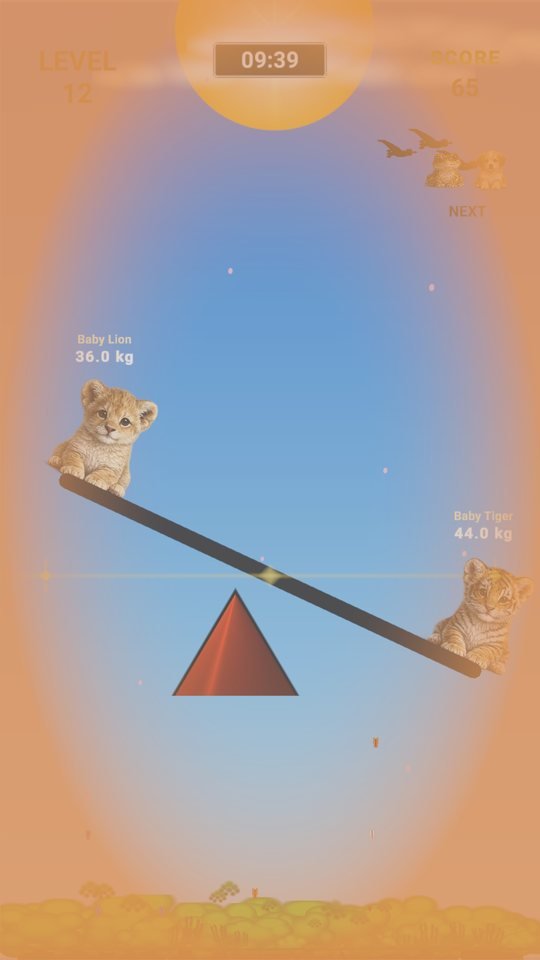
After both animals jumped, the lion / tiger plank was pushed all the way down on the tiger’s side and is stuck near its limit. The lion sits there as if nothing happened, and its “36.0 kg” label has not changed.
- The balance point of this round is now under the tiger (+0.92). The animal on the left effectively no longer exists.
- The fix is to park the triangle near the right end (around 0.9) and keep it there for the rest of the round. Anywhere else and the plank keeps tipping.
How early does the hand have to go? Here are the results by the moment the hand started moving after the jump began (4 per second, following the balance point).
| Pair | Reaction start (after jump starts) | Max tilt | Result |
|---|---|---|---|
| Lion / Tiger | 0.3 s | −7.7° | Inside 4° at 4.0 s |
| Lion / Tiger | 0.8 s (the moment of landing) | +1.8° | Caught right after it starts to tilt |
| Cat / Dog | 0.3 s | +1.8° | Caught |
| Rhino / Elephant | 0.3 s | −17.3° | Still −8° at the end of 8 s (a slow return) |
| Rhino / Elephant | Hand fixed | −25.0° | Passes 22.5° at 1.8 s |
The key is that “for the 0.8 seconds of the jump nothing happens.” If you see both animals jump (the plank suddenly going calm is the signal), use that gap to move the triangle toward the right end. The tilt begins the moment they land, and a pair with a large sum becomes dangerous within a second.
Surprise drop: a new animal falls from the sky
From level 10 on, when exactly half of the round has passed (7.0 seconds at level 12), an animal falls with a 35% chance. The side is left only 35% · both 35% · right only 30% (going by the code: a comment in the code says “both is 30”, which does not match what actually happens). The falling animal is any animal different from the ones already there; it comes down 0.55 seconds from 5.5 units above the plank and attaches just inside the animal already on that side. There is no warning text on screen: the fall itself is the only notice.
At the moment of landing, the masses on that side are merged and the position is recalculated as a mass-weighted average, so the balance point jumps in one step. These are the results with the hand held on the old balance point (the drop starts at timer 7.0 s, and “after landing” excludes the 0.55 s of the fall).
| Base pair | Animal that fell (mass) | Mass sums after landing | Balance point | To 4° after landing | To 22.5° after landing |
|---|---|---|---|---|---|
| Lion / Tiger (−0.10) | Elephant on the right (4.0) | 2.5 / 6.0 | +0.20 | 0.4 s | 1.1 s |
| Hippo on the left (4.0) | 6.5 / 2.0 | −0.31 | 0.4 s | 1.5 s | |
| Both sides, elephant + hippo | 6.5 / 6.0 | −0.04 | 0.7 s | 2.5 s | |
| Sparrow on the right (0.15) | 2.5 / 2.15 | −0.08 | 3.2 s | Not reached (−7° at 4.9 s) | |
| Cat / Dog (+0.31) | Elephant on the left | 4.3 / 0.6 | −0.38 | 0.3 s | 0.9 s |
| Elephant on the right | 0.3 / 4.6 | +0.49 | 0.5 s | 1.9 s | |
| Both sides, elephant + hippo | 4.3 / 4.6 | +0.03 | 0.4 s | 1.6 s | |
| Sparrow on the left | 0.45 / 0.6 | +0.19 | Never exceeded (max 3.0°) | — | |
| Koala / Penguin (−0.40) | Gorilla on the right (3.5) | 1.0 / 3.9 | +0.27 | 0.3 s | 0.9 s |
* Times are ±0.1 s. Which animal falls is random, so extreme examples (elephant, hippo, gorilla, sparrow) were chosen here.
- Light pairs are the most dangerous. Cat / Dog tips only slowly even when you slip, but once an elephant sits on the left the sum becomes 4.9 and the plank reaches 22.5° in 0.9 seconds. The balance point goes all the way to the other side at −0.38, so the triangle also has a long way to travel.
- When both sides drop together, the balance point barely moves (+0.03 to −0.04). But the sum becomes 9-12, so the same mistake plays out two or three times faster. At that point it is a matter of finesse, not distance.
- A light animal such as the sparrow is practically harmless (balance point shift of 0.02-0.12).
How fast do you have to move after landing?
The plank stays as it is during the 0.55 s fall, so the moment of landing is the starting line. With the hand set to follow the balance point, we changed only the time after landing at which it started to move (4 per second).
| Event that fell | Just after landing (0.05 s) | +0.3 s | +0.6 s | +0.9 s |
|---|---|---|---|---|
| Lion / Tiger + elephant on the right | −2.1° | −7.4° | −15.0° | −22.7° |
| Lion / Tiger + hippo on the left | +2.3° | +5.9° | +11.1° | +16.3° |
| Cat / Dog + elephant on the left | — | +12.1° | +20.0° | +25.0° |
| Koala / Penguin + gorilla on the right | — | −12.7° | −22.6° | −25.0° |
The numbers in the table are how far the plank has already tipped by the time you start. The later you start, the bigger the angle you have to undo, and at the same speed it also takes longer to come back (a Cat / Dog that starts at +0.9 s needs 2.5 seconds after the drop began to get back inside 4°). For these two pairs, a hand that moved within 0.3 s of landing held the plank under 13°, at 0.6 s it was stopped at 20-23°, and at 0.9 s it reached the maximum angle.
The drop always begins at exactly half of the target time (7 s on a 14-second round). When the timer is near that, do not let go just because you are balanced; keep your hand on the triangle. From the moment you see the elephant to the landing is 0.55 seconds. In that time, look at “which side got heavier,” and the moment it lands, go straight to that side.
“NICE SAVE!”: the 2.5 seconds back from 22.5°
If the tilt reaches 22.5° (90% of the 25° maximum) or more and then comes back inside ±4° within 2.5 seconds of the last moment it was at 22.5° or beyond, a green NICE SAVE! shows at the top of the screen for 0.9 seconds (with a 1.5-second cooldown). If you come back later than 2.5 seconds, the game treats it as ordinary stabilizing and does not count it.
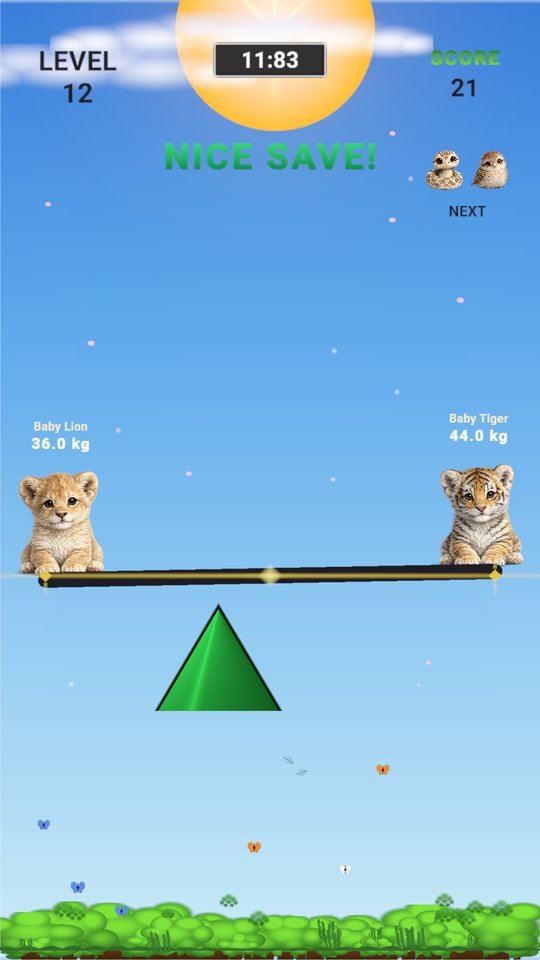
This is the moment the lion / tiger plank was tilted to 25°, the triangle was sent back, and the plank became level. On the very frame it is inside 4°, NICE SAVE! appears.
- The average speed you need is (22.5° − 4°) ÷ 2.5 s ≈ 7.4° per second or more.
- And the speed was 10 × mass sum × fulcrum error, remember? For a pair with a small sum, even the maximum error does not reach this speed.
We measured whether it is possible for each pair. On a plank tilted to 25°, the hand ran toward the balance point at 6 per second, and the “return time” in the table runs from the last moment at or above 22.5° to being inside 4°.
| Pair (mass sum) | Reaction time | Return time | NICE SAVE! |
|---|---|---|---|
| Lion / Tiger (4.5) | 0 | 0.6 s | Shown |
| 0.4 s | 0.7 s | Shown | |
| 1.0 s | 0.6 s | Shown (even after holding 25° for one more second) | |
| Rhino / Elephant (7.0) | 0.4 s | 0.5 s | Shown |
| Koala / Penguin (1.4) | 0 | 2.5 s | Shown (borderline) |
| 0.4 s | 2.4 s | Shown (borderline) | |
| Kangaroo / Cat (1.8) | 0 | 3.3 s | Not shown |
| 0.4 s | 3.0 s | Not shown | |
| Cat / Dog (0.9) | 0 | 3.0 s | Not shown |
* The longer the reaction time, the longer the plank sits at 25°, which pushes “the last moment at or above 22.5°” later, so the return time comes out similar even when the reaction is late. The Cat / Dog and Koala / Penguin values were measured only under this condition, not across a whole round’s range of errors.
- Heavy pairs almost always get NICE SAVE!. With a sum of 4.5 or more, the plank is back from 25° within 0.6 seconds. It is actually a light tilt that is dangerous.
- Koala / Penguin, at a sum of 1.4, is exactly on the threshold. The rig’s hand ran the shortest path with no reaction time and still needed 2.4-2.5 seconds, so with a human hand it will probably not trigger.
- With a sum of 1.8 or less, if you hit 22.5° it could not have triggered. For these pairs, never going past 20° is the only defense.
- Funnily enough, a chained jump into a second animal can hand you one for free: with the hand left still, a rhino jump sent the plank to −23.6°, then 1.3 seconds later the elephant jumped and swung the plank back the other way, so it was inside 4° two seconds after the jump started and NICE SAVE! appeared.

Failure slow-motion: touch 22.5° and you lose at 0.25x
There is one more effect on the other side of “NICE SAVE!”. If you could not turn the round around and lost, and the plank hit 22.5° or more at some point in the last 1.2 seconds before losing, time slows to 0.25x at the moment of Game Over and returns to normal speed after 0.5 seconds of real time (the code notes that the outcome is already decided by then, so it has no effect on fairness). The result screen appears 0.8 seconds after the end in total.
| Last scene | Angle at grace start | Angle at end | Time at Game Over |
|---|---|---|---|
| Ends with the plank at 25° (lion / tiger) | 25.0° | 25.0° | 0.25x, back to 1x after 0.52 s of real time |
| Triangle on the balance point at about 12°, but the automatic sway keeps pushing it further (same pair) | 19.2° | 23.7° | 0.25x, back to 1x after 0.5 s |
| Went to 25°, was brought back to 5°, then failed to settle and ended | 5.0° | 8.3° | No slow-motion |
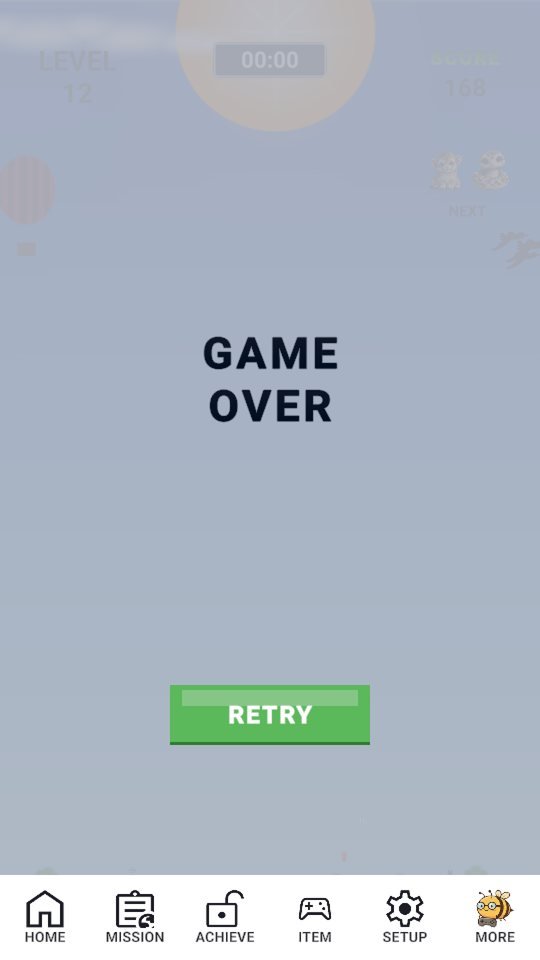
This is the Game Over screen you get when the 2.8-second grace period runs out. After a plank pinned at 25°, the 0.25x slow-motion runs for 0.5 seconds just before it.
- When Game Over appears, the background sinks to a blue-grey, the phone vibrates and the screen shakes for 0.15 seconds.
- One thing to remember: the fact that you hit 22.5° has to remain within the 1.2 seconds before you lose for the slow-motion to trigger. A round where you survived the danger once and recovered just ends normally.
Pro move: a response table for each event
| Event | When | Signal | Move the triangle | Time to spare (measured) |
|---|---|---|---|---|
| Animal jump | Lv.5+, at the moment of combo 2 | Plank suddenly tilts | Toward the end of the remaining animal, then straight back on landing | 0.3-0.4 s for sums of 4.5 or more |
| Double jump | 25% of jump rounds | The plank unexpectedly goes calm | Move to one end (around 0.9) during the jump and stay there to the end of the round | 0.3 s after landing (large sum) to several seconds |
| Surprise drop | Lv.10+, half of the target time, 35% | An animal falls for 0.55 s | Toward the newly heavier side, the instant it lands | Light pair + elephant-class: 22.5° at 0.9 s after landing |
| NICE SAVE! | After reaching 22.5° | Green text for 0.9 s | All the way past the balance point | Impossible at a sum of 1.8 or less |
| Failure slow-motion | 22.5° within 1.2 s before losing | 0.25x, blue-grey | — (already too late) | — |
- Once combo 2 has passed, keep your hand on the triangle. The jump fires at that moment, and with a pair that has a large sum, a reaction just 0.3 s late goes past −12°.
- If the plank suddenly goes calm, two animals have jumped together. Move the triangle to one end (around 0.9) before they land. One side’s mass stays at 0.01 until the end of the round.
- Beware of a drop when the timer hits half. The new balance point is “the side that got heavier.” The instant it lands, go straight there.
- An angle, once tilted, does not come back by itself. To undo it, go past the balance point.
- Pairs with a small sum (2 or less): do not let it pass 20°. Once you touch 22.5°, neither NICE SAVE! nor a comeback during the grace period is easy.
The point of this post is simple: the “surprises” in this game come with no warning, and they flip the round not by angle but by the speed of the moment. The larger the mass sum, the faster the same event plays out, so as levels rise and the animals get heavier, the habit of keeping your hand on the triangle is what scores points.
There is no warning. There is 0.55 seconds.
Keep your hand on the triangle.

Play BalanceMaster now
Playing it is much faster than reading about it.
Find the other Master Series games all in one place at hanilab.app.

More from this game
 “Caster, the triangle is on the move!” Reading one BalanceMaster round as a broadcast script
 BalanceMaster Game Over: 7 Ways You Lose When the Animals Never Fall
 BalanceMaster Level 1 vs Level 500: Is It the Same Game? Timer 15 s to 8.5 s, Plank 90% to 52%
 BalanceMaster Weather and Special Modes — Rain, Snow, Lightning and 20 Modes, Measured
🌌 Universe stories
 Roddy Universe, Part 2 — Fallen Down, Only One Step Back at the Roadside
 Roddy Universe, Part 1 — One Beat Before Crossing, the Empty Road Between the Cars
 Bombi Universe, Part 2 — Behind You: The Reaper That Walks Through Walls
Try other games
 FlipMaster
 WordMaster
 TapMaster