
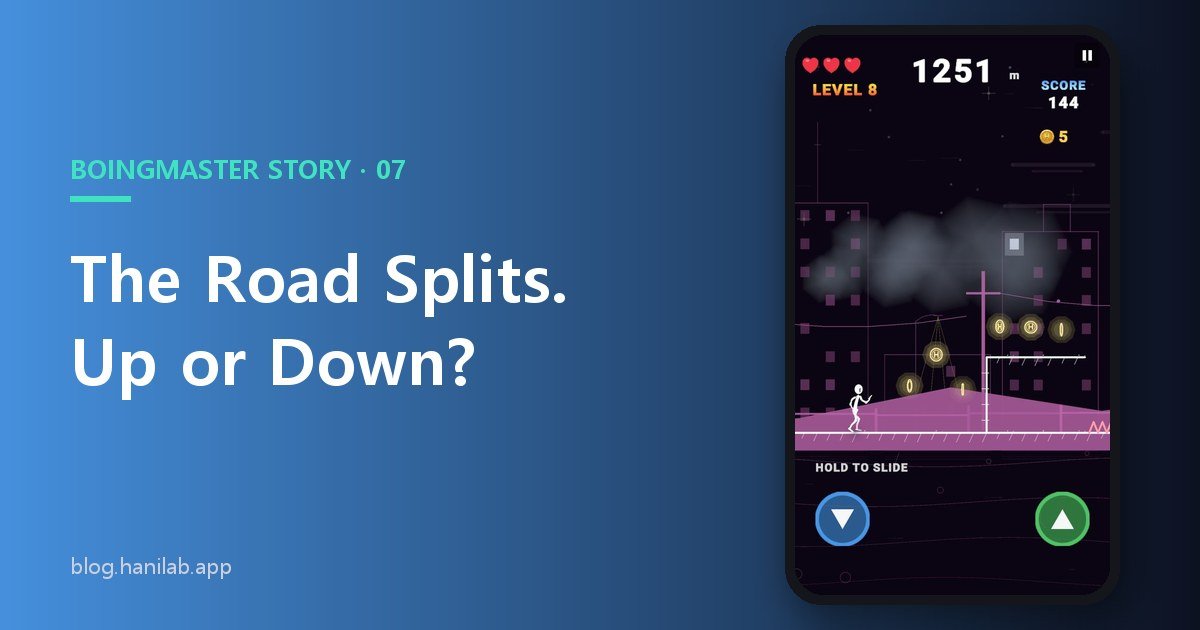

The road splits.
Go high, or go low?
You are running, a wall rises ahead, and a line of coins floats above it. The flat ground below is safe, but it holds only two coins. The BoingMaster terrain is not just traps and beasts — the road itself fights back: it splits, crumbles, slides, and demands a rhythm.

This is a story about the BoingMaster terrain. It sorts the thirty-four kinds of ground that build the road into forks and floors, corridors that demand a rhythm, and paths that crumble or slide underfoot, then lays out which terrain opens at which level and which stretches catch you out — with real gameplay screenshots and the game’s code.
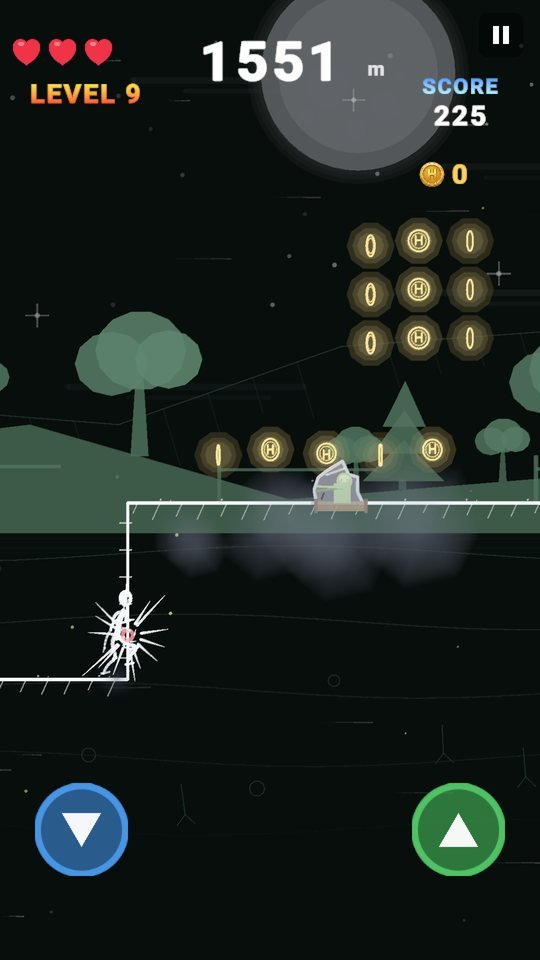
 A fork at level 8 — a wall and a raised platform ahead, coins above
The road is built one chunk at a time
The road is made endlessly by attaching one chunk of terrain after another ahead of you. There are four rules.
- Favorites, 65% — each level has a stretch character (Chapter 5), and a terrain from that character’s favorites is picked with 65% probability. The rest comes from everything that is open.
- The last three are avoided — terrain that matches one of the last three used is avoided where possible, so the same shape does not come up again and again.
- Flat ground after danger — the resting flat stretch from the previous story.
- Only what the level has opened — each terrain has a fixed level at which it opens.
| Level | Terrain newly opened |
|---|---|
| 1 | Flat · Gap · Step · Spikes |
| 2 | Tunnel · Fire pit · Stairs · Trampoline |
| 3 | Water puddle · Second floor (wall) · Second floor by stairs |
| 4 | Wall climb · Conveyor · Fork · Fire-pillar row · Second floor by ramp |
| 5 | Ice · Underground · Crumbling platforms · Rhythm · Ledge chain |
| 6 | Rope · Pendulum · Underground fork · Saw corridor · Triple deck |
| 7 | Crusher · Spike corridor · Stepping stones · Tower |
| 8 | Pendulum row · Ice gap |
| 9 | Crusher hall · Crumbling bridge |
* The names describe how each terrain looks; the game does not show names on screen. Thirty-four in total. The code has one more, a “precision platform”, but walking mode is switched off so it never appears, and I left it out.
The code comments explain why spikes are there from level 1. If the first run has no trap at all, it does not feel “easy” — it feels like “nothing happens”. The trampoline, on the other hand, is a gift rather than a danger; if it showed up late, after the player had only learned traps, they would learn to avoid it, so it opens early at level 2.
Forks and floors — up is dangerous, and rich in coins
The road has four heights: underground (−3.4), ground (0), second floor (3.6) and third floor (7.2) — in world units, where the hero stands 2.05 tall. A single jump peaks at about 2.6, so the second floor cannot be reached with one jump. You climb a wall, or use a path such as stairs, a ramp, a ledge chain or a rope. Splitting the ways up into several kinds is a design fix for the old problem that “the way up is always one wall”, which made every such terrain feel the same.


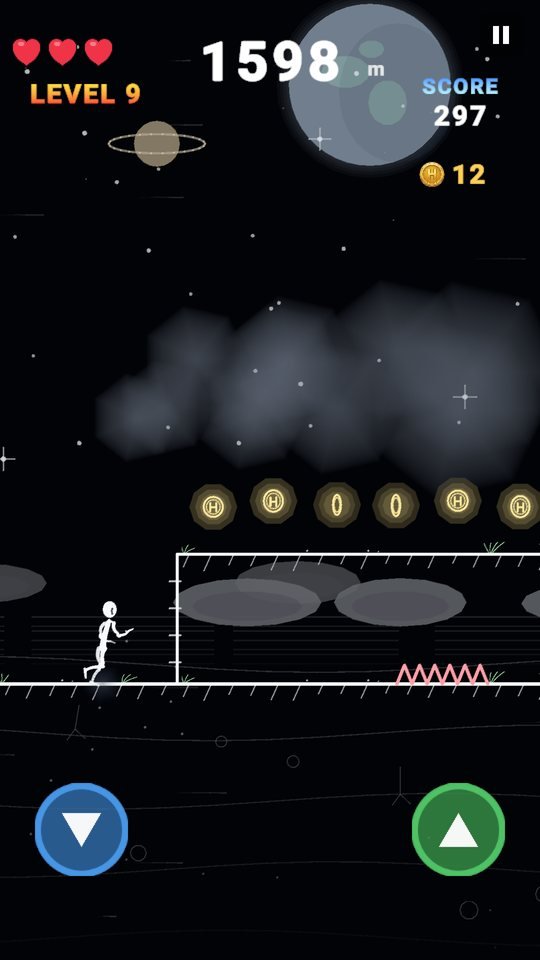
Below is unbroken flat ground with barely two coins. Above, you must climb a wall, then cross three to five broken platforms full of coins. When the difficulty value passes 0.55, spikes are laid under the gaps between platforms. Even so, if you fall from the upper platforms you do not die — you land on the lower road, because a failure should not end the run if you are to try again.
The opposite layout. The upper road is safe, with sparse platforms, and if you fall you drop to the road below. The lower road has dense coins but is laid with spikes and saws, and at the end you climb a wall to return. If “up is dangerous” were always true it would just be memorized, so it is flipped here.
The triple deck (level 6+) shows three roads at once — underground, ground and second floor — and the tower (level 7+) climbs to a third floor above the second. The higher you go, the more coins there are.
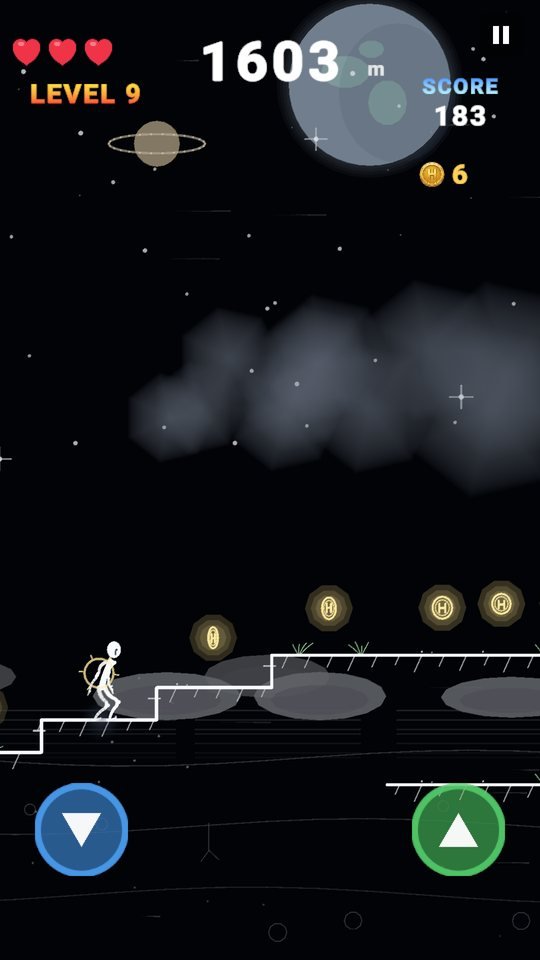


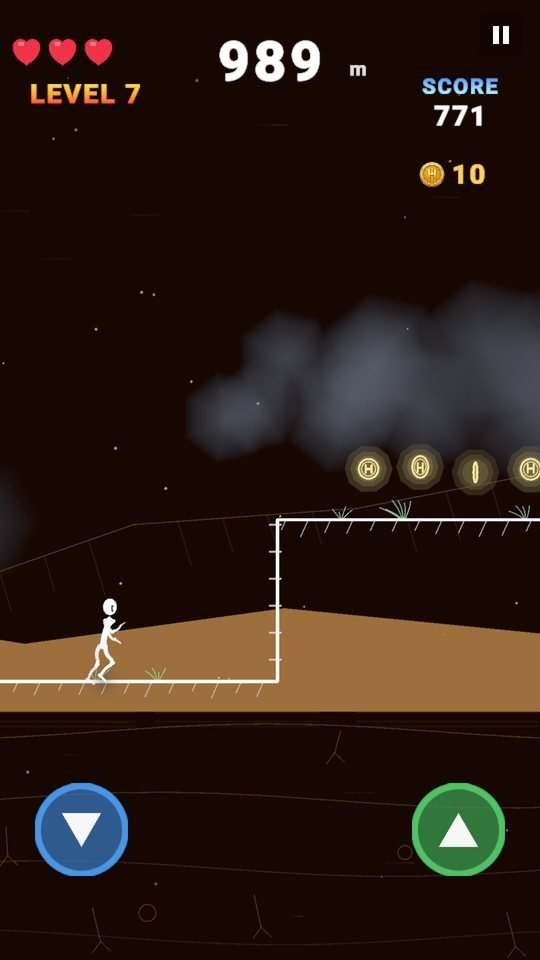
Each step of the stairs has a wall face, so you can also climb them with a wall climb, and a ramp carries the speed you were running at straight up. A ledge chain is three or four short platforms (four above difficulty 0.6) rising in a zigzag, with five coins at the top. Upper roads sometimes have fire placed on them, to make you pay for having climbed.
Corridors that demand a rhythm
The traps themselves were covered in the previous story; here they are terrain that lines them up. Each one is easy alone, but in a row they have an order.
| Terrain | Opens at level | What is lined up |
|---|---|---|
| Rhythm | 5 | Even beats are spikes (jump), odd beats are a low ceiling (slide). 3 to 6 beats; the beat spacing shrinks from 13 to 7.6 units but never goes below 8.6 (the resting flat’s lower limit + 0.8) |
| Saw corridor | 6 | A saw between each narrow platform. Platform length 6.5 down to 4.2 units, 2 to 4 saws |
| Fire-pillar row | 4 | 2 to 5 fires in a line. Each fire gets an evenly staggered period, so they never happen to rise all at once |
| Pendulum row | 8 | A road hung with 2 to 4 weights at staggered phases. Spacing 10 down to 7.5 units |
| Crusher hall | 9 | 2 to 4 crushers, spacing 10 down to 7.8 units |
| Spike corridor | 7 | 2 to 4 floor spikes under a low ceiling. You cannot jump; you pass by rolling or ducking. The spikes are deliberately spaced out — laid without gaps, it would be impossible |


What these have in common is that the road sets a rhythm. Weights, crushers and fires sit at staggered phases, so once you have read the road you simply pass at that tempo. How to read each one is exactly as in the previous story’s “rhythm” table; the only difference here is that the next one arrives the moment you clear the last.
Roads that crumble, slide and carry you
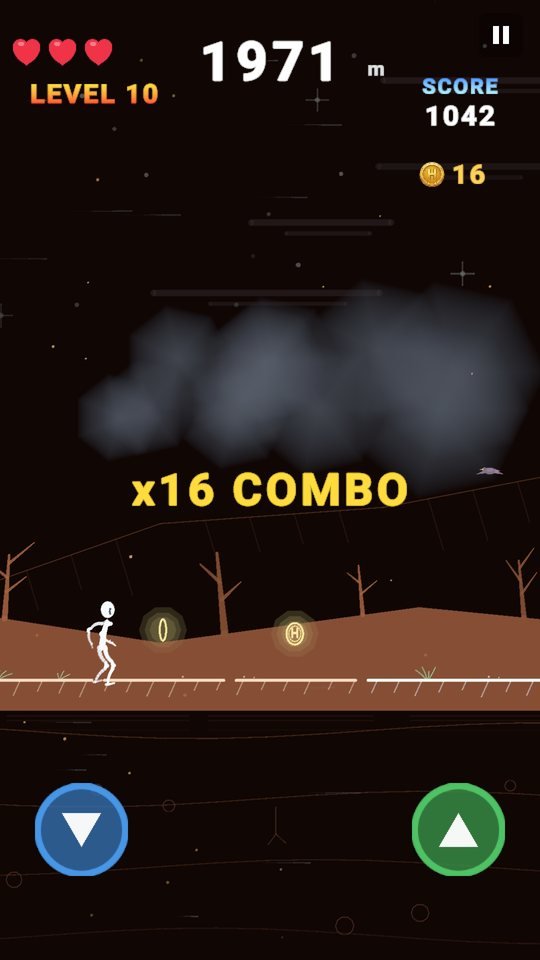
- Crumbling platforms (level 5+) — 3 to 6 platforms. They drop 0.42 seconds after you step on them, so you must not stop. Platform length 3.2, gaps 1.5 to 2.2 units.
- Crumbling bridge (level 9+) — the same principle with 3 to 6 platforms, 4.5 down to 3.2 units long, and gaps of only 0.35 between them. They start to drop the moment you step on them.
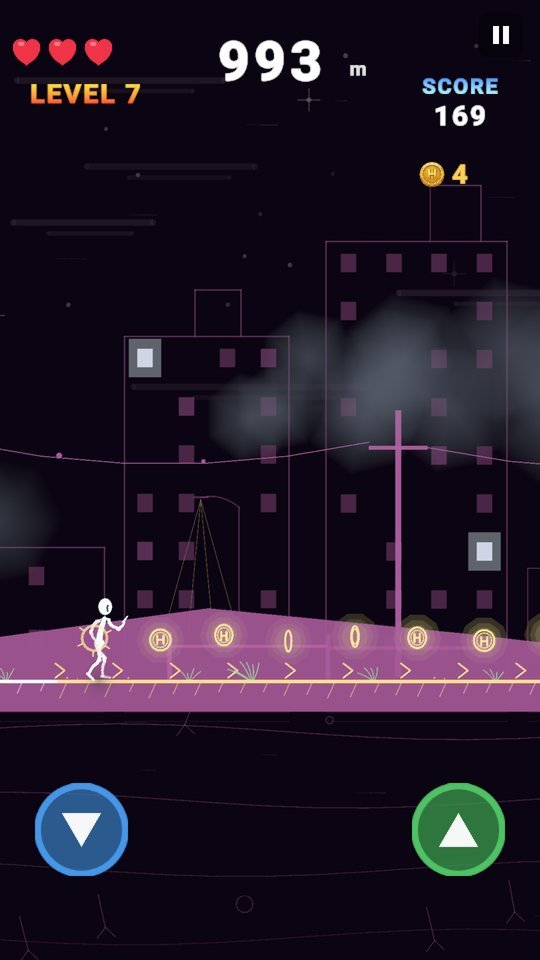
- Conveyor (level 4+) — belt length 12 to 19 units. While you stand on it your speed becomes 1.35 times, and the belt pushes you a further 3.4 units per second forward. So you have to jump earlier than usual.
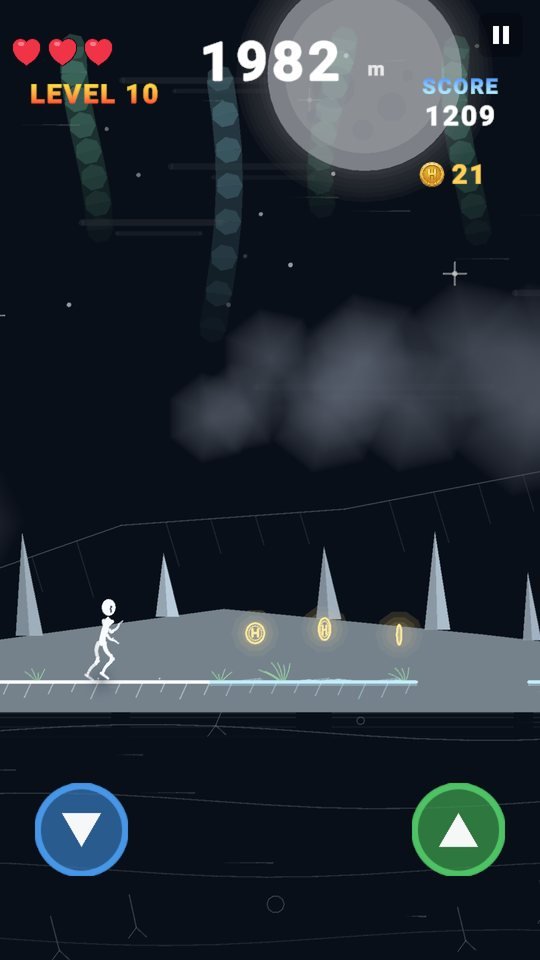
- Ice gap (level 8+) — a 3.0 to 3.1 unit gap between 2 to 4 ice platforms. Ice will not let you stop even when you try, so this is terrain where you work out your speed before landing.
- Stepping stones (level 7+) — 3 to 6 platforms, 3.6 down to 2.4 units long, with the height varied slightly so no two jumps are the same. Below is empty air.
Every stretch has a character
Each time the level changes, the road is given a character: “what kind of stretch is this one”. Two to four favorite terrains for the stretch are picked with 65% probability. There are seventeen stretches, and the previous one is avoided so the same stretch is never drawn twice in a row. The names are internal and never shown on screen, so I call them by how they look.
| Stretch (descriptive name) | Level range | Favorite terrain |
|---|---|---|
| Intro | 1~4 | Flat · Gap · Step |
| Trench | 2~7 | Gap · Spikes · Step |
| Cave | 3~8 | Tunnel · Water puddle · Flat |
| Tower | 4~9 | Second floor · Wall climb · Step |
| Underground cave · Thorn field · Uphill | 5~ | Tunnel · Underground · Spikes / Spikes · Gap · Fire pit / Wall climb · Second floor · Rope |
| Slippery · Machine | 6~ | Ice · Water puddle · Conveyor / Pendulum · Crusher · Conveyor |
| Collapse | 7~ | Crumbling platforms · Gap · Second floor |
| Fork · Rhythm | 8~ | Two forks + second floor / Rhythm · Tunnel · Spikes |
| Trial | 9~ | Pendulum · Crusher · Crumbling platforms · Spikes |
| Furnace · Frost · Dungeon | 12~ | Saw corridor · Fire-pillar row · Crusher hall / Ice gap · Ice · Stepping stones / Spike corridor · Pendulum row · Underground |
| Ruins | 13~ | Stepping stones · Crumbling bridge · Stairs |
That is why around levels 6 to 8 you start to feel “this stretch has a lot of slippery road” or “this is a machine stretch”. The intro stretch ends at level 4, and later on more stretches have spikes, pendulums and crushers as favorites. What changes the face of a level is not the kind of obstacle but which roads come up often.
Six lines for reading the road
- A wall means a fork. Up is coins, down is safe. Falling does not kill you.
- The second floor is out of reach of one jump. Use whichever way you can see — stairs, ramp, ledges, rope or wall.
- Traps in a row go by rhythm. In the rhythm terrain it is jump, then slide; with weights and fire, read the staggered phases.
- Never stop on crumbling road. Reach the next piece within 0.42 seconds.
- Early on conveyors, early on ice too. On platforms that change your speed, the moment to jump changes.
- Remember the stretch’s character. In the first few seconds you can tell which kind of road this level favors.
Terrain, traps, beasts, warnings, and difficulty — that is the whole outline of the hardness BoingMaster throws at you. All that is left is to run it yourself.
The road joins up differently every time.
Whoever reads it runs the longest.

Play BoingMaster now
Playing it is much faster than reading about it.
Find the other Master Series games all in one place at hanilab.app.

More from this game
 BoingMaster Special Disruptions: Meeting Minutes on the Four Promises Behind the WARNING! Banner
 BoingMaster Difficulty — Level 1 and Level 12 Differ Right Down to the Odds of Every Obstacle
 BoingMaster Items: 6 Items and 3 Hearts — How to Run Farther
 BoingMaster WARNING! — 25 Special Disruptions and the Weather
🌌 Universe stories
 Roddy Universe, Part 2 — Fallen Down, Only One Step Back at the Roadside
 Roddy Universe, Part 1 — One Beat Before Crossing, the Empty Road Between the Cars
 Bombi Universe, Part 2 — Behind You: The Reaper That Walks Through Walls
Try other games
 PathMaster
 AstroMaster
 FanMaster


