


Same line, same tilt,
only the guest changes
A baseball is round, yet among the LineMaster objects it is one of the ones that does not roll. Neither does the apple. Only 24 of the 65 objects roll; the other 41 sit on the line and slide. On top of that, a Bowling Ball listed at 4.0 in the collection can be rolled at 1.0 in one round, and a 0.3 Bubble at 1.5. We put different guests on the same line and had a test rig time how fast each one heads for the edge, and how quickly mass tips the line over.

This post is about LineMaster objects, the guests that land on your line. Controls, lines and items are in the complete guide. This post does not repeat the mass averages by difficulty tier. It looks at when each guest arrives, how rolling guests differ from sitting ones and how fast mass tips the line, using newly measured values.
No human hand: a capture rig did the timing. At level 30 (Easy tier) it put one guest at a time on a straight line and fixed the physics values the round normally rolls for itself (gravity 1 · mass 1 · air drag 0.08 · angular drag 0.1 · line friction 0.35 · bounce 0.05). The line was held at a set angle on every physics step (tilted from 0° to 12° or 25° in 0.1–0.2 s), the ball was placed in the middle, and we timed how long it took to move 1.5 units. Each guest was timed once, so do not read much into differences of around 0.1 s. The mass experiment is explained separately.
Guests do not all arrive at once — 10 at level 1, 65 at level 50
A guest is admitted once your highest level reached (BestLevel) is at or above that guest’s unlock level. Reaching counts, not clearing, so even if you fall at that level, new guests mix in from the next round. Unlocked guests are dealt out as a shuffled bag, so none repeats until the whole lap has been dealt, and the NEXT box at the top of the screen previews the next guest.
| Level | Total guests | Rolling | Sitting | New guests at that level |
|---|---|---|---|---|
| 1 | 10 | 3 | 7 | Apple · Avocado · Baby Turtle · Baseball · Donut · Frog · Golf Ball · Onion · Red Bean Bun · Sparrow |
| 11 | 12 | 3 | 9 | Baby Snake · Parrot — the first new guests |
| 20 | 24 | 7 | 17 | Koala |
| 28 | 35 | 10 | 25 | Bowling Ball — collection mass 4.0 |
| 30 | 38 | 11 | 27 | Bear Cub |
| 39 | 50 | 16 | 34 | Watermelon |
| 43 | 56 | 17 | 39 | Baby Elephant · Bitcoin |
| 50 | 65 | 24 | 41 | Bubble — the last guest (collection bounce 0.5) |
* The names above are the English names from the game data. Inside the game the unlock screen shows only the pictures and Lv.N, no names.
- Round guests become more common later on. Of the 11 guests that arrive at levels 43–50, 8 are rolling ones (Bitcoin · Globe · Pizza · Cabbage · Clock · DVD · Stone · Bubble). All 41 sitting guests are in by level 46 (Mug), and the last four levels (47–50) brought only rolling guests.
- Level 50 is the end of the guest list. After that no new guests arrive; what keeps rising with level is the clock, gravity and mass.
Here is the unlock section of the Achievements tab, opened with a best level of 20. Unlocked guests are in color; guests you have not met yet are grey pictures with the needed level written on them, such as Lv.21 and Lv.22.

Lv.21 down
Lv.5024 that roll, 41 that sit and slide
Whether a guest rolls or sits is decided not by its name but by the outline of its picture when the round starts. If the ratio between the outline’s farthest and nearest distances is 1.2 or less, the guest is round. The rig opened all 65 and read the verdict:
Donut · Golf Ball · Red Bean Bun · Tomato · Orange · Peach · Billiard Ball · Pear · Melon · Bowling Ball · Tennis Ball · Table Tennis · Soccer Ball · Basketball · Volleyball · Watermelon · Bitcoin · Globe · Pizza · Cabbage · Clock · DVD · Stone · Bubble
All 32 animals, plus Apple · Avocado · Baseball · Onion · Macaron · Hamburger · Mug · Bear Doll · Penguin. The apple and the baseball look like balls but are on the sitting side.
- Rolling guests have their rotation enforced. Sideways speed divided by the radius becomes the angular speed, so they roll without slipping and start rolling as soon as the line tilts.
- Sitting guests have rotation locked and follow the line’s angle at 720° per second to lie down along it. They slide in exactly the pose of sitting on the line, with a stickiness (tangential damping c) applied to the slide. c is 1.70 on easy levels and falls to 0.80 as they get harder, so they slide more freely. Level 30 is about 1.49 (calculated), and rain or snow lowers it further.
- Sitting guests also get an assist push downhill when tilted (mass × 0.8 × sin angle), and their friction is almost nothing at 0.03. However slow a sitting guest looks, once the line tilts far enough it flows down for sure.
Racing on the same line
The straight level-30 line was held at 12° and 25°, the guest was placed in the middle, and this is how long it took to travel 1.5 units (physics fixed, one measurement per guest). The smaller the number, the faster it heads for the edge.
| Guest | Type | Size (units) | 12° | 25° |
|---|---|---|---|---|
| Bubble | Rolling | 1.45 | 1.96 s | 1.16 s |
| Stone | Rolling | 2.63 | 2.20 s | 1.27 s |
| Bowling Ball | Rolling | 2.57 | 1.61 s | 1.29 s |
| Billiard Ball | Rolling | 1.31 | 1.94 s | 1.36 s |
| Donut | Rolling | 1.73 | 2.24 s | 1.41 s |
| Golf Ball | Rolling | 1.19 | 2.03 s | 1.53 s |
| Watermelon | Rolling | 3.09 | 2.23 s | 1.53 s |
| Mug | Sitting | 1.90 | 1.86 s | 1.05 s |
| Hamburger | Sitting | 2.54 | 1.91 s | 1.22 s |
| Apple | Sitting | 1.45 | 1.87 s | 1.26 s |
| Frog | Sitting | 2.04 × 1.80 | 1.92 s | 1.27 s |
| Baby Elephant | Sitting | 2.04 × 1.86 | 1.92 s | 1.27 s |
| Bear Doll | Sitting | 3.64 × 3.80 | 2.14 s | 1.25 s |
| Baby Giraffe | Sitting | 1.50 × 2.03 | 1.90 s | 1.33 s |
* We timed 10 rolling and 14 sitting guests; the table shows representatives. Size is the collision box in world units (the screen is about 5.6 units wide). Apart from the Mug, the 14 sitting guests all landed between 1.22 and 1.33 s at 25°.
- Sitting guests move at almost the same speed whoever shows up. Apple · Baseball · Avocado · Frog · Baby Turtle · Baby Snake · Kitten · Baby Elephant · Baby Shark · Baby Giraffe · Penguin · Bear Doll · Hamburger, 13 in all, took 1.22–1.33 s at 25° and 1.86–2.14 s at 12°. The apple and the baby elephant differ in size and mass, but they seem to move to the same script (rotation lock + viscosity + assist push). Only the Mug stood out as faster at 1.05 s, and we could not pin down why.
- Rolling guests spread out more. At 25° the gap runs 0.4 s, from Bubble at 1.16 s to Golf Ball and Watermelon at 1.53 s. It looks as if size and material (friction and bounce) differ per guest, but we did not separate how much each contributes.
- On a gentle tilt they are alike; the steeper it gets, the more the sitting side pulls ahead. At 12° the 10 rolling guests (1.61–2.24 s) were mixed in with the sitting ones (about 1.9 s), but at 25° only one of the 10, Bubble (1.16 s), came close to the sitting guests (1.22–1.33 s). This seems to be because sitting guests get a separate assist push proportional to the tilt.
Below, guests are placed on the same line (25°) and caught 0.6 s later. The combo text on screen (COMBO x1.6, AIRBORNE, BOUNCED) was put up by the game itself while the rig waited with the guest in the middle.


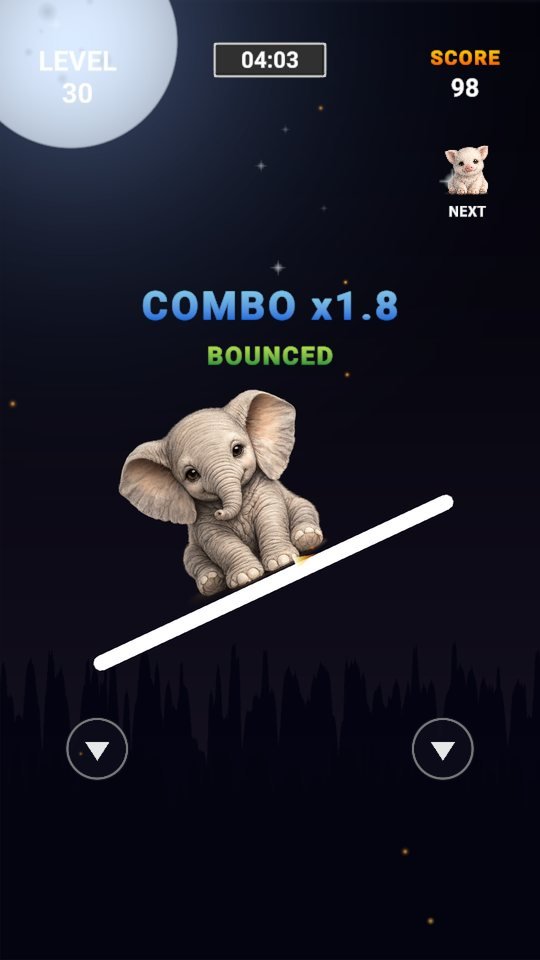

Here is one clip each of the rolling and the sitting movement on the same 25° line.


- Looking like a ball does not mean it rolls. Apple · Baseball · Avocado · Onion are on the sitting side. Tilt the line and they do not roll and speed up; they flow down with the same viscosity.
- 1.5 units to the edge takes just over a second. At 25° any guest arrives within 1.0–1.5 s, which is why you tap in short presses instead of tilting the line far in one go.
- Rather than memorizing per-guest formulas, keep the feeling that once the ball starts moving you are already late. Rolling guests shuffle their order around 12°, so size or name alone could not tell fast from slow.
The mischief of mass — the same guest arrives at a different weight every round
The collection lists a mass for each guest (Bowling Ball 4.0, Baby Elephant 4.0, Bubble 0.3 …). But when a round starts, that value is overwritten with a value rolled by that round’s difficulty tier. We opened the same level-30 (Easy) round 24 times and read each guest’s real mass.
| Guest | Collection mass | Mass this round (measured) |
|---|---|---|
| Bowling Ball | 4.0 | 1.02 |
| Baby Elephant | 4.0 | 1.01 |
| Stone | 4.0 | 1.59 |
| Baby Shark | 2.7 | 0.85 |
| Golf Ball | 0.3 | 1.17 |
| Bubble | 0.3 | 1.51 |
* Across the 24 rounds (10 rolling, 14 sitting guests) the measured range was 0.85–1.66. These are values from one round; another round gives different ones.
So put away the expectation that a Bowling Ball is heavy. Whether a round is heavy is decided by the round, not the guest. What matters is that this mass is multiplied into the line torque. A released line tilts with a force equal to the sum of (position × mass) of the objects on it, times 280°/s². The bigger the mass, and the closer the ball is to the edge, the faster the line goes down.
How long the line takes to tip, by mass
We pinned the ball at 80% of the line’s length (blocking only sideways movement), set the mass, and timed how long a released line took to reach each angle. The maximum angle of a straight line is 39°.
| Mass | 5° | 10° | 20° | 30° | 39° (end) |
|---|---|---|---|---|---|
| 0.3 | 0.44 s | 0.66 s | 1.02 s | 1.26 s | 1.48 s |
| 0.5 | 0.32 s | 0.49 s | 0.76 s | 0.98 s | 1.18 s |
| 1 | 0.24 s | 0.34 s | 0.52 s | 0.68 s | 0.80 s |
| 2 | 0.18 s | 0.28 s | 0.40 s | 0.48 s | 0.56 s |
| 3 | 0.17 s | 0.27 s | 0.41 s | 0.51 s | 0.59 s |
| 4 | 0.14 s | 0.26 s | 0.43 s | 0.59 s | 0.72 s |
- Light mass buys you time. At the same 80% spot, mass 4 took 0.14 s to reach 5° and mass 0.5 took 0.32 s. The time to react in the first 5° after release differs by more than double.
- Weight does not keep making it faster. Going from mass 2 to 4, the time to reach the end (39°) got slower, from 0.56 s to 0.72 s. With a heavy ball the line drops first and there are moments when the ball is off the line, and during those moments the torque is cut. The rig counted the physics steps spent off the line as 5 of 29 at mass 2 and 27 of 36 at mass 4.
- The simple calculation was optimistic. The 280 × mass × position formula alone gives about 0.30 s to 39° at mass 4 and 80%, but the measured time was 0.71–0.72 s. It looks like the combined effect of the line’s angular-speed damping (2.5 per second) and the “off the line” moments described above.
- Position and mass are tangled together. For mass 1 the time to 39° was 0.94 s with the ball at 50% and 0.80 s at 80%, so closer to the edge was faster, but mass 4 was the reverse: 0.51 s at 50% and 0.71 s at 80%. A heavy ball probably leaves the line more easily at the edge, but we will not claim that firmly.
- Press before the ball reaches the edge. In a round with mass above 1.0, a released line takes about 0.3 s to tip to 10°. If you wait to see it with your eyes, you are late.
- Do not trust a guest’s collection mass. The NEXT box shows who is coming, but not that round’s mass. Because the mass range grows with level, it is safest to assume any guest can come in heavy.
- A light arrival is your chance. In a round where the line tips slowly, you have longer to bring the ball back to the center.
Two times in one line
Boiled down to one sentence, the numbers measured here are: on the same line (25°) a guest drifts toward the edge in 1.0–1.5 s, and a released line tips over in 0.3–1.2 s depending on mass. The speed at which the line tips is governed by the mass the round set, and the speed at which a guest drifts on a tilted line is governed by whether it rolls or sits. Both are time that the game demands from the player pressing.
Limits of the measurements
- Everything was measured on a straight line at level 30 (Easy) with gravity fixed at 1. Curved, wavy or bumpy lines and weather would give different results. The rig (AI) is weak on curves and on sitting animals that slide, so we did not measure how long a human can hold on.
- The held-angle experiment is “speed to the edge”, not the difficulty of a real round, where you press to bring the line back.
- With one measurement per guest, small differences may be chance, and for some guests (the Mug’s speed, the Baby Elephant’s bounce) we could not work out the reason.
In the next story we follow the line itself, the thing these guests stand on, and the tilt limit that differs with each shape.
The apple does not roll, and the Bowling Ball is not 4.0.
Whoever stands in front of you, only two things matter: how fast the line tips, and how fast the guest flows.

Play LineMaster now
Playing it is much faster than reading about it.
Find the other Master Series games all in one place at hanilab.app.

More from this game
 This Is Live from the Line: LineMaster’s 6-Second Round as a Radio Broadcast Script
 LineMaster Mistakes: Five Ways to Lose, Counted Backwards from the Source
 LineMaster Score Formula: Survival Time x (10 + Center Bonus), and Where the Ball Ends Decides It
 LineMaster Lines: 42 Lines That Don’t Match Their Names, Opened and Measured One by One
🌌 Universe stories
 Roddy Universe, Part 2 — Fallen Down, Only One Step Back at the Roadside
 Roddy Universe, Part 1 — One Beat Before Crossing, the Empty Road Between the Cars
 Bombi Universe, Part 2 — Behind You: The Reaper That Walks Through Walls
Try other games
 FlipMaster
 WordMaster
 TapMaster