

LineMaster levels: how a 6-second round stretches to level 1000, measured in clock, gravity and mass

From a 6-second round
to level 1000
On level 1 the clock reads 06:00. A silver ball lands on the line and all you have to do is hold it there for six seconds. From level 201 on, though, that clock swings between 12 and 15 seconds every round, the ball falls more than twice as fast, and rain, snow and wind all pour down at once. To see exactly what changes as LineMaster levels climb, I opened real rounds at levels 1, 10, 50, 100, 200, 500 and 1000 and measured them.

This story follows the curve of the LineMaster levels. Controls, lines, objects and items are covered in the complete guide, and I will not repeat its difficulty table here. Instead we look at what that table turns into in a real round: the target time on the clock, how long the ball takes to reach the line, the range of gravity and mass each round rolls, and how quickly the calm rounds disappear.
Each level was opened under the same conditions (a straight line) and played by a capture rig, not a human hand. The ranges for target time, gravity, mass, weather and special modes come from running the game’s own functions 400 times per level (level 1000 has a few extra samples read directly). Fall times are the survival time at the moment the ball first touches the line, so expect roughly ±0.1 s of wobble. The rig is weak against curves, sliding animals and heavy weather, so I did not use it to measure difficulty itself.
The clock: 6 seconds becomes 8 at level 50
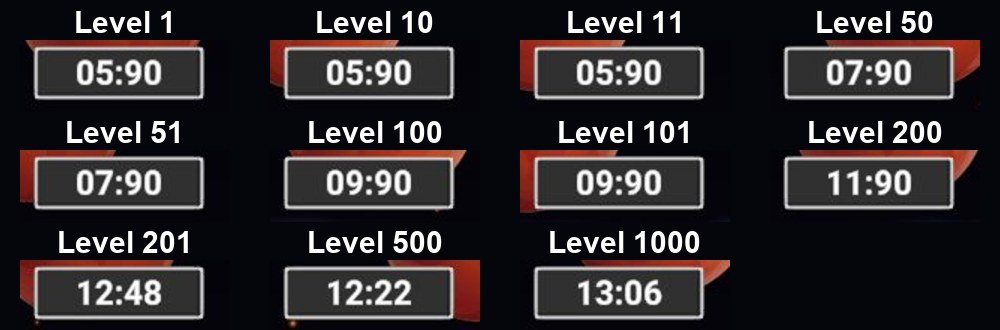
When a round starts, the clock box at the top center begins counting down from the target time. The picture below gathers the clock at the same moment (0.3 seconds after the round opens) for each level. Levels 1-11 read 05:90, levels 50 and 51 read 07:90, level 100 and 101 read 09:90, and level 200 reads 11:90: the target minus the 0.1 seconds that have already run.
| Level | Target time | What decides it |
|---|---|---|
| 1-10 | 6 s fixed | The learning stretch: identical for all ten rounds |
| 11 → 50 | 6 → 8 s | Grows in a straight line over 39 steps (level 30 is 7.0 s) |
| 51 → 100 | 8 → 10 s | Level 75 is 9.0 s |
| 101 → 200 | 10 → 12 s | Level 150 is 11.0 s |
| 201+ | 12-15 s | Random every time you open a round, and it never grows past that |
- From 201 on, the clock wobbles. Opening levels 201, 500 and 1000 gave targets of 14.04, 12.20 and 12.48 seconds, and several rounds of level 1000 gave 13.88, 13.95, 14.61 and 14.2. Running the game’s function 400 times gives 12.01-15.00 s, averaging 13.5 s. Even replaying the same level (a failure restarts the same level from the beginning) rolls a fresh clock.
- The clock of level 1000 is almost the clock of level 200. Level 200’s 12 seconds is only 1.5 seconds shorter than level 1000’s 13.5 second average. What gets harder after 201 is not the time but what happens during it.
- Reaching zero while off the line does not end the round. A clear is decided by whether the ball is touching the line at the moment the time runs out. That is why the rig’s clear at level 300 reported 14.0/13.8 and level 500 reported 13.6/13.5.
- The target time includes the 1-second fall. The time you actually spend balancing is that much shorter (more in the next chapter).
Gravity: a slow climb all the way to level 1000
Gravity does not come from the level itself but from a value called D (0 to 1). A round’s base gravity is 0.85 + 1.40 × D, and a random ±0.15 is added to give that round’s gravity multiplier. Levels 1-10 hold D fixed at 0.10, so the average is 0.99x for all ten rounds. From 11 it climbs slowly along a logarithmic curve until D reaches 1.0 at level 1000, an average of 2.25x.
| Level | D | Average gravity (sample range) | Time to reach the line (measured) | Slide damping c |
|---|---|---|---|---|
| 1 | 0.100 | 0.99 (0.84-1.14) | 1.0 / 1.1 / 1.1 s | 1.70 |
| 10 | 0.100 | 0.99 (0.84-1.14) | 1.1 s | 1.70 |
| 50 | 0.326 | 1.30 (1.16-1.45) | 0.9 s | 1.36 |
| 100 | 0.454 | 1.48 (1.34-1.64) | 0.9 s | 1.17 |
| 200 | 0.600 | 1.69 (1.54-1.84) | 0.8 s | 0.95 |
| 300 | 0.692 | 1.82 (calculated) | 0.8 s | 0.81 |
| 500 | 0.817 | 2.00 (1.84-2.14) | 0.7 s | 0.80 |
| 1000 | 1.000 | 2.25 (2.10-2.40) | 0.7 / 0.7 / 0.7 s | 0.80 |
Note: D, average gravity and range come from running the game’s function 400 times per level (level 300’s gravity is calculated from the formula). The time to reach the line is the survival time when the ball first touches the line, so it depends on each round’s own gravity. Slide damping c applies to objects that sit and slide, such as animals; the smaller it is, the more they slide.
Using the same line and the same golf ball, I recorded the first 1.7 seconds after the round opens at level 1 and at level 1000. Compare how the ball drops onto the line.


This curve was deliberately slowed down
The comment explaining the curve in the source keeps the development history intact. The game used to apply D as log10(level+1) ÷ log10(1001) directly, and the note says difficulty was crammed into the early levels. D was already 0.35 at level 10 (1.34x base gravity) and hit 0.5 at level 31, leaving the remaining 969 levels to share the upper half. The stretch where you are supposed to feel success while learning the rules became hard the fastest.
So now (1) levels 1-10 are pinned at D 0.10, and (2) from 11 the logarithmic curve is raised to the power 1.8 to flatten it, then joined so it still reaches 1.0 at level 1000. Here is how the base gravity of the same level compares (calculated from the formulas).
| Level | Old curve D | Old base gravity | Current D | Current base gravity |
|---|---|---|---|---|
| 10 | 0.347 | 1.34 | 0.100 | 0.99 |
| 31 | 0.502 | 1.55 | 0.248 | 1.20 |
| 100 | 0.668 | 1.79 | 0.454 | 1.49 |
| 125 | 0.700 | 1.83 | 0.499 | 1.55 |
| 1000 | 1.000 | 2.25 | 1.000 | 2.25 |
The level that reaches D 0.5 (1.55x base gravity) moved from 31 to 125, while the end point at level 1000 stayed the same. That turns levels 11-100 into a gentle slope.
One new thing at a time
Even with a smooth curve, events on the line pile up like stairs. Here are the boundaries confirmed in the source, in order.
| Level | What gets added |
|---|---|
| 1 | 3 line types (straight, curved, wave), special modes 15%, momentary events 30%; the sky is calm |
| 6 | The control mode PushObject joins with a 30% chance (pressing pushes the ball directly) |
| 11 | Weather begins (15%, strength 1-2), 22 line types, special modes 35%, difficulty grade Easy |
| 51 | Disturbance ball (15%), asymmetric lines bring it to 42 types, special modes 45%, grade Normal |
| 101 | Grade Hard: the mass range suddenly jumps, special modes 55% |
| 201 | Grade Extreme: weather 100% plus combinations, special modes 85%, disturbance ball 80%, clock 12-15 s at random |
Level 11: the first snow
The first weather on level 11 is weak rain, snow or wind at strength 1-2. With a 15% chance that is once or twice in ten rounds, and there is no announcement, so the only clue is a few flakes drifting past (below, the rig called up a strength 2 snow).
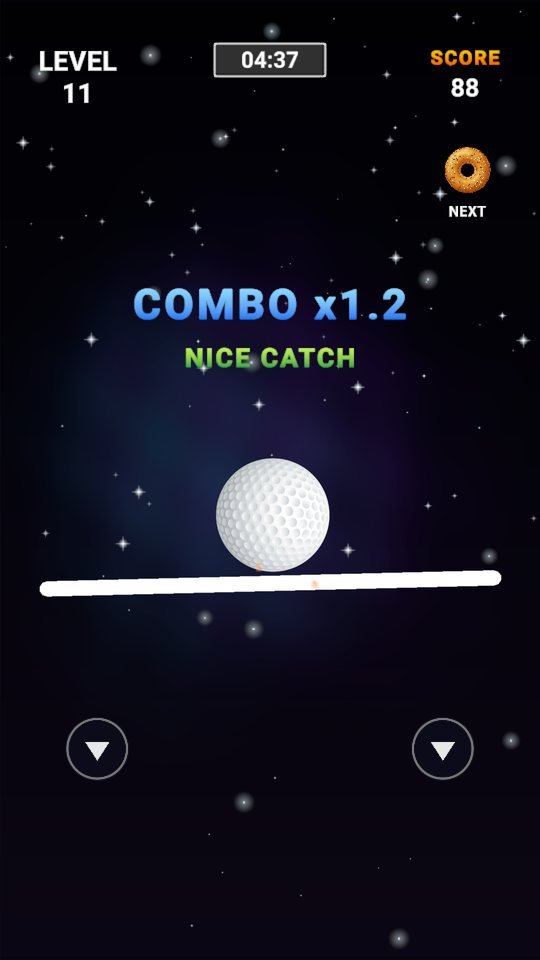 Level 11, strength 2 snow: a few faint flakes drift among the stars (the popup in the middle is the combo text from the first landing)
Level 51: one more ball
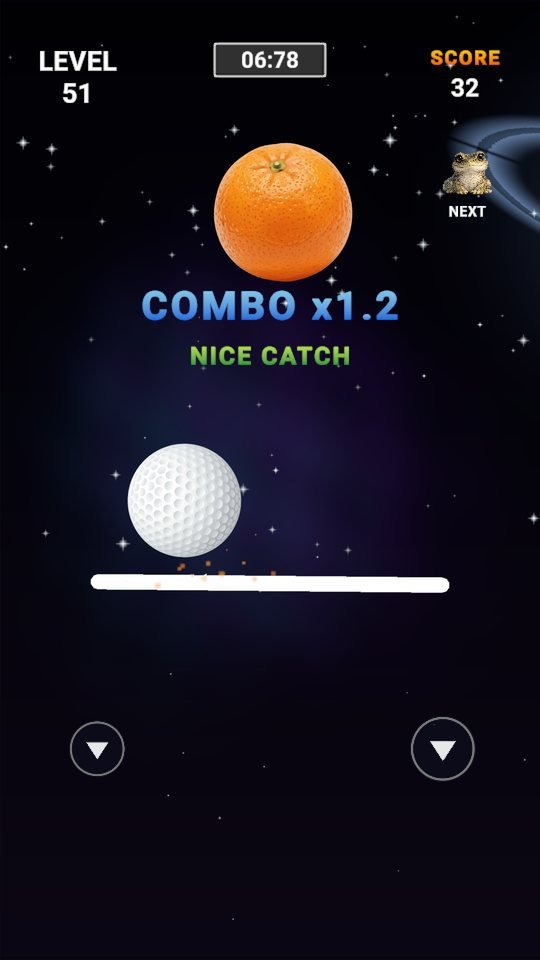
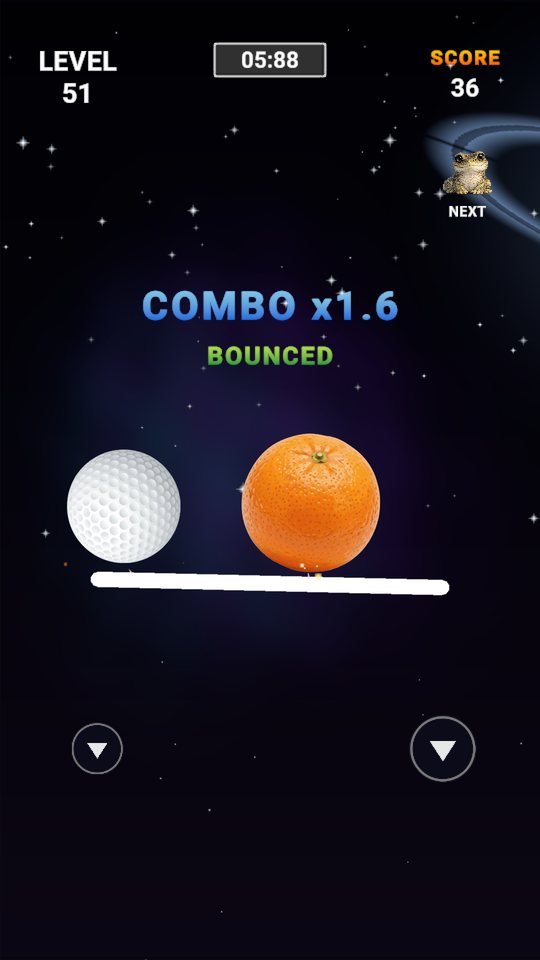
From level 51, a second ball can drop from above 3-7 seconds after the round opens. The chance is 15% at level 51, 45% at 100, 70% at 200 and 80% from 201. On an 8-second round even a drop at 7 seconds lands inside the round, so a round that rolls this ball is almost certain to meet it before it ends. The weights on the line add together and tilt it much more. Here are two moments from the rig calling up an orange at level 51.
Level 101: the same ball gets twice as heavy
Once the grade becomes Hard, the mass range changes dramatically. I measured the mass each round rolls 400 times per level (these are values the round freshly rolled, not the object data values).
| Level | Grade | Average mass | Mass range |
|---|---|---|---|
| 1-10 | VeryEasy | 0.47 | 0.30-0.72 |
| 50 | Easy | 1.17 | 0.72-1.68 |
| 51 | Normal | 1.71 | 0.91-2.80 |
| 100 | Normal | 1.67 | 0.93-2.76 |
| 101 | Hard | 2.77 | 1.38-4.50 |
| 200 | Hard | 2.69 | 1.37-4.44 |
| 201 | Extreme | 4.19 | 2.24-5.93 |
| 1000 | Extreme | 4.10 | 2.20-5.99 |
Mass is multiplied into the line’s torque (when you let go, weight tips the line). Levels 100 and 101 have nearly the same gravity, yet the average mass goes from 1.67 to 2.77, a factor of 1.7. Against the 0.47 of levels 1-10, Extreme is about 9 times heavier: the same golf ball shakes the line that much harder the moment you let go. The grade changes at 100 → 101 and 200 → 201 are where the numbers jump the most.
Level 201: the sky never rests
On Extreme, weather always arrives, and wind 75%, rain 65% and snow 50% are rolled separately and combined (at least one is guaranteed). Over 400 rolls, 281 rounds (70%) had two or more weathers overlapping, with strengths from 5 to 10 and an average of 8.3. On top of that come special modes at 85% and a disturbance ball at 80%.

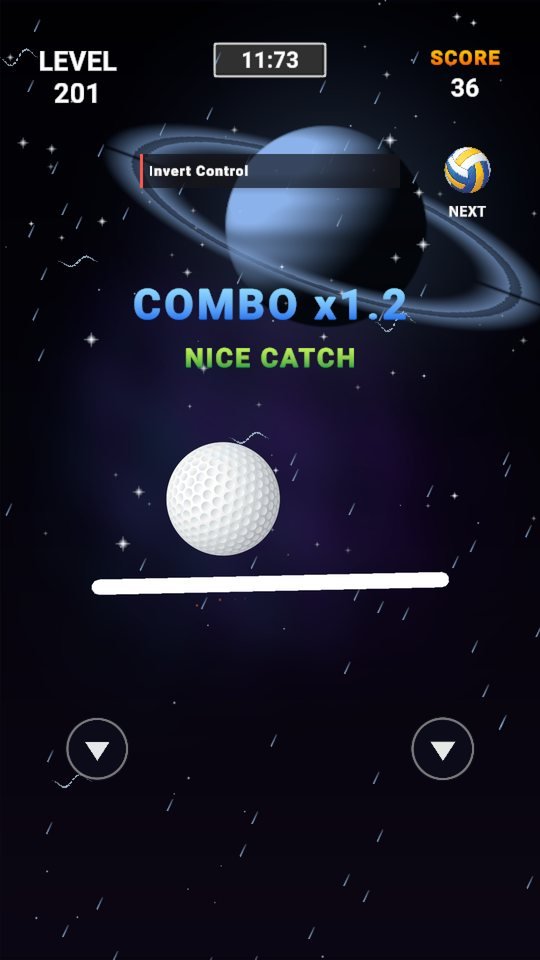
How many calm rounds are left?
Weather, special modes, the disturbance ball and momentary events (a 30% chance per round of either a gust or a UI shake between 2 and 4.5 seconds) are rolled separately. Multiplying the probabilities for each level gives the share of rounds in which none of these four happens. It treats the four as independent and multiplies the probabilities from the source.
| Level | Weather | Special mode | Disturbance ball | Momentary event | Nothing at all |
|---|---|---|---|---|---|
| 1-10 | 0% | 15% | 0% | 30% | 59.5% |
| 11 | 15% | 35% | 0% | 30% | 38.7% |
| 30 | 35% | 35% | 0% | 30% | 29.6% |
| 50 | 55% | 35% | 0% | 30% | 20.5% |
| 51 | 55% | 45% | 15% | 30% | 14.7% |
| 75 | 67% | 45% | 30% | 30% | 8.9% |
| 100 | 80% | 45% | 45% | 30% | 4.2% |
| 101 | 80% | 55% | 45% | 30% | 3.5% |
| 200 | 95% | 55% | 70% | 30% | 0.5% |
| 201+ | 100% | 85% | 80% | 30% | 0% |
- Even on levels 1-10, four rounds in ten have something going on. Special modes at 15% and momentary events at 30% are there from the start, so the learning stretch is not perfectly quiet.
- Around level 100 the sky nearly closes. Only about one round in 20 (4.2%) is free of trouble. Across the 50 rounds from 51 to 100, calm rounds shrink from 14.7% to 4.2%.
- From 201 it is 0%. Weather is 100%, so by the numbers there is no resting round left.
How to hang on in each stretch
The ball is light (mass 0.3-0.72) and gravity is around 1x. Don’t hold the line down; tap for 0.2-0.3 seconds at a time and just learn the feel of staying centered.
Weather rises from 15% to 80%. The wind is strongest about 5 seconds after the round starts, so once the clock passes halfway, gather the ball to the center. After 51 a second ball can drop between 3 and 7 seconds.
The same ball rolls two or three times heavier, so the line tips faster. All you can do is press before the ball heads for the edge and hold it at the center. If you are late, it falls while coming back.
- Watch the ball, not the clock. From 201 the target is always different at 12-15 seconds, so it is hard to trust the clock and catch your breath.
- After a failure you restart the same level. Weather, special modes and the disturbance ball are rolled again, so when a very rough combination shows up it pays to try once more.
- Every round of the same level is different. Gravity is ±0.15 and mass is freshly rolled inside the grade’s range each round, so the same ball is light in one round and heavy in another.
A record of the rig climbing
Finally, here is the record of the rig climbing from level 1 to 1000 with the same straight line and golf ball. Because it is the rig and not a person, it is not evidence of difficulty; it only shows how the clock and the clear time line up.
| Level | Clock (target) | Result |
|---|---|---|
| 1 | 6.0 s | Clear 6.0/6.0 |
| 10 | 6.0 s | Clear 6.0/6.0 |
| 50 | 8.0 s | Fell at 4.0 s, again at 6.0 s (the rig both times) |
| 100 | 10.0 s | Clear 10.0/10.0 |
| 200 | 12.0 s | Clear 12.0/12.0 |
| 300 | 13.8 s | Clear 14.0/13.8 |
| 500 | 13.5 s | Clear 13.6/13.5 |
| 1000 | 14.2 s | Clear 14.2/14.2 |
I could not tell whether the rig’s two falls at level 50 came from the round’s difficulty or from the rig’s clumsiness (I did not record that round’s ball and gravity combination). All this table can tell you is that the clock and the clear time line up.
In the next story we follow the guests who step onto this curve: the 65 balls and animals, and why the same object rolls with a different weight every round.
The ball that starts at 6 seconds falls more than twice as fast by level 1000, and rolls in about nine times heavier.
Still, there are only two things to press: left and right.

Play LineMaster now
Playing it is much faster than reading about it.
Find the other Master Series games all in one place at hanilab.app.

More from this game
 This Is Live from the Line: LineMaster’s 6-Second Round as a Radio Broadcast Script
 LineMaster Mistakes: Five Ways to Lose, Counted Backwards from the Source
 LineMaster Score Formula: Survival Time x (10 + Center Bonus), and Where the Ball Ends Decides It
 LineMaster Lines: 42 Lines That Don’t Match Their Names, Opened and Measured One by One
🌌 Universe stories
 Roddy Universe, Part 2 — Fallen Down, Only One Step Back at the Roadside
 Roddy Universe, Part 1 — One Beat Before Crossing, the Empty Road Between the Cars
 Bombi Universe, Part 2 — Behind You: The Reaper That Walks Through Walls
Try other games
 FlipMaster
 WordMaster
 TapMaster