

TakMaster Difficulty — The Fall Speeds Up and the Same Box Gets Twice as Heavy as Time Goes By

There’s no time limit,
but the board tightens as time goes by
The first 26 seconds are leisurely. Pieces drift down at an easy pace, and neither the weather nor the ink does anything. Then the clock passes 26 seconds, the words 2 · FASTER appear over the board — and from that moment the fall speeds up, the same box gets a little heavier, and the weather and ink start to bite. TakMaster has no time limit, but it does have a difficulty clock. This is the story of how TakMaster difficulty changes over time, and what order to respond in.

This post is about TakMaster difficulty. How many seconds mark the four phase boundaries, what curve the falling piece follows, what the weight multiplier is applied to, how the mix of materials, item boxes and box states tilts over time, and what extra pressure each level adds on its own — all laid out with real gameplay screenshots and the numbers from the code. Individual hazards such as ink, weather and fatigue were covered in the earlier weather post; here the focus is on the clock that tightens them all at once.
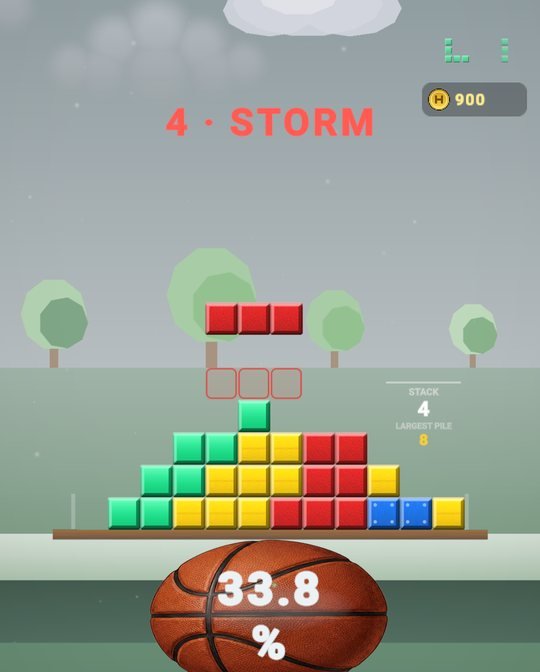
 Phase 4 · STORM — the same board that sat at 53.0% remaining strength is now at 29.6%
One difficulty clock, four phases
The clock restarts from 0 every time a round begins, and the phase changes when it crosses a boundary. The phase name appears in big letters over the board, and the color changes too.
| Phase | Clock (s) | Clock color | In one line |
|---|---|---|---|
| 1 · WARM-UP | 0 ~ 26 | White | Weather has no force, no ink, box weight ×1.0 |
| 2 · FASTER | 26 ~ 78 | Sky blue | The fall visibly speeds up; weather and ink begin |
| 3 · HEAVIER | 78 ~ 150 | Yellow | Weight multiplier goes from ×1.2 to ×1.5, fatigue ×1.6 |
| 4 · STORM | 150 ~ | Red | The fall hits its floor, 20% of the weight stays even after you clear a row, fatigue ×2.6 |


- Values don’t jump at the boundary. Within a phase, the fall, the weight and the probabilities keep changing continuously. If it ever feels like “it suddenly got hard at the one-minute mark,” the code comment’s position is that this is an accident, not difficulty design.
- The boundaries were moved earlier. They used to be 60 · 180 · 300 seconds, but real rounds rarely lasted half that long, so most players only ever saw phase 1. With 26 · 78 · 150 seconds, even a two-minute round passes through three phases.
- While the board is frozen (the shop is open, or the 3 · 2 · 1 countdown is running), the clock stops too.
On levels 1, 2 and 3 the clock runs slowly
On the beginner levels, only the clock that counts phases and fall acceleration runs slowly. The survival time shown on screen is real time; the phases simply arrive later.
| Level | Clock speed | Phase 2 arrives at | Phase 3 | Phase 4 |
|---|---|---|---|---|
| 1 | ×0.55 | 47 s | 142 s | 273 s |
| 2 | ×0.70 | 37 s | 111 s | 214 s |
| 3 | ×0.85 | 31 s | 92 s | 176 s |
| 4 and up | ×1.0 | 26 s | 78 s | 150 s |
If phase 2 arrives before the on-screen clock reaches 26 seconds, you’re not on levels 1–3. Conversely, hitting the target within the time on level 1 is the most relaxed practice there is.
The fall — a curve, not a staircase
The time a piece takes to drop one cell starts at 0.72 seconds and shrinks exponentially. No matter what the clock reads, what comes after is always different from what came before, so the feeling of being chased never lets up. The table below is the base curve before the level and cleared-box adjustments are multiplied in.
| Clock (s) | 0 | 10 | 20 | 40 | 60 | 100 | 149 | 150+ |
|---|---|---|---|---|---|---|---|---|
| Seconds per cell | 0.72 | 0.61 | 0.52 | 0.39 | 0.31 | 0.22 | 0.18 | 0.16 |
| Cells per second | 1.4 | 1.6 | 1.9 | 2.6 | 3.2 | 4.5 | 5.6 | 6.3 |
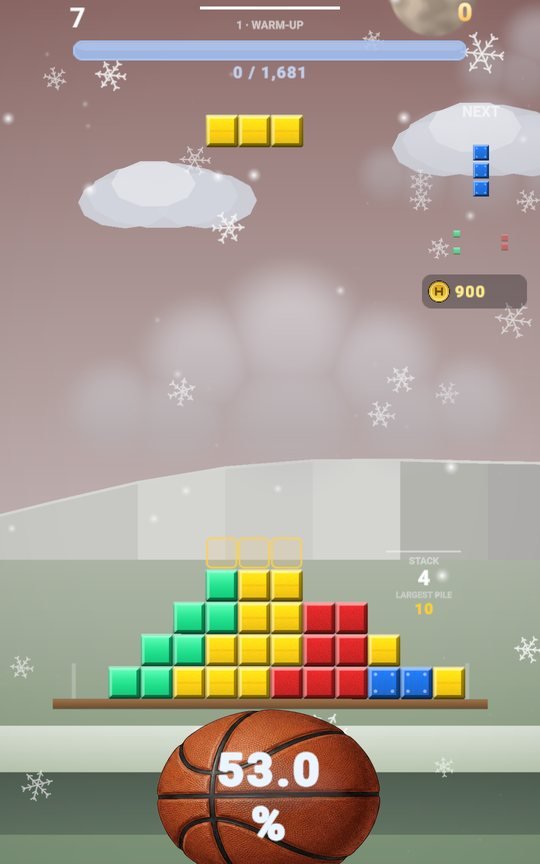
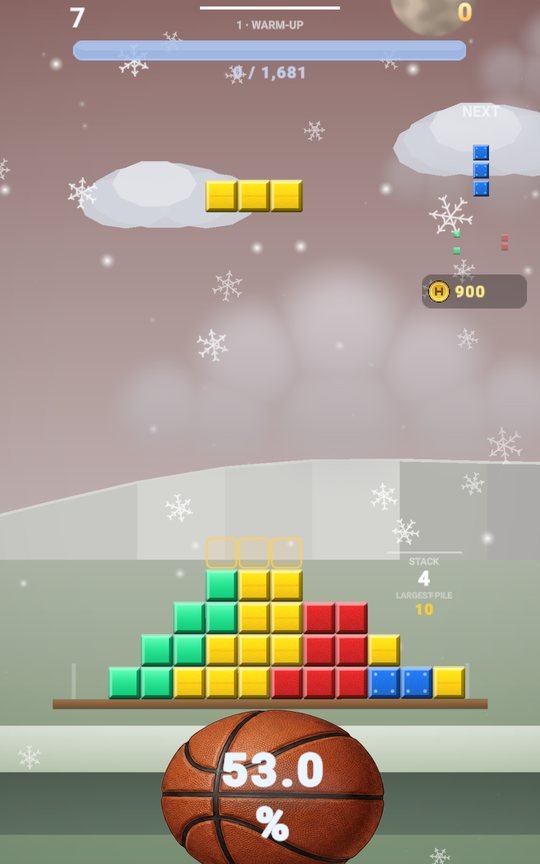
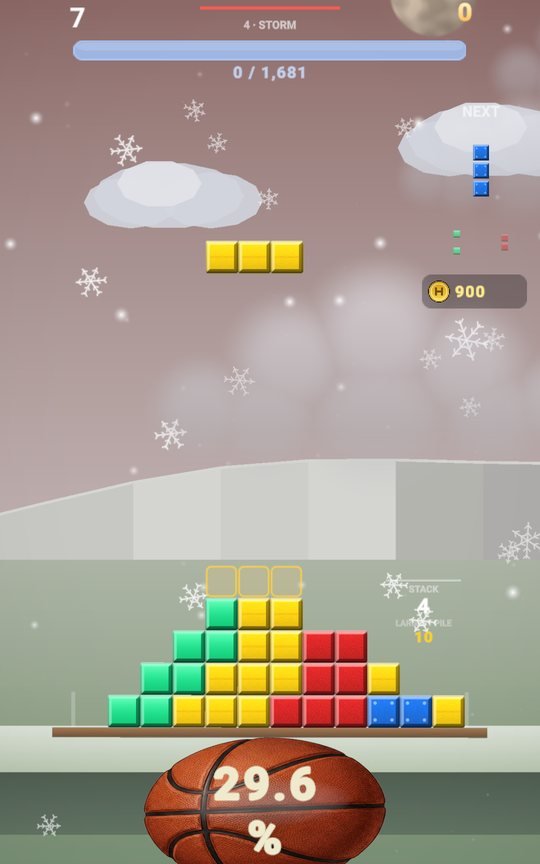
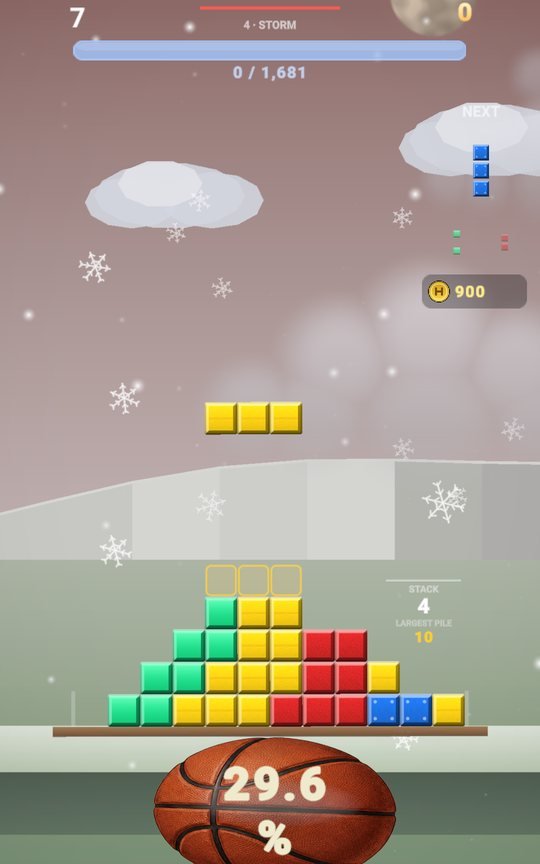
Same board, same piece, same starting point; only the clock was changed, to 4 seconds and 210 seconds (both pairs were shot at the same interval).
Three things multiplied into the curve
| What | How much | Why |
|---|---|---|
| Boxes cleared | Every 120 cleared cells, the interval gets ×(1−4.5%), up to 45% | The better you play, the faster it gets — skill becomes pressure |
| Level | Level 1 ×0.97 · 10 ×0.90 · 30 ×0.85 · 100 ×0.80 | Higher levels start a little faster |
| Phase 4 | ×0.88 (and a floor of 0.16 seconds) | One last squeeze |
- It isn’t only row clears that count. Boxes removed by the bomb, drill and row-clear items go into the same tally (12 cells count as one row). But 39 cells wiped in one go is worth 3 rows, so it only shortens the interval by 1.5%. The rescue bomb from continuing is not counted.
- From 150 seconds on, everyone falls at the same speed. At 150 seconds the calculated value drops below 0.16 and hits the floor, so in phase 4 it’s 0.16 seconds per cell (6.3 cells per second) whether your level is high or you cleared a lot. Higher levels reach the floor sooner (level 100 gets there in about 2 minutes).
- Phase 4 is harder for a reason other than speed. Speed has already gone as far as it can; what tightens after that is weight.
Weight — the multiplier hits the whole board
The weight multiplier rises continuously from ×1.0 in phase 1 → ×1.2 in phase 2 → ×1.5 in phase 3, then stays at ×1.5 in phase 4. What it multiplies is the key point. It isn’t only the box you’re placing — it multiplies every box on the board, the weather load and the leftover weight, all added together. So your remaining strength shrinks even if you sit still. These are the same board (28 boxes in a mix of four materials) shot with only the clock changed.

Remaining strength 53.0%

Remaining strength 48.4%
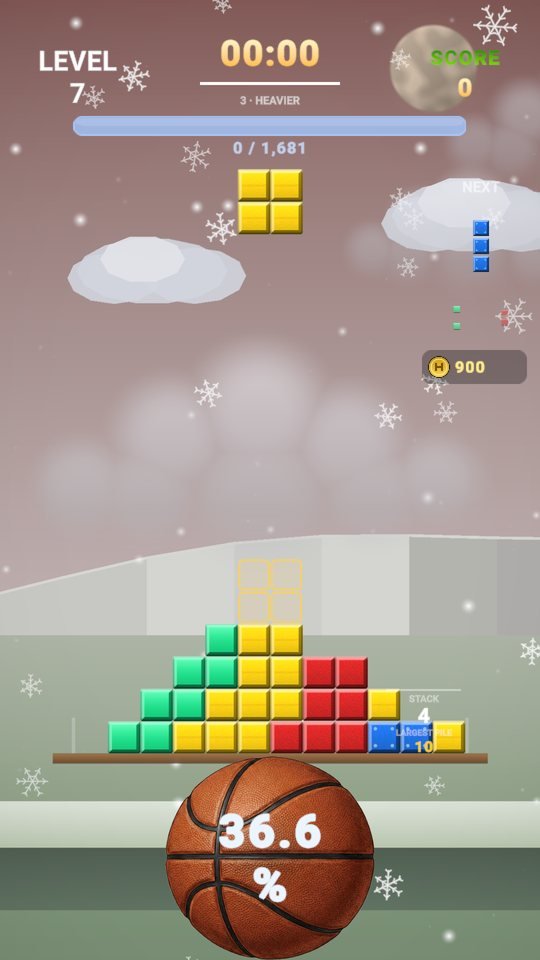
Remaining strength 36.6%
Remaining strength 29.6%
Without adding a single box, remaining strength went from 53.0% to 29.6%. In terms of pressure, that’s 47% rising to 70% (47 × 1.5 ≈ 70). That’s why a pile that felt comfortable at 40% remaining strength in phase 1 slides into the danger zone in phase 4 with the exact same shape.
Phase 4’s leftover weight
In phase 4, clearing a row no longer removes 100% of the weight. The share that comes off (the recovery rate) starts at 100% at 150 seconds and falls to 80% at 210 seconds. The share that doesn’t come off builds up as leftover weight.
- Clearing one row of wood boxes (12 cells × 1.5 = 18) leaves 3.6 as leftover, and each time you clear a row, 30% of the accumulated leftover is shed. If you keep clearing rows of the same weight, the leftover levels off at about 8 (= 18 × 0.47). With the ×1.5 on top, an Orange (max load 84) keeps around 15% of its limit permanently occupied.
- The bomb sheds leftover weight too (size × 25% — 25% for 3×3, 50% for 5×5, 75% for 7×7). That’s why bombs are so valuable late in a round.
- The continue bomb sheds 70% of the leftover weight.
The mix changes — from help to hindrance
As time passes, what comes down tilts too. The probabilities of materials, items and box states keep changing along the clock (box states and items reach their end values 2 minutes after phase 4 begins, at clock 270). The values below are read at four points on the clock.
| Clock | 0~26 s | 78 s | 150 s | 270 s+ |
|---|---|---|---|---|
| Rubber (0.8) | 51% | 45% | 38% | 34% |
| Wood (1.5) | 30% | 28% | 26% | 24% |
| Stone (2.2) | 14% | 18% | 22% | 24% |
| Iron (3.2) | 5% | 9% | 14% | 18% |
| Average weight per cell | 1.33 | 1.46 | 1.63 | 1.74 |
| Bomb | 7.0% | 6.3% | 5.9% | 5.5% |
| Magnet | 3.5% | 3.3% | 3.1% | 3.0% |
| Drill | 2.5% | 2.5% | 2.5% | 2.5% |
| Plus | 2.0% | 3.0% | 3.5% | 4.0% |
| Mystery | 3.0% | 3.8% | 4.1% | 4.5% |
| Box states (among ordinary pieces) | 0% | 8.5% | 12.8% | 17% |
* Materials are rolled for every piece, and items are rolled first for the whole piece (total 18.0% → 19.5%); a state (lead · cracked · locked · fickle) can then be added to an ordinary, non-item piece. The 17% of box states breaks down into lead 6% · cracked 5% · locked 4% · fickle 2%. Cell counts are rounded from the displayed values.
- The same number of cells comes down 1.3 times heavier. The average per cell rises from 1.33 to 1.74, and with the ×1.5 multiplier on top, the same number of boxes presses on the support about twice as hard (1.96×) as at the start. Lead boxes (2.2×) weigh on top of that.
- Bombs fall and plus boxes double. Helpful items thin out gradually, while plus boxes that grow the pile and mystery boxes of unknown identity increase (46% of mystery boxes are bombs, 12% are plus).
- There are no box states in the first few seconds. They grow to 4% at 26 seconds, 8.5% at 78 seconds and 12.8% at 150 seconds — which is why you needn’t worry about them in phase 1.
The pressure that levels add on their own
The clock is the time axis within a single round, and the level is a separate axis. With only the time axis, level 3 and level 30 would start identically, so as the level rises the support gets weaker and a starting pile is laid down.
| Level | Effectively | Support max load | Start pressure cap | Starting pile target |
|---|---|---|---|---|
| 1 ~ 3 | As is | 100% | 10% | 2 ~ 3 rows |
| 4 | As is | 98% | 12% | 3.5 rows |
| 5 | Like level 2 | 100% | 10% | 2.5 rows |
| 9 | As is | 90% | 22% | 6 rows |
| 10 | Like level 4 | 98% | 12% | 3.5 rows |
| 15 | Like level 12 | 87% | 28% | 6 rows |
| 20 | Like level 14 | 84% | 32% | 6 rows |
| 30 | Like level 24 | 77% | 40% | 6 rows |
| 100 | Like level 94 | 70% | 40% | 6 rows |
- Multiples of 5 play like 3 levels lower, multiples of 10 like 6 levels lower — breather rounds. This applies to three things: support max load, start pressure and the starting pile. That’s why level 10, coming right after level 9, is actually easier. The level adjustment to fall speed and the target score stay at the real level.
- Support max load eases down smoothly to 0.70 and stops. Even the highest levels still hold 70% of the support.
- The starting pile is decided in two layers. One is the row cap (2 rows + 0.5 rows per level, at most 6 rows, a third of the board height of 18 — the actual height is random between 55% and 100% of the target), the other is the start pressure cap. After stacking, the pressure is measured, and if it is over the cap, boxes are removed one cell at a time from the top of the tallest column. With a weak support the pressure cap bites first and the pile ends up lower.
- The starting pile always keeps empty columns (2 up to roughly level 6, 1 after that) so that no row is cleared right at the start, and from roughly level 12 on, lead boxes are mixed into the bottom two rows with a 14% chance.
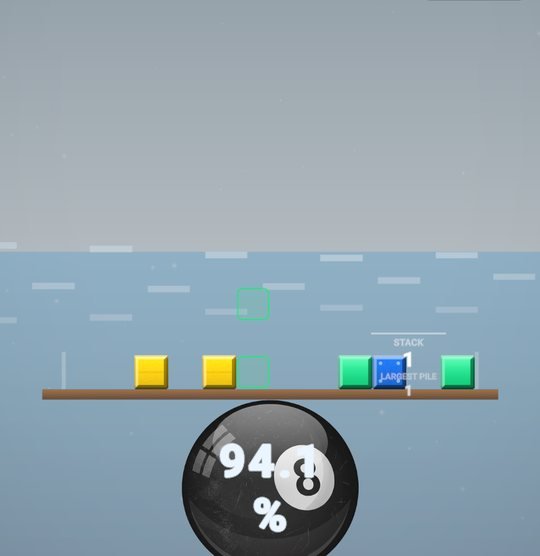
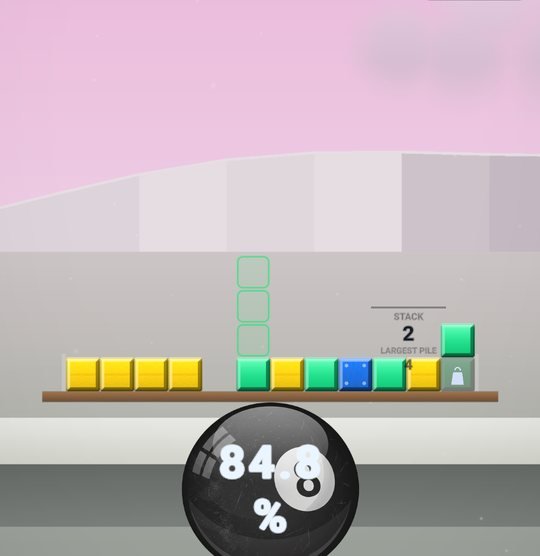
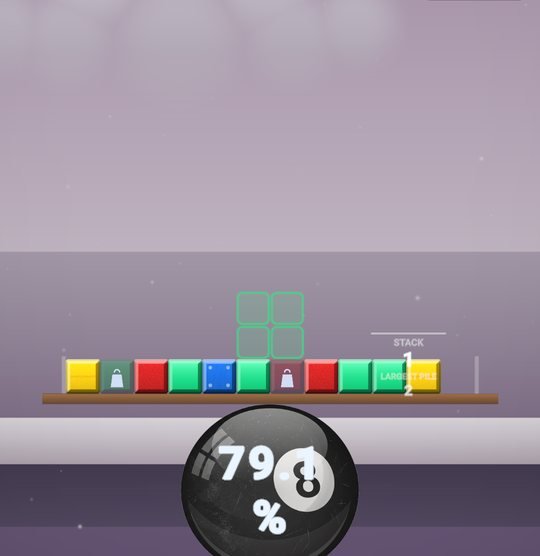
All three are boards right after the start. The higher the level, the more remaining strength is already shaved off at the start, but the pile is only laid within the start pressure cap (10% · 30% · 40%).
The order of response — what to do in each clock range
| Clock | State of the board | What to do now |
|---|---|---|
| 0 ~ 26 s | No weather, ink or box states. The fall is leisurely | Build structure. Prepare same-material clusters and empty columns now |
| 26 ~ 78 s | The fall speeds up from 0.47 to 0.26 s. Weather and ink begin | Slam early. Trust the ghost position and save your hand movements. When ink comes, trust the number you saw just before and save the big pieces |
| 78 ~ 150 s | Weight ×1.2 to ×1.5, more stone and iron. Box states 9~13% | Clear rows often. It’s the surest way to shed weight. Save bombs until a big cluster has formed |
| 150 s ~ | The fall is fixed at its floor, and row clears only shed up to 80%. Fatigue ×2.6 | Shed leftover weight with bombs and items. Rows alone let the floor creep up slowly |
- Finish the level before phase 4. Once your score reaches the target the round ends, and the clock starts from 0 in the next round. It’s the surest difficulty control there is.
- Factor in the weight multiplier and treat 40% remaining strength as the safety line. If you’re at 40% early in phase 3, the same board falls to about 25% in phase 4.
- The more you clear, the faster the fall, but only until phase 4. It’s 4.5% per 120 cells, and from 150 seconds it’s at the floor anyway, so there’s no need to worry about it.
- In phase 4, use bombs to clear leftover weight. The share a bomb sheds (25~75%) is something a row clear doesn’t have.
- Levels that are multiples of 10 are rest rounds. The support and the starting pile are as light as 6 levels lower, so you can go easy on items.
- Watch the phase name and color on screen. White → sky blue → yellow → red. The moment the color changes is the moment the strategy changes.
The next story is about the danger that stacks upward — the ceiling. We’ll look at how full the board can get before it’s over, and which pieces leave gaps.
Watch the clock,
and clear rows first.

Play TakMaster now
Playing it is much faster than reading about it.
Find the other Master Series games all in one place at hanilab.app.

More from this game
 TakMaster Continue Script: From a Red Base to the Clear, One Run Called Live
 TakMaster Ceiling — Where a Piece Sets Decides the End, and One Line Fills a Hole
 TakMaster Items: Line Clear, Material Swap, Quick Bomb and Magnet Pulse, Timing Is Skill
 TakMaster Weather — Rain and Snow Add Weight, Wind Pushes the Piece, Ink Hides the Numbers
🌌 Universe stories
 Roddy Universe, Part 2 — Fallen Down, Only One Step Back at the Roadside
 Roddy Universe, Part 1 — One Beat Before Crossing, the Empty Road Between the Cars
 Bombi Universe, Part 2 — Behind You: The Reaper That Walks Through Walls
Try other games
 FlipMaster
 WordMaster
 TapMaster