
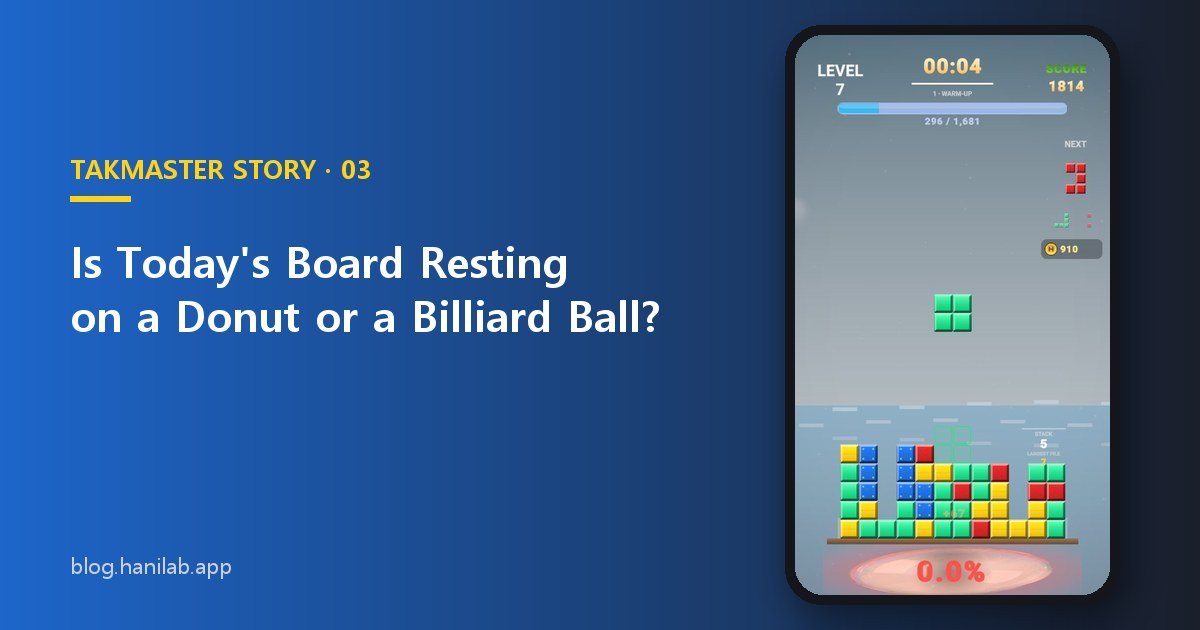
TakMaster Supports — Ten Supports, from Soap Bubble to Hamburger: How They Squash and Warn

Is Today’s Board Resting
on a Donut or a Billiard Ball?
When a new round opens, something is carrying the wooden plank at the very bottom. Yesterday it was a squishy soap bubble, today it’s a hamburger, tomorrow a glossy billiard ball. And they don’t just look different. How they squash, how long they hold on and how they burst are all different. The character of the round is settled before you drop a single box. This is the story of the support object.

This post is about TakMaster supports: how the support is chosen, the real difference between the three ways one can be squashed (elastic, brittle, plastic), the four warning stages that signal danger, the three ways a support bursts, and the rule that makes supports weaker as your level rises.
The Support Is Picked at Random Every Round
- Ten of them — Soap Bubble · Orange · Basketball · Apple · Macaron · Billiard Ball · Peach · Cabbage · Donut · Hamburger.
- A new one is drawn every round. You never get the same one as the round just before. Random tends to hand you the same thing two or three times in a row, and players read that as a bug rather than as randomness.
- Levels 1-3 are the intro, so only supports with a generous grace time come up: Soap Bubble · Orange · Basketball · Donut. It keeps a first-timer from touching the Billiard Ball (0 s grace, over the instant it hits) before they even know the rules.
- None of the ten is locked. You don’t unlock them by levelling up; all of them can show up from the start.
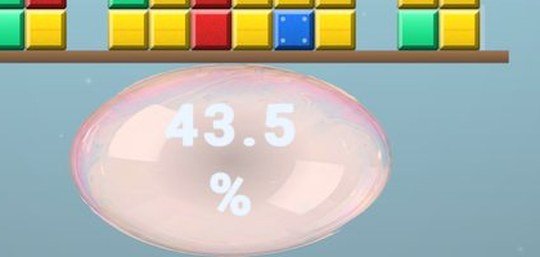


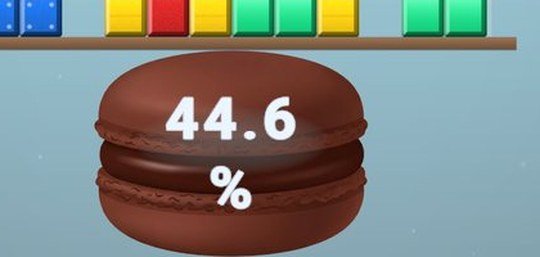
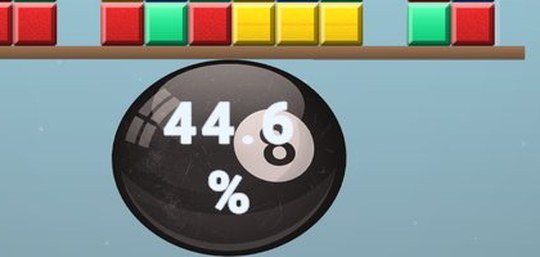

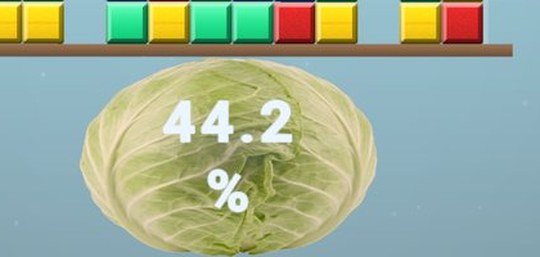


* All ten were shot under the same pressure (about 55%).
Only Two Things Really Differ
Every support has its own look and its own way of squashing, but only two values decide whether you win or lose.
| Support | Reaction | Max load | Grace (s) | Squash depth |
|---|---|---|---|---|
| Soap Bubble | Elastic | 68 | 0.60 | 62% |
| Orange | Elastic | 84 | 0.45 | 46% |
| Basketball | Elastic | 104 | 0.40 | 50% |
| Apple | Brittle | 92 | 0.10 | 42% |
| Macaron | Plastic | 82 | 0.20 | 40% |
| Billiard Ball | Brittle | 132 | 0.00 | 34% |
| Peach | Plastic | 78 | 0.35 | 54% |
| Cabbage | Plastic | 98 | 0.30 | 50% |
| Donut | Plastic | 74 | 0.40 | 58% |
| Hamburger | Plastic | 88 | 0.35 | 56% |
- Max load — if the combined weight of the stacked boxes goes past this value, your remaining strength is 0%. These are the level 1-3 values; in wooden boxes (1.5 each) that is roughly 45 boxes for the Soap Bubble up to about 88 for the Billiard Ball, a twofold gap.
- Grace — the time left before it bursts once you touch 0%. The Billiard Ball’s 0 s means it’s over the moment you touch it, while the Soap Bubble’s 0.6 s is a small window in which you might even place one more.
- Squash depth is “how much shorter it gets when squashed to the max.” It’s very eye-catching, but it isn’t used in the verdict. How flat it looks and how much it can bear are separate things.
Three Ways to Be Squashed
Elastic — squashed, then it comes back (Soap Bubble · Orange · Basketball)

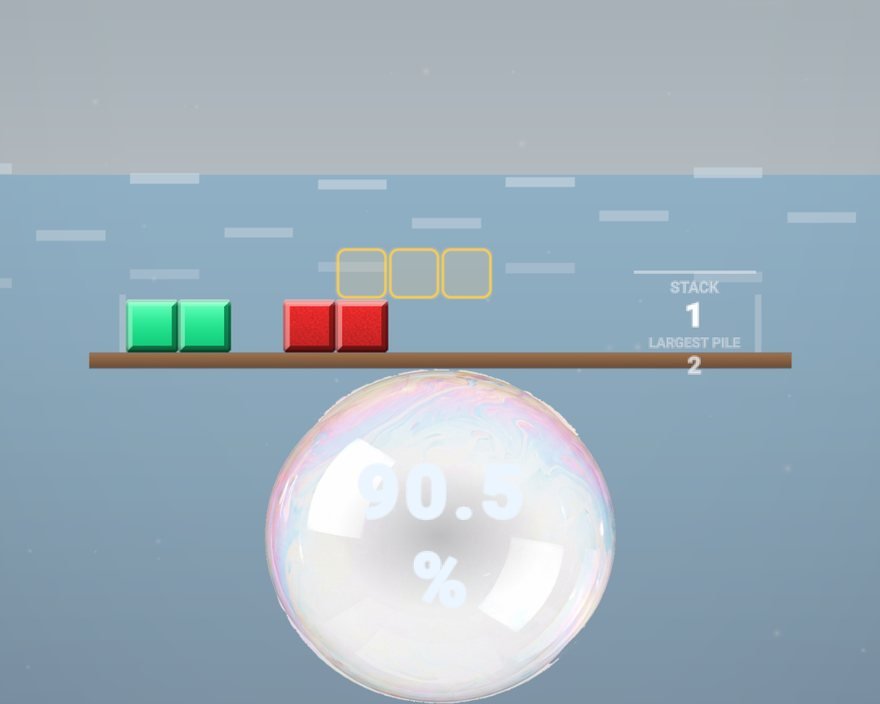
It bulges out sideways by as much as it’s pressed down (as if its volume were conserved) and springs back when the weight is gone. It’s the easiest support to read: the flatter it gets, the closer you are to danger, and when you clear a row it swells back like a breath.
Plastic — the dent stays (Macaron · Peach · Cabbage · Donut · Hamburger)


It remembers a fixed share of how deep it was pressed (Macaron 70% · Peach 65% · Cabbage 82% · Donut 60% · Hamburger 74%). In the same situation the Soap Bubble above came back round, but the Peach stays flat even after nearly all the boxes above it are gone. That is only how it looks, though: the remaining-strength number is calculated purely from the stacked weight, so it recovers to 90% when you clear rows. What the shape remembers is the trace of how close you came in this round.
Brittle — squashes less and breaks all at once (Apple · Billiard Ball)

Since it squashes less, danger shows up only in the numbers and colour. The red glow that spreads behind other supports doesn’t appear for brittle ones either (the Apple and Billiard Ball only heat up in colour), so “it still looks fine” is the most dangerous illusion with these. When a box lands, there’s almost no reaction either (the impact response is 28% of the elastic one).
Danger Is Announced by the Body First: Four Warning Stages

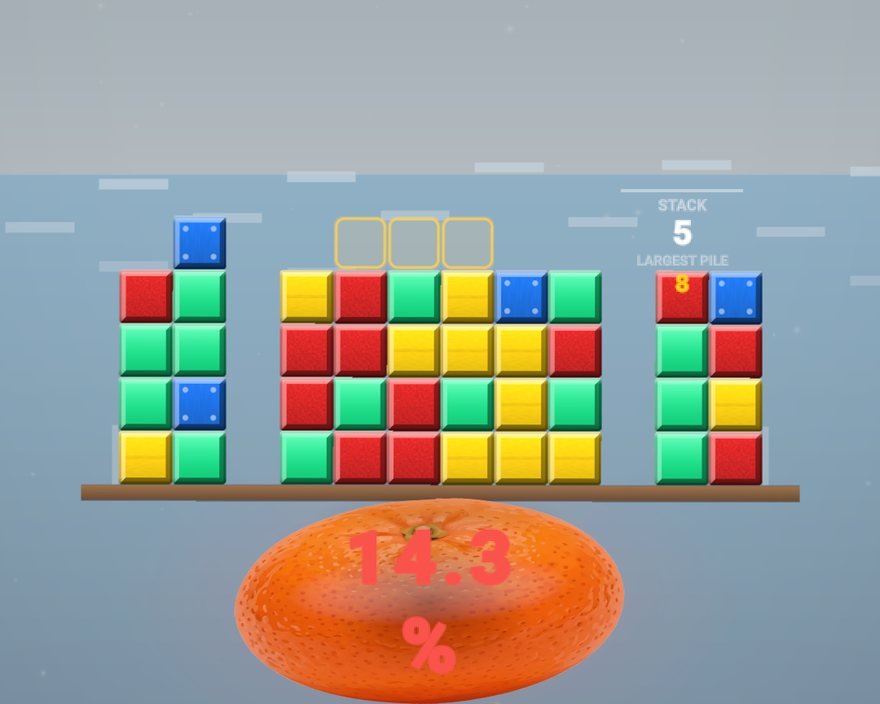
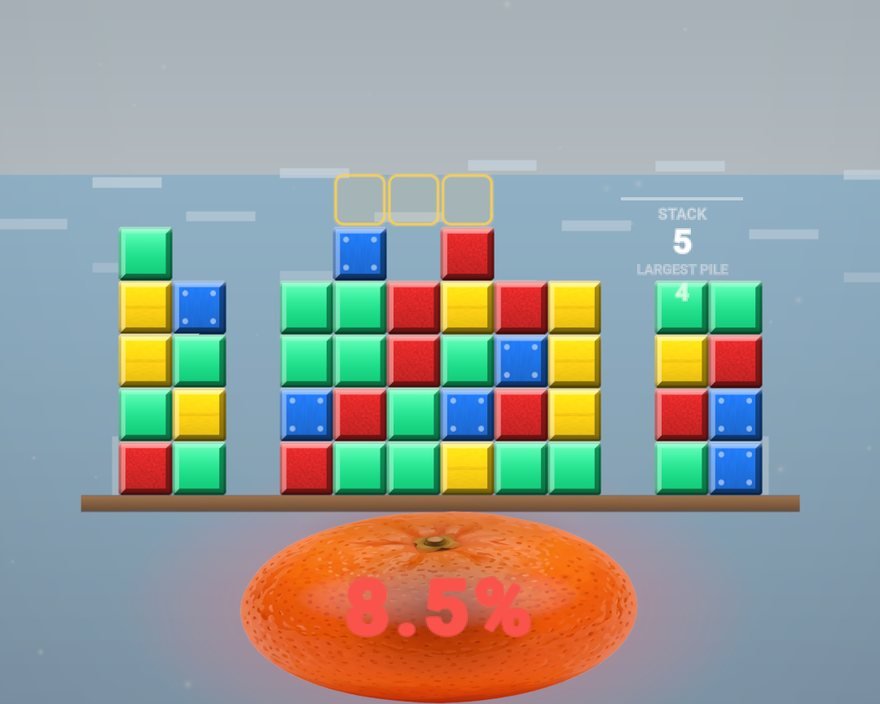
| Pressure | Remaining | What the support does |
|---|---|---|
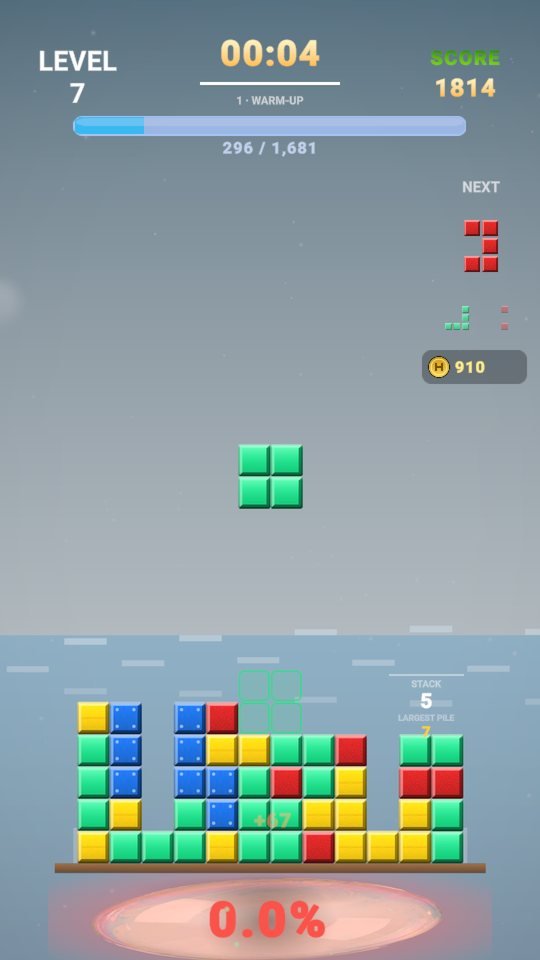
| 70% or more | 30% or less | A slow pulse (the support swells and sinks as if breathing). A warning sound plays only at the moment the stage goes up |
| 80% or more | 20% or less | The pulse quickens and a red glow spreads behind it (except for brittle ones) |
| 88% or more | 12% or less | A creaking sound keeps going |
| 90% or more | 10% or less | Faster still, and the body trembles |
| 96% or more | 4% or less | The pulse almost never stops: the final warning |
A single number gives you no yardstick for “is it really dangerous now?”, so the beat quickening, like a heartbeat, is meant to be the scale itself. The remaining-strength number also runs to one decimal place. The support tires over time (fatigue) and its limit slowly drops, and as a whole number it would look like it dropped in one jump every 5 seconds. When you feel the pulse, set everything else aside and clear rows first.
Even the Bursting Differs by Support
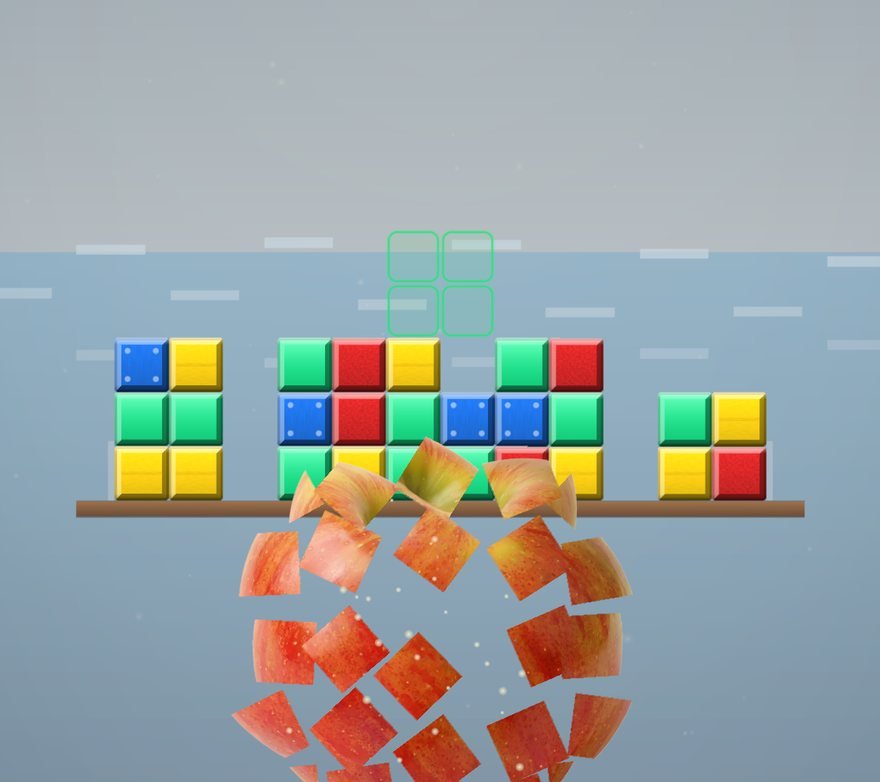

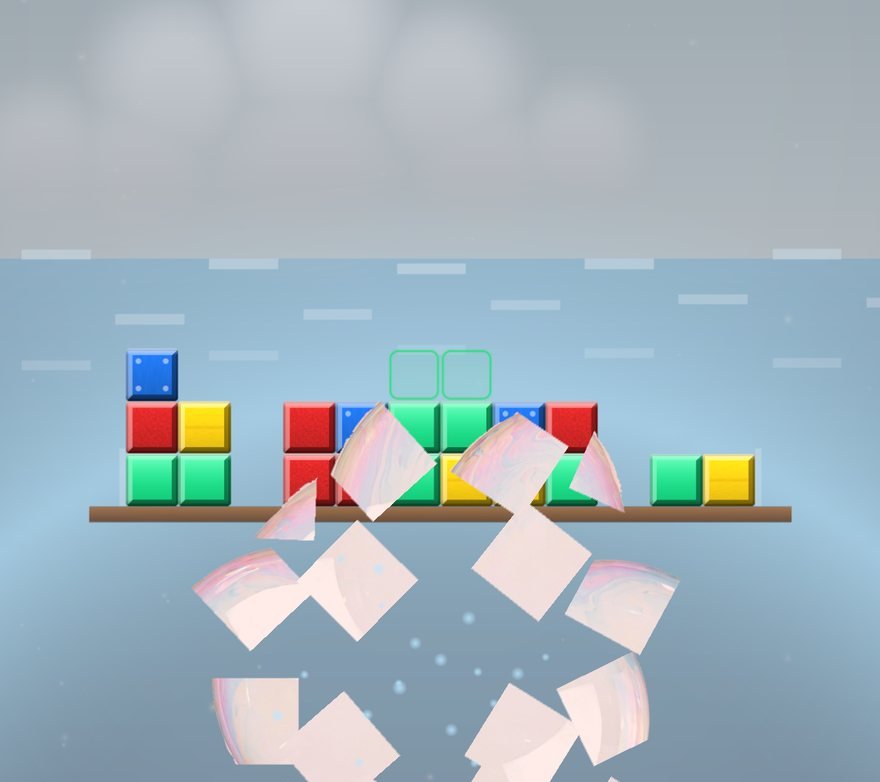
The support’s actual picture breaks apart and flies off. A scatter of same-coloured squares would just say “something burst,” not “this object shattered,” so the skin pattern and logo fly off along with it. The ending stays in the memory differently for every support.
As Levels Rise, Supports Get Weaker
Even the same support holds less from level 4 onward. The multiplier applied to max load starts at 100% for levels 1-3 and eases down to a floor of 70%.
| Level | Multiplier | Billiard Ball max load | Soap Bubble max load |
|---|---|---|---|
| 1-3 | 100% | 132 | 68 |
| 9 | 90% | about 119 | about 61 |
| 20 | 84% | about 111 | about 57 |
| 30 | 77% | about 102 | about 53 |
| 50 | 72% | about 95 | about 49 |
| 100 | 70% | about 92 | about 48 |
- Levels that are multiples of 5 play like “three levels down” and multiples of 10 like “six levels down,” so they become rounds to catch your breath.
- On top of that comes fatigue: once a round passes 20 seconds, the limit is cut by 0.2% every 5 seconds, down to a maximum of 60%.
- So even the same Billiard Ball is a different support at 132 on level 1 and 95 on level 50.
Six Lines Before the Support
- When a round opens, look at the support first. Its max load and grace time set the character of the round.
- The Billiard Ball is sturdy but unforgiving. It’s over the instant you touch 0%, so watch the number early.
- The Soap Bubble is weak but easy to read. Getting flat is the warning.
- Don’t trust the shape of a plastic support. It can stay dented while the number recovers: watch the number.
- When it pulses, clear rows first. The beat that starts at 70% is your scale.
- The higher the level, the weaker the same support. Levels that are multiples of 5 and 10 are rounds to breathe.
Next up is the trouble that comes attached to the boxes on the board: lead, cracked, locked and fickle boxes.
Listen to the support’s breathing
all the way to the end.

Play TakMaster now
Playing it is much faster than reading about it.
Find the other Master Series games all in one place at hanilab.app.

More from this game
 TakMaster Continue Script: From a Red Base to the Clear, One Run Called Live
 TakMaster Ceiling — Where a Piece Sets Decides the End, and One Line Fills a Hole
 TakMaster Difficulty — The Fall Speeds Up and the Same Box Gets Twice as Heavy as Time Goes By
 TakMaster Items: Line Clear, Material Swap, Quick Bomb and Magnet Pulse, Timing Is Skill
🌌 Universe stories
 Roddy Universe, Part 2 — Fallen Down, Only One Step Back at the Roadside
 Roddy Universe, Part 1 — One Beat Before Crossing, the Empty Road Between the Cars
 Bombi Universe, Part 2 — Behind You: The Reaper That Walks Through Walls
Try other games
 BlockMaster
 SnakeMaster
 MathMaster


