
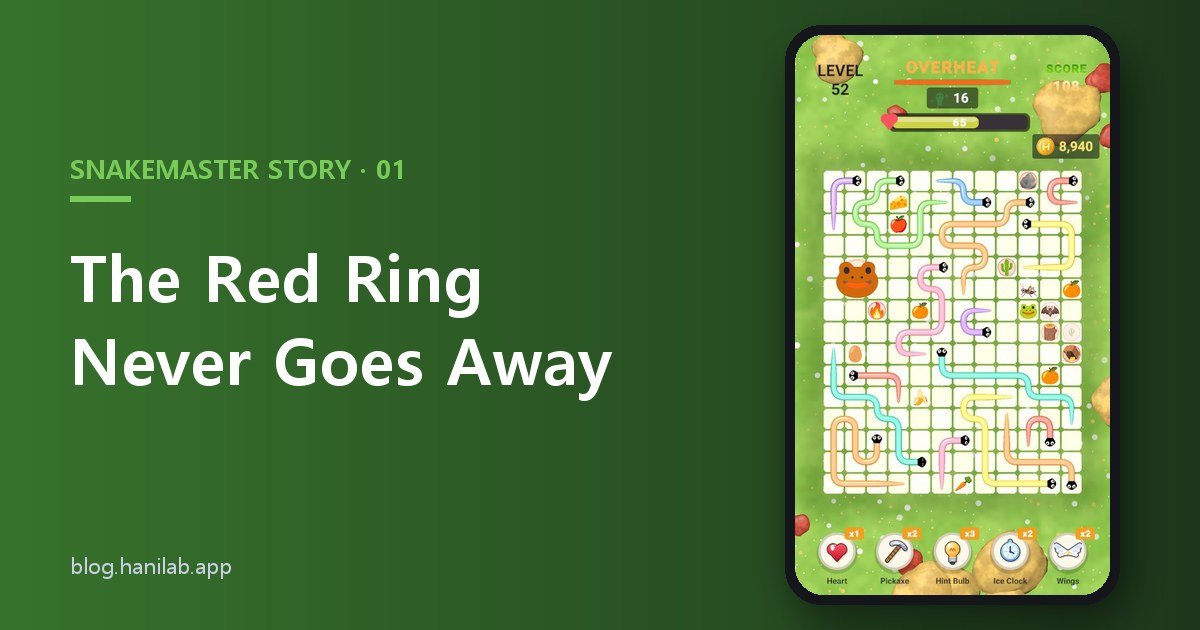
SnakeMaster Hazards — Ten That Rise and Sink, and Four Hunters That Come to Block Your Way, Measured One by One

The Red Ring
Never Goes Away
On level 2, a rock ringed in red sits in the top-right cell of the board. Bump it and you lose 4 life. But this rock does not sit still. It rises out of the ground, then dips back under — and the path is open only in that gap. This post starts from that rock and goes all the way to lions and tigers, measuring when, how and how hard each of the twenty things on the board gets in your way.

The SnakeMaster hazards come in two groups: ten stationary hazards that rise and sink in place, and ten moving hazards that roam the board. Both wear a red ring, and both take a fixed amount of life when you bump them. The numbers are the values checked in the game code, and the photos and animations are real footage from the running game.
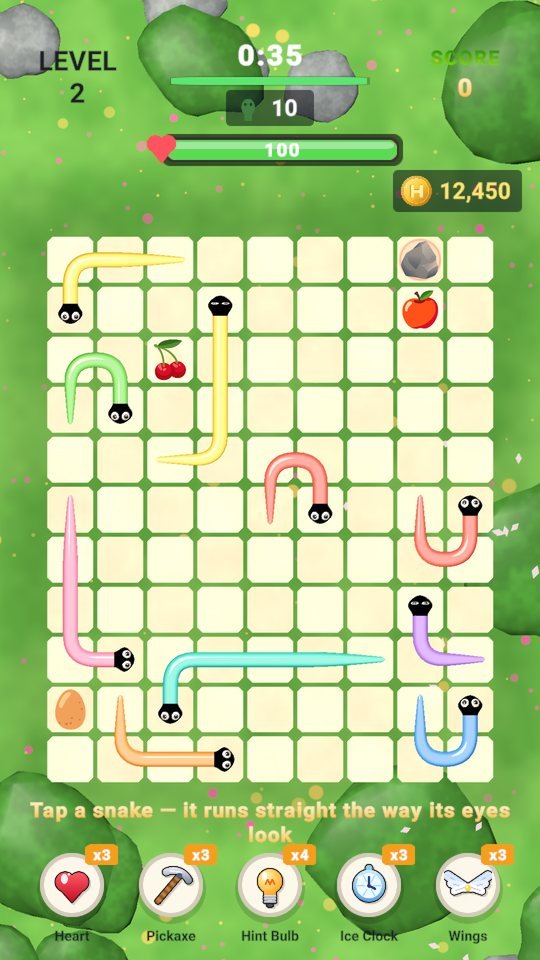 Level 2 — the first hazard, the rock at the top right (-4)
Twenty Values — How Hard Is Each to Avoid?
The code says the life a hazard takes is set by “how hard it is to avoid.” A rock that always sits in the same spot costs little; lions and tigers that cut across a lane cost a lot. Life is 100 on every board, so a rock can hit you twenty-five times, while a bomb or a lion ends it in seven. Bumping another snake costs 5.
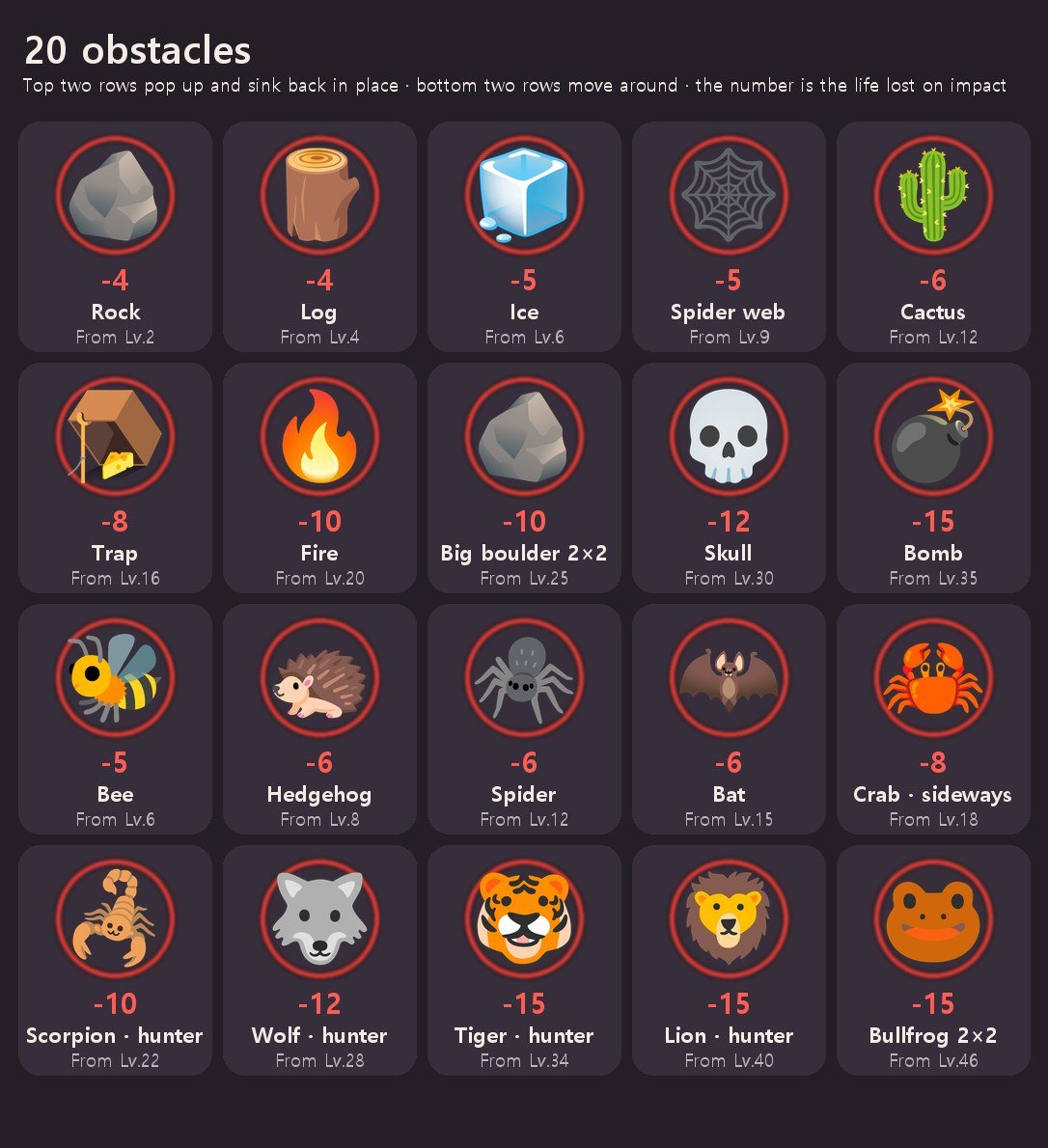
| Life lost | Stationary | Moving |
|---|---|---|
| 4–5 | Rock · Log · Ice · Spider web | Bee |
| 6–8 | Cactus · Trap | Hedgehog · Spider · Bat · Crab |
| 10–12 | Fire · Big boulder (2×2) · Skull | Scorpion · Wolf |
| 15 | Bomb | Tiger · Lion · Red bullfrog (2×2) |
New hazards become “possible” one by one as levels rise. When a board is built, one is picked with equal chance from those unlocked, so the higher the level, the more varied the faces on each board. A hit of 6 or less makes a small sound, 11 or less a medium one, and anything bigger a loud one.
Up, Then Down — The Beat of the Stationary Hazards
When a board is built, a stationary hazard is always placed on the exit path of some snake. If it stood there all the time, that snake could never leave. So the hazard rises above the ground (it blocks, and bumping it hurts), then sinks below (you can pass), over and over.
 Up — the big rock at the top right, ringed in red, with a bomb below it
| Level | Time standing up | Time sunk |
|---|---|---|
| 1+ | 1.8–3.0 s | 1.6–2.4 s |
| 31 | about 2.2–3.7 s | about 1.3–2.0 s |
| 61+ | about 2.6–4.4 s | about 1.0–1.6 s |
- Each hazard gets its own length within the range, and its own starting beat, so the whole board never moves to one rhythm.
- It blinks for 0.6 seconds before it rises. A hazard that was sunk and faint starts to blink, and soon it stands up.
- If a snake body or anything else is on that cell, the hazard waits instead of rising. It never rises in the middle of a snake’s run and cuts it.
- Bumping it does not make it disappear. It flinches and flashes red, then rises again on the next beat.
- The number of stationary hazards starts at 1 on level 2 and grows by one every 6 levels, capped at 1/30 of the cell count (about 3 at level 15, 4 at level 25, 6 near level 61).
The code comments keep the story of how this came about. At first, hazards were a “toll” that broke when you bumped them. Then came the note that “obstacles must not disappear,” and that became today’s design: they stay on the board, yet the way still opens. So a board is always solvable, and the only life you lose is what you cost yourself by tapping while a hazard is up.
Ten That Roam — From Level 6
At level 6, hazards that walk, fly and hop join the board. The moment the first one appears, the guide line shows Moving troublemakers! Wait for a clear lane. According to a code comment, they used to start at level 10, which was too late — the board was a “just think” puzzle for far too long.
| Level | On the board at once | New one every |
|---|---|---|
| 1–5 | 0 | — |
| 6–15 | 1 | about 6.8 s |
| 16–25 | 2 | about 6.4 s |
| 26–35 | 3 | about 6 s |
| 36–45 | 4 | about 5.6 s |
| 46+ | 5 | about 5 s → about 4.6 s from level 61 |
| During overheat | +1 | shortened, based on 4 s (about 2.6 s near level 61) |
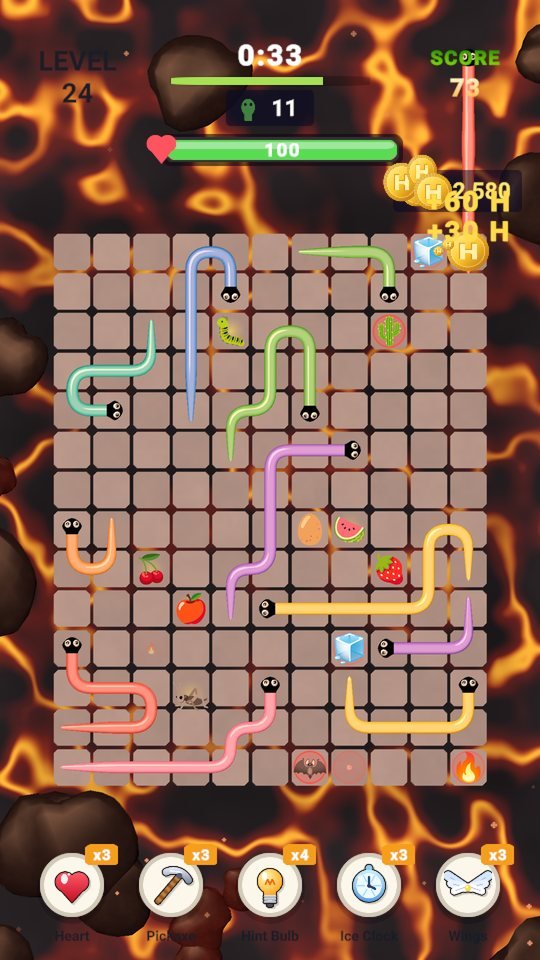
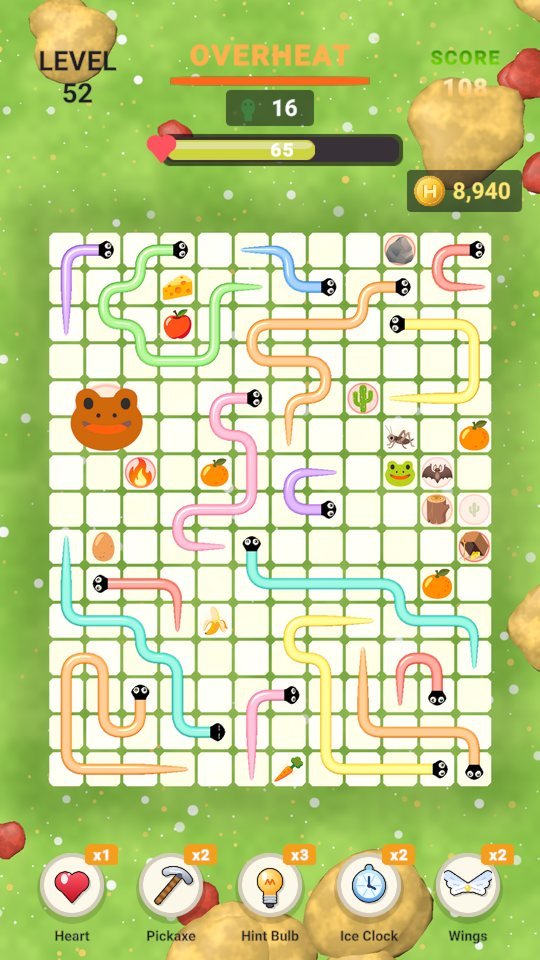
Hedgehog · Spider · Scorpion · Tiger · Lion. They go one cell at a time: forward, then sideways, then back.
Bee · Bat. They change direction often as they fly, which makes them the hardest to read.
Crab. Left and right only, one cell every 0.5 seconds.
The wolf runs at short intervals, and the bullfrog jumps two cells at a time. The view is from above, so a jump is shown by the body growing while it is in the air.
- A moving hazard never appears in the cell right in front of a snake’s head. You would have no time to react.
- They need an empty cell to appear. They do not spawn on snake bodies, other objects or stationary hazards, so on a packed early board you hardly see them, then more show up as snakes leave.
- A cell counts as moved to the next one the moment the hazard starts moving. That is why a snake bumps into the cell a hazard is “going to.”
- One stays for 18–26 seconds and leaves; if it cannot move four times in a row (it is stuck), it leaves early.
Four Hunters — They Come to Block the Open Path
Four of the moving hazards do not go just anywhere. Scorpion (level 22) · Wolf (28) · Tiger (34) · Lion (40) — these hunters pick the nearest of the cells in front of the heads of snakes that can leave right now, walk there, and stay a moment once they arrive. If they chased you the same way every time, you would read them, so one move in four is random.


That means that if you just sit and think, the open paths close one after another. In the words of a code comment, “you have to tap fast or stop them with the Ice Clock.” After level 22, the basic rule is: use an open path while it is open.
If the moving hazards leave no snake on the board able to exit (checked every 2 seconds), all moving hazards leave and no new ones come until one snake gets out. The hunters can never seal you into a total standstill.
How to Cope — Wait, Freeze, Smash
- The check happens one cell at a time. Even a lane that was empty when you tapped will bump if a moving hazard enters it while the snake runs. The safest moment is right after a hazard has just passed the lane.
- Watch the blink on stationary hazards. Tap while one is faint, sunk and not blinking, and the snake passes. A snake runs 15 cells per second, so 1–2 seconds of sinking is plenty.
- Ice Clock (2,000 H) — for 5 seconds everything stops where it is. A risen hazard freezes risen, a sunk one freezes sunk, moving hazards stand still and no new ones appear, and the life drain of overheat stops too. After 5 seconds the beat resumes as it was, so use it to pull out the snakes whose path is open right now. A frozen hazard still blocks its cell.
- Pickaxe (2,500 H) — tap it and all the stationary hazards on the board burst one after another, and the spots stay empty for 5 seconds. After that they rise again in the same places (if a snake or something else is on a spot, it stays empty until it clears). They are not gone for good, so use the gap to pull out the blocked snakes. It cannot smash moving ones, and if there is nothing to smash it shows No rock to smash and your count does not go down.
- Wings (4,000 H) — if a snake is blocked and cannot leave, the longest of them gets wings and flies out over whatever blocks it; if none is blocked, the longest snake left on the board does.
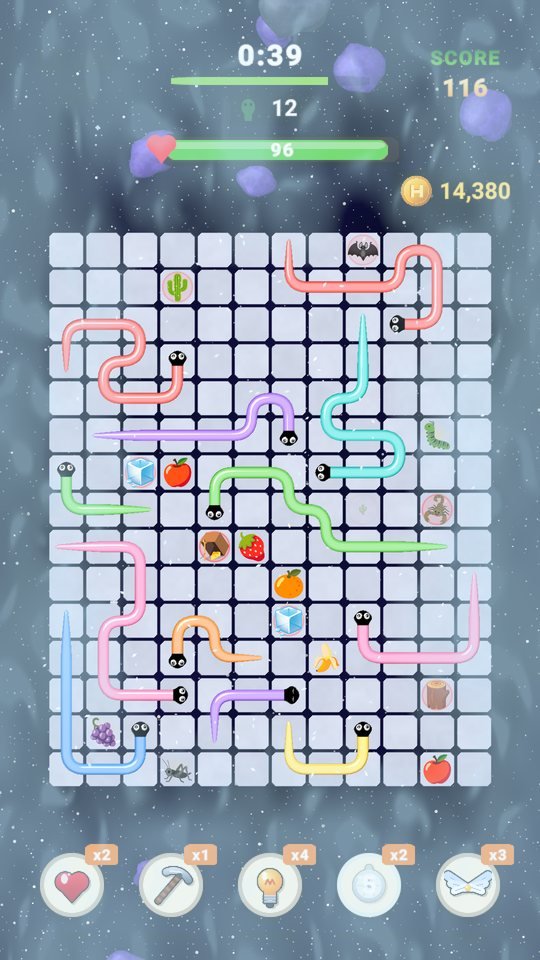
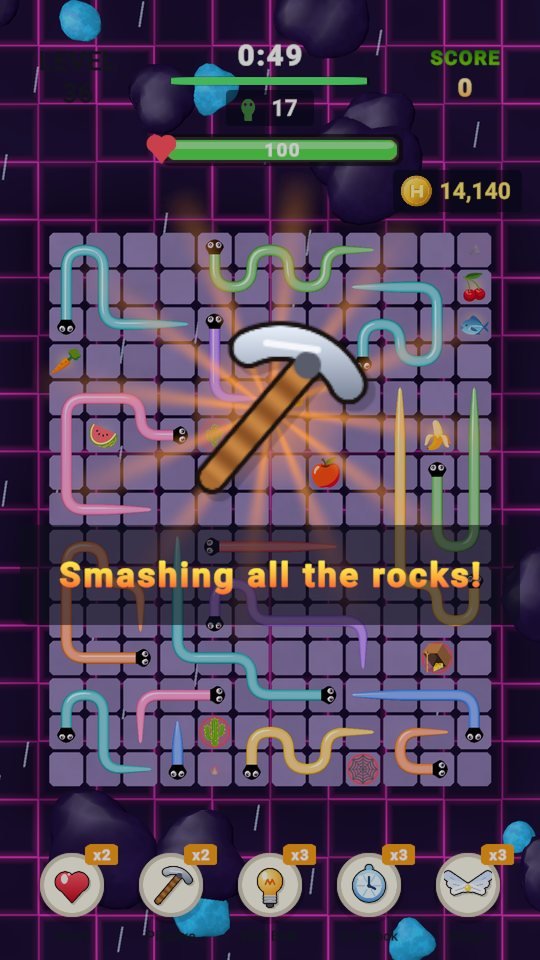
The item counts in the photos were filled in for the shoot. At the start they are all 0, and you buy items with H coins in the shop, or tap a slot at 0 to buy on the spot. If you tap an item in the middle of a board, a big picture and a one-line message appear first, and then the effect starts.
Hazards on One Page
| Stationary | Moving | |
|---|---|---|
| Kinds | 10 (rock – bomb) | 10 (bee – bullfrog, 4 of them hunters) |
| First level | 2 | 6 |
| Life lost | 4–15 | 5–15 |
| When it blocks | Only while up (blinks 0.6 s before) | On its cell · the cell it is heading to |
| Bonus boards | None | None |
| Ice Clock | Stops in place for 5 s → a risen one stays risen | Frozen for 5 s → its cell still blocks |
| Pickaxe | All burst, rise again in the same places after 5 s | Cannot be smashed |
In the next post we use the five tools that fight these hazards — Heart · Pickaxe · Hint Bulb · Ice Clock · Wings — one by one, and measure their values and uses.

That one second when the red ring sinks.
That is when you tap.

Play SnakeMaster now
Playing it is much faster than reading about it.
Find the other Master Series games all in one place at hanilab.app.

More from this game
 Before and After the Bump: What Happens When You Hit Something in SnakeMaster, in Four Scenes
 Go Again Within 4 Seconds: Stacking the SnakeMaster Combo Bonus in Five Steps
 SnakeMaster First Run Diary: From Level 1 to Level 5, a Beginner’s Log
 SnakeMaster Worlds — From the Sunny Garden to the Aurora Tundra, a Lap of 22 Worlds in 66 Levels
🌌 Universe stories
 Roddy Universe, Part 2 — Fallen Down, Only One Step Back at the Roadside
 Roddy Universe, Part 1 — One Beat Before Crossing, the Empty Road Between the Cars
 Bombi Universe, Part 2 — Behind You: The Reaper That Walks Through Walls
Try other games
 PathMaster
 AstroMaster
 WordMaster