

WingMaster Obstacle Paths — Not Just Straight Lines: Twenty Paths and the Secret of the Red Ring

Not Just Straight Lines
Twenty Paths for Obstacles
A red ring blinks at the edge of the screen. 0.9 seconds later, will a raptor fly straight out of it, skim low and then shoot up, or bounce across the whole screen the moment it appears? This post is about WingMaster obstacle paths — the routes the things flying at you actually take.
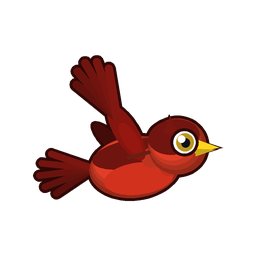
This post is about WingMaster obstacle paths. We follow how helicopters, drones, raptors, bird flocks and bat flocks each travel along a named path, which paths are open at the start, and what happens the moment the red ring goes out — using the formulas in the code and real game screens. The path diagrams are drawn straight from the game’s position formulas, and some of the motion after the ring was checked by actually running the game and logging values.

Movement Has Names Too
In the old WingMaster, obstacles had only three kinds of motion — horizontal speed, vertical speed and a sine sway. Helicopters, raptors and flocks were all “things that come in steadily, wobbling a little up and down”, and even with eighteen kinds, there was only one way of approaching. That meant only one way of dodging: match your height the moment you spot it and wait. More obstacles never made the game harder, just busier.
So paths were born. Different paths create different things to read. Something that snakes in makes you watch its next position, not its current one; an arc makes you gauge where the peak is; a dive makes you wait for the moment it turns. The same single bird becomes a completely different problem depending on its path.
 Helicopters · Drones
Machines — they move precisely. Drawn from ten paths.
 Raptors
Hunters — they come at you. Drawn from nine.
 Bird flocks · Bat flocks
Swarms — they only drift out of line in their own slot. Seven paths.
There are 22 named paths in all. Twenty of them, counting Straight, sit in the three tables above; the other two — Bouncing (bouncing rocks only) and Stretch and shrink (moving walls only) — are kept apart, because giving them to just any obstacle would make the world lie. Nothing outside these five kinds receives a path: falling rocks, fireballs and icicles simply fall, and pillars and wires stay put.
Who Takes Which Path
There is a reason paths are not handed out at random. If a helicopter swung like a pendulum or a falling rock chased the bird, the world would be lying, and players would stop trusting the screen. How something moves is information about what it is. So machines move precisely (straight, zigzag, stop-and-go) and birds move freely (waves, arcs, dives). In the diagrams below, the dot is where it appears and the line is its route over the next 2.4 seconds (horizontal is the direction the screen flows; the vertical scale is the same within each table).
Machines — Helicopters · Drones
The baseline. Wobbles only a little
Constant slope — the easiest to read
Slow, wide swells
Keeps dropping 1.1 units per second
Keeps rising 1.1 units per second
Sharp turning points make the direction clear
Halts, then lunges out
Rises, then comes down — gauge the peak
Slow at first, more urgent the closer it gets
Bolts out all at once


Hunters — Raptors
The baseline. Wobbles only a little
Sags, then climbs back up
Skims low, then shoots back up
Rushes in, then slows right in front of you
Falls back for a moment, then returns
Comes in level, then snaps downward
Ricochets between the top and bottom walls
Bolts out all at once
Slowly follows the bird’s height
Swarms — Bird Flocks · Bat Flocks
The baseline. Wobbles only a little
Slow, wide swells
Constant slope — the easiest to read
Two frequencies layered into a squiggle
Amplitude swells and shrinks
Up-down and front-back turn together
Sharp turning points make the direction clear

The swarm table has no dives and no bouncing. A bird flock always leaves one row empty, and that gap is the way through. A path that sets Y outright would pull all fifteen birds to the same height and the gap would vanish. Swarms use only drift within their own slot — wave, diagonal, pendulum, spiral.
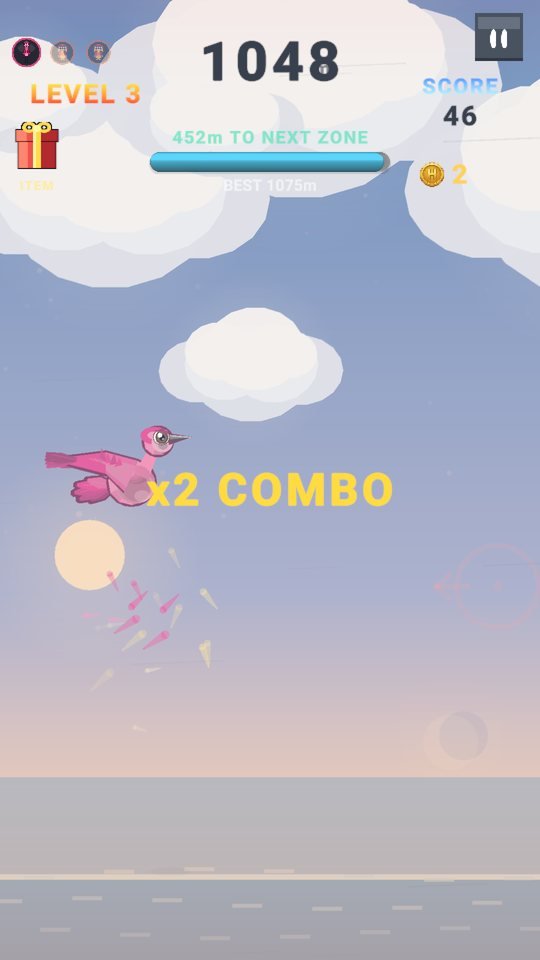
Each bird picks its path separately (the slot number is mixed into the random seed), so even within one formation they sway a little differently. That is why the flock on the screen beside this text is not a tidy grid but slightly out of line.
Easy Ones Open First
All three tables are listed easy → hard, and the game uses them from the front. The number of paths available is table length × (0.45 + intensity × 0.55). Intensity is distance run ÷ 1,800 m (capped at 1) multiplied by the difficulty multiplier the AI sets. At first only the easy-to-read ones appear, and the tables are fully open around 1,800 m.
| Table | 0m | 450m | 900m | 1,350m | 1,800m+ |
|---|---|---|---|---|---|
| Machines (10) | 4 | 6 | 7 | 9 | 10 |
| Hunters (9) | 4 | 5 | 7 | 8 | 9 |
| Swarms (7) | 3 | 4 | 5 | 6 | 7 |
| Table | Order of difficulty — distance where each opens (approx.) |
|---|---|
| Machines | Straight · Diagonal · Gentle wave · Sinking 0m → Climbing 0m → Zigzag 330m → Stop-and-go 650m → Arc 980m → Accelerating 1,310m → Charge 1,640m |
| Hunters | Straight · Downward arc · Sweep and soar · Decelerating 0m → Loop 160m → Dive 530m → Bouncing 890m → Charge 1,260m → Homing 1,620m |
| Swarms | Straight · Gentle wave · Diagonal 0m → Ripples 160m → Pendulum 630m → Spiral 1,100m → Zigzag 1,570m |
* In a run where the AI has decided to give this player a hard time, the intensity is multiplied and these distances get shorter. The distances above are approximate, for a multiplier of 1.0.
There is one exception. In the scattered stretch (an irregular layout mixing drones, helicopters, raptors, bats and flocks), the pattern picks paths itself, and the intensity it uses is not distance but the AI’s weakness adjustment (almost 1.0), so it uses most of each table from the very start. In exchange, drones, helicopters and raptors in this stretch have zero speed of their own and no warning — they drift in with the world and sway only vertically. The only raptors that come at you horizontally are the raptor charge pattern and the environment-signature helicopters (sea and mountains).
After the Red Ring Goes Out
While the ring is up, something with a warning has no body and stands still. Reading the code, though, one oddity shows up — the path clock (T) counts through the warning time. A raptor’s warning is 0.9 seconds, so the moment the ring goes out, the clock has already run 0.9 seconds. So we summoned raptors in the real game, gave them one path at a time and logged their position every 0.2 seconds — for example, a raptor given the upward arc had a ring height of 3.0 but was already at 4.29 when it appeared.
| Path | What actually happens after the ring goes out |
|---|---|
| Charge | The 0.9-second “wind-up” runs on the same clock as the warning, so there is no wind-up. Right after the ring goes out it rushes in at about 12 units per second (scroll included). The ring is the starting gun. (measured) |
| Dive | The turn happens at 1.1 seconds, so it plunges about 0.2 seconds after appearing. The fall accelerates as d²×3.4 — 3.4 units after 1 second, 13.6 after 2 (it is cut off at the floor). (calculated from code) |
| Sweep and soar · Downward arc | The clock is already about halfway through, so it appears roughly 1.9 and 1.2 below the ring and climbs back up. (calculated from code) |
| Bouncing | It travels between the top and bottom bounds about once every 0.7 seconds. The ring height means nothing, and it crosses the whole screen (±6.6) the moment it appears. (measured) |
So it is safer to read the ring as “it comes from this side” rather than as a height. Only Straight, wave, Charge and Dive come straight out at the height the ring pointed to; for the rest, the entry point is offset above or below the ring. The numbers here are the values of the raptor charge pattern (amplitude 0.6, frequency 3.0), and we cannot tell whether the game deliberately counts the warning clock — but this is how it behaves right now.
Homing — It Follows, but Never Catches Up
The last path in the hunter table, and the latest to open (roughly after 1,600 m), is Homing. The raptor approaches toward the bird’s height — but it closes the gap by no more than 1.4 units per second. A single flap lifts the bird at 9.6 units per second, so it is far slower. Because the player moves up and down overwhelmingly faster, it was set on purpose to leave you in a spot where “you can shake it off, but you get hit if you sit still”.
Of all the paths, Homing is the only one that looks at the bird’s position. All the others move by looking at the world alone. If everything chased you, it would be impossible to dodge — a punishment, not a game. So against a homing raptor, don’t stay at one height; change it.
Two Exceptions, and No Leaving the Screen
Where every other path asks “where to?”, this one alone asks “when?” While the rock is in the air it moves down, while it is resting it moves up — the instant it touches the ground is exactly the start of one cycle, so the landing sound and the picture never drift apart. The bounce height does not decay (if it did, the gap would differ every time and you could never read the rhythm).
The wall stays attached to the ceiling or floor and only the end facing the gap sways. It used to move the whole wall, so it looked like a rectangle floating in mid-air. To keep the information that it is attached, it became the only path that changes length (HH).
And one rule common to all — no path may leave the screen. A raptor that soars up and returns from off-screen would be an “invisible death” the player had no chance to read. At the end everything is clipped to the upper and lower bounds (except straight-falling objects like falling rocks, and the two exceptions above). The hit shape is also left untouched, so where it is drawn and where it hits you are always the same.
How to Read a Path
| Path | What to watch |
|---|---|
| Wave · Ripples · Pendulum | Not the height now but the height when it reaches you. For a swarm, watch whether the gap flows up and down with it. |
| Zigzag | The turn. It is a triangle wave, so the turns are sharp and easy to catch with the eye. |
| Arc | Where the peak is. About 1.5 seconds to the peak. |
| Dive · Charge | The moment the ring goes out. Charge goes immediately; Dive 0.2 seconds later. |
| Stop-and-go | When it stands still. The waveform is a sine cut at 0, so there really are stretches where it stops. |
| Accelerating · Decelerating | When to dodge — the timing. One gets more urgent the closer it is; the other rushes in, then slows right in front of you (never below 0.4x — a stopped one would become a wall). |
| Homing | Don’t stay still. Change your height. |
| Bouncing | Don’t trust the ring; watch what happens after it appears. It changes direction at the top and bottom ends. |
Six Lines for Reading Paths
- Five kinds receive paths. Helicopters · drones · raptors · bird flocks · bat flocks. Everything else falls straight or stays put.
- Only easy paths at first. The tables are fully open around 1,800 m. Hard paths like Homing and Charge appear only after 1,200 m.
- The ring is a direction. Don’t trust its height as is; look again at what appears the moment the ring goes out.
- Charge starts the instant the ring goes out. There is no wind-up. Move out of the way while you are still watching the ring.
- Homing can be shaken off. 1.4 units per second vs. 9.6 for a flap.
- Watch the gap in a swarm. However they sway, one row is always empty.
How obstacles appear and how they move — what remains is the story of the lives and continues that keep you going in the middle of it all: how to spend your three birds, and what you can choose when the last bird falls.
Don’t miss the moment
the ring goes out.

Play WingMaster now
Playing it is much faster than reading about it.
Find the other Master Series games all in one place at hanilab.app.
More from this game
 WingMaster Announcer Script: A Sky Station Anchor Reads the Big On-Screen Captions
 WingMaster patterns: pillars, flocks and beasts, fourteen templates and there is always a way through
 WingMaster Environments: Eight Skies from Grassland to Storm
 WingMaster Items: 10 Feathers That Switch On by Themselves
🌌 Universe stories
 Roddy Universe, Part 2 — Fallen Down, Only One Step Back at the Roadside
 Roddy Universe, Part 1 — One Beat Before Crossing, the Empty Road Between the Cars
 Bombi Universe, Part 2 — Behind You: The Reaper That Walks Through Walls
Try other games
 FanMaster
 BurstMaster
 PoseMaster


