

FingerMaster Items and Coins — Six Items Tested One by One, and How Many Rounds Your Coins Buy

100 coins buys you
one undo for a failure
The six FingerMaster items are priced in five tiers, from 50 to 100 coins. But is each price really worth that much power? I held the same baseball bat on the same Man Finger and used Revive, Stop3, CLEAN, Wall, Speed and Turtle one at a time, timing how many seconds each one buys. Then I counted the coins you can earn from bonus rounds, missions and ads to work out how many rounds’ worth of items your coins actually pay for.

This story puts the real effects of the six FingerMaster items and H Coins into numbers. The price list, how to get items and the bonus-round rules are already in the complete guide, so I won’t repeat that table. Here I follow what the table leaves out — how many seconds Revive needs to put a falling bat back, exactly when Stop3 kicks in at level 1 and when you would actually need it, the angle at which Wall bounces the bat, whether Speed really evens out all ten hands, how much time Turtle buys, and how coin income compares with item prices.
The hand is Man Finger, the object is the baseball bat and the round is level 3 (Stop3 only: levels 1, 20, 100 and 300). The capture rig handed over the item at the start of each round (so no coins were spent), and when two runs are compared they were opened with the same random seed. “Hands off” means nothing was pressed; the “machine hand” is a simple controller that only looks at the tilt (used for capture), so it does not react like a person. “Clock” in the tables is the in-game clock — danger effects and slow frames make it drift a little from real seconds, so each table says which seconds it uses.
You meet the item window twice — and what happens when you’re short on coins
You use an item in the Choose an item to use window that opens at the start of every round. The ITEM tab in the bottom bar is where you buy; the start window is where you use. Each unit has its own 24-hour clock, and below is the tab right after the six items were added — every row shows the left timer just under 24 hours (23:58 left a couple of minutes in).

Six rows · each shows 23:58 left · price buttons 100 · 80 · 70 · 60 · 60 · 50 coins

Revive 100 coins · [Use for 100 coins]

All six rows show x0 · Not enough coins below
Rows you own show x count and just get used when tapped; rows you don’t own show x0 and the price. Tapping one opens the pop-up in the middle picture (the ad route is the other button in that pop-up). If neither coins nor an ad are available, the row shakes and Not enough coins appears, as in the right picture. The most important line comes next — this window opens again every time you press Retry. One item per round, so a failed run that you retry costs another one.
Revive, 100 coins — 0.76 seconds after passing 75°
The most expensive item first. I let the bat fall with nothing pressed, pushing it hard to the right from the same start, once with Revive and once without. Without it: about 1.45 seconds after the push it passes 75° (tilt 81.5°) and straight away the round is in GAME OVER. Now the timeline with it.
| After the push (real s) | Game clock | Bat tilt | What happens |
|---|---|---|---|
| 0.00 | 1.02 | 1.2° | The hand lets go and the bat is pushed to the right |
| 0.41 | 1.43 | 20.1° | It lies over — around 50° per second |
| 1.26 | 2.28 | 67.4° | The screen turns red (photo ① is around 60°) |
| 1.36 | 2.38 | 74.7° | Just before 75° |
| 1.41 | 2.39 | 76.2° | Past 75° — the rescue starts the same instant (the state does not go to game over and keeps running) |
| 1.47 ~ 2.06 | 2.46 ~ 3.05 | 59.7° → −115° | The bat flies to the fingertip in an arc through the air (photos ② ③) — the numbers are the bat spinning |
| 2.13 | 3.12 | 0.0° | Standing straight on the fingertip, with spin close to zero (photo ④) |
| 3.42 | 4.36 | 0.9° | Even with the hand off, it hardly tilted for 1.3 seconds |
* From 1.37 s, when it passed 75°, to 2.13 s, when it stood straight, is 0.76 seconds. The code’s return arc takes 0.40–0.80 s and then waits up to 2 more seconds for things to settle, but in this run it settled the moment the arc ended. The fall check also pauses during the rescue, just as the code says.

The bat is far over to the right — red danger screen, Revive icon at the fingertip

The fingertip icon glows yellow

The bat arcs in from above — golden pieces follow it

Straight up, with an orange ring spreading out
Next I knocked it over a second time. After the rescue the machine hand held the bat for 1.2 seconds, then let go and pushed the other way; this time there was no rescue and GAME OVER appeared at game clock 7.23. That is why Revive is once per round.
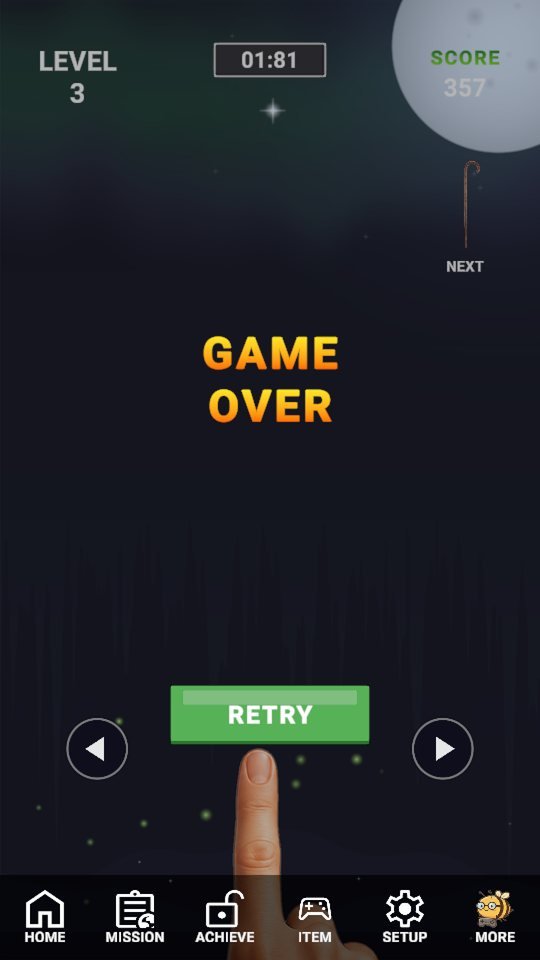 The second fall after using Revive — GAME OVER (and pressing [RETRY] opens the item window again)
- Not time — posture. The revived bat is at 0° tilt with almost no spin, the easiest state there is. The clock is not rewound, and it keeps running while the bat flies back for 0.7 seconds (2.39 → 3.12). So it is an item that leaves the time left after the fall as it is, and only puts the posture back to a fresh start.
- The code also teleports the hand to the centre, but in this round the hand was already in the middle (−0.07), so there was no visible difference. You would notice it much more if you fell with the hand pinned against one edge.
- Because it is once per round, it fits as insurance for the longest rounds. At low levels, where rounds are short, you will almost never need it (see the end of chapter 3).
Stop3, 80 coins — not needed at level 1, and from level 20 you fall before it freezes
Stop3 triggers on its own 3 seconds before the target time. Level 1’s target is 6.8 seconds, so that is the 3.8 second mark. I opened level 1 with the same seed and had the machine hand hold well until 3.0 seconds and then deliberately move to let the bat fall. First without the item, then with it.
| Game clock | No Stop3: tilt | Stop3: tilt | Stop3: fingertip position |
|---|---|---|---|
| 3.4 | −8.5° | −12.5° | 0.46 |
| 3.9 | −21.7° | −26.6° (ice starts at 3.89) | 1.51 |
| 4.3 | −32.6° | −26.6° | 1.51 |
| 4.9 | −45.5° | −26.6° | 1.51 |
| 5.3 | −64.9° | −26.6° | 1.51 |
| 5.51 | −76.7° game over | −26.6° | 1.51 |
| 6.69 | — | −26.6° | 1.51 |
| 6.80 | — | Clear | — |
* Both rounds were opened with the same seed and the machine hand moved to knock the bat over from 3.0 seconds in both, but small differences inside a round mean the two columns do not line up exactly (read it as a trend). The fingertip position on the right did not move at all from 1.51 once the ice set in — even though the machine hand kept pressing.

The bat is stopped at a lean while only the time left keeps counting down
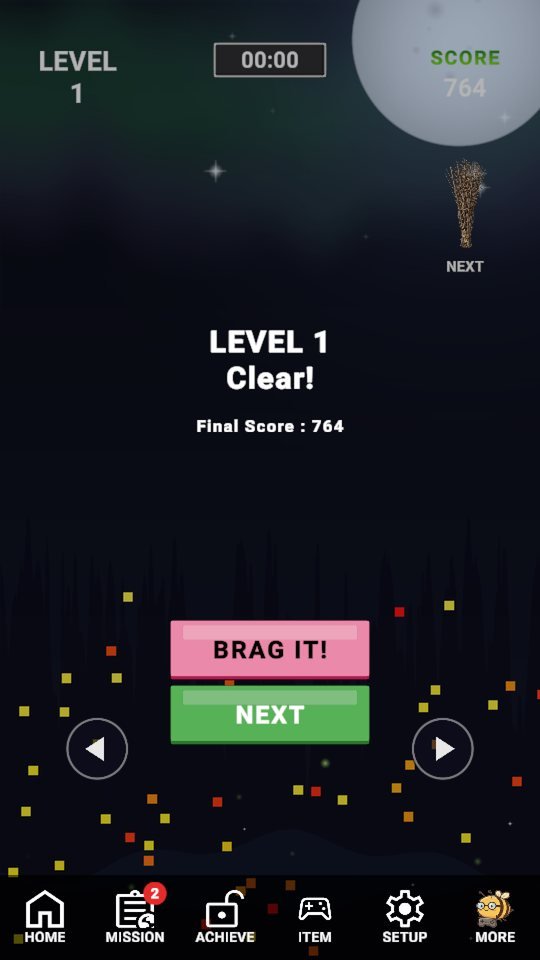
Level 1 · only the clock ran to 6.80 s and the level was cleared

So far that is Stop3 saving a round. But is there really a moment when you need it? On the same level I measured when the bat falls if nothing is pressed and compared it with when Stop3 kicks in.
| Level | When Stop3 kicks in (target − 3) | When it falls with hands off (game clock) | How to read it |
|---|---|---|---|
| 1 | 3.8 s | 6.41 · 6.35 · (one run did not fall before the clear) | It doesn’t fall before the freeze — even hands off it nearly reaches the target (6.8) |
| 20 | 6.5 s (target 9.5) | 5.35 · 5.49 | It falls 1 second before the freeze |
| 50 | — | 5.39 · 5.16 | — |
| 100 | 8.3 s (target 11.3) | 4.96 · 4.94 | It falls more than 3 seconds before the freeze |
| 300 | — | 4.50 · 4.89 | — |
* Level 1 is three runs with the same hand and bat, no item and hands off; the others are two runs each (from level 20 up, the fourth run was an eased round with a shorter target, so it was left out). The level 1 target of 6.8 and the level 100 ice time of 8.3 are the numbers in the complete guide, and the 9.5 seconds at level 20 was measured in the previous story on weather and special modes.
- At level 1 Stop3 is practically never needed. In six runs with hands off, the tilt when the ice formed was between −12° and +8°, and the three no-item hands-off runs lasted until 6.4 seconds or cleared. Freezing at 3.8 seconds freezes a round that wasn’t going to fall anyway.
- As levels rise it flips. A bat you let go of falls earlier the higher the level (6.4 → 5.4 → 5.0 → 4.7 s) while the ice time gets later. The rounds Stop3 saves are the ones you held up yourself until the ice time, and at level 100 that time is 8.3 seconds — more than 3 seconds later than when the bat falls on its own.
- So Stop3’s share is best read as the proportion the last 3 seconds make up of the whole round. Level 1 is 3 of 6.8 seconds (44%), level 20 is 3 of 9.5 (32%), level 100 is 3 of 11.3 (27%), level 1000 is 3 of 14 (21%). It is an item that is worth less the longer an expert holds on.
CLEAN, 70 coins — it blocks the weather and nothing else; special modes stay
CLEAN clears the weather at the start of the round and stops the round from even starting its weather calculation. I opened rounds at level 30 under identical conditions with natural weather left on (by turning off the capture rig’s hazard removal) and watched each one for seven seconds.
| Condition | Rounds | Rounds where weather began | What I saw |
|---|---|---|---|
| No item | 8 | 2 rounds | Rain 5 (1 round) · wind that climbed from 1 to 5 over eight steps (1 round) |
| CLEAN | 8 | 0 rounds | No weather · in one round a special mode (Static Noise) switched on anyway |
* The sample is small. In the code, the chance of weather at level 30 is in the 60% range (the table in the previous story), so 2 of 8 without the item is on the low side (the machine hand may have fallen early, before the weather came, or some of the rounds were eased rounds with weaker weather). The point is the right-hand number — weather never came in the eight CLEAN rounds — and that in one of them a special mode simply switched on.
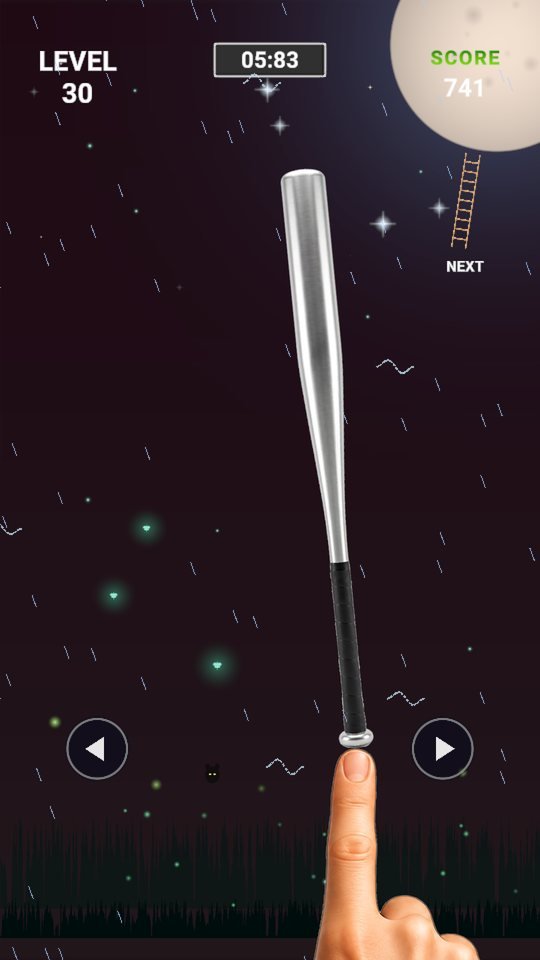
Level 30 · rain streaks and wind marks on screen (called up by the capture rig)
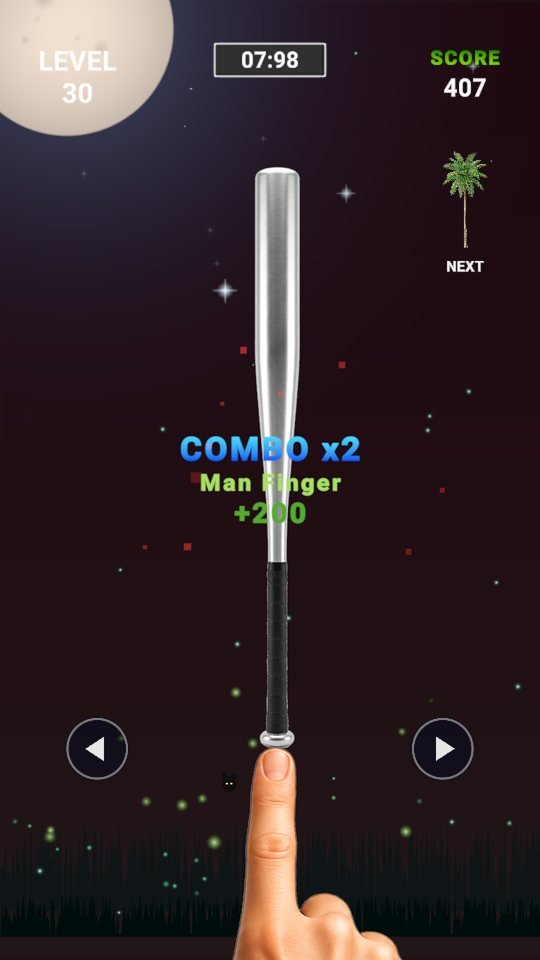
No weather — the night sky stays as it is (the blue sky does not show on a night background)
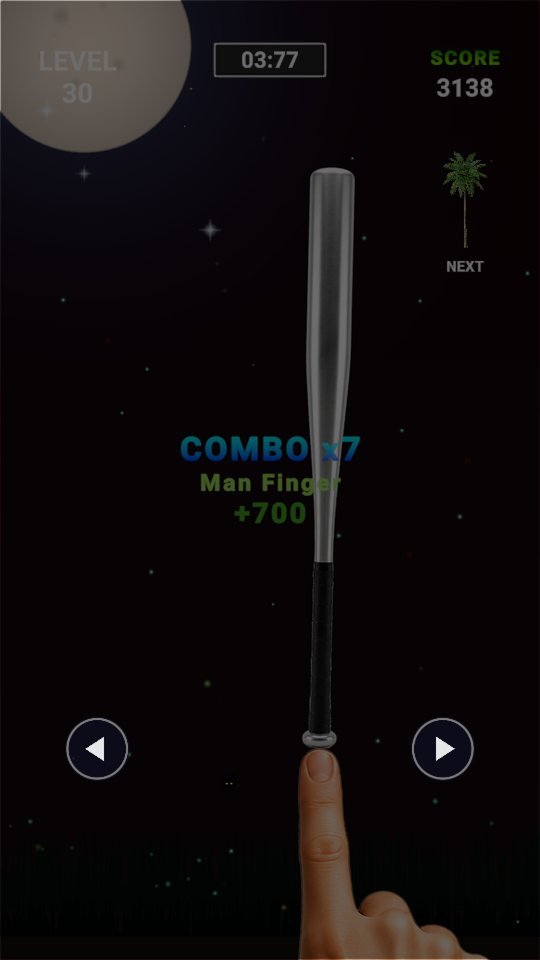
When Dark Mode was called up the screen went dark — modes can’t be blocked
So how many more quiet rounds does one CLEAN card buy? Weather and special modes are separate dice, so once CLEAN removes the weather, the only interference left is special modes. I calculated it from the probabilities in the previous story’s table.
| Level | Rounds with weather | Rounds with a special mode | Interference-free rounds (no item) | Interference-free rounds (CLEAN) |
|---|---|---|---|---|
| 20 | 63% | 20% | 30% | 80% |
| 50 | 68% | 20% | 26% | 80% |
| 100 | 72% | 30% | 20% | 70% |
| 200 | 76% | 40% | 15% | 60% |
| 201 | 76% | 70% | 7% | 30% |
| 1000 | 85% | 70% | 4% | 30% |
- It is worth the most at levels 11–200. At level 20, quiet rounds go from 3 in 10 to 8 in 10; at level 100, from 2 to 7. That is the biggest change 70 coins buys.
- From level 201 its power drops. Special modes are at 70%, so even with CLEAN seven rounds in ten still have interference (quiet rounds 0.7 → 3 in 10), and the effect falls to less than half of level 100’s. In that range an item that copes with modes (Revive) is relatively better than one that handles weather.
- At level 10 and below it is meaningless. There is no weather there at all, so you would just be throwing the 70 coins away.
Wall, 60 coins — contact at about 25°, then a bounce to the other side
Wall raises an electric barrier on only the left or the right edge of the screen each round. To see how it really bounces, I pushed the bat toward the wall’s side and let it fall (hands off), then opened one more round and pushed it toward the side without a wall. In this round the wall stood on the right.
| After the push (real s) | Tilt | Spin (right is +) | Bat centre X | What happens |
|---|---|---|---|---|
| 0.41 | 16.9° | +43°/s | 0.94 | Leaning toward the wall |
| 0.60 | 24.9° | +46°/s | 1.39 | Just before touching the wall (photo ①) |
| 0.66 | 21.9° | −63°/s | 1.22 | Thump — a bounce. The spin flips direction and gets faster |
| 1.02 | 0.8° | −56°/s | −0.03 | It passes through upright (photo ②) |
| 1.67 | −37.9° | −65°/s | −2.23 | It falls toward the left, the side without a wall |
| 2.20 | −77.2° | −86°/s | −3.50 | Game over (game clock 3.00) |
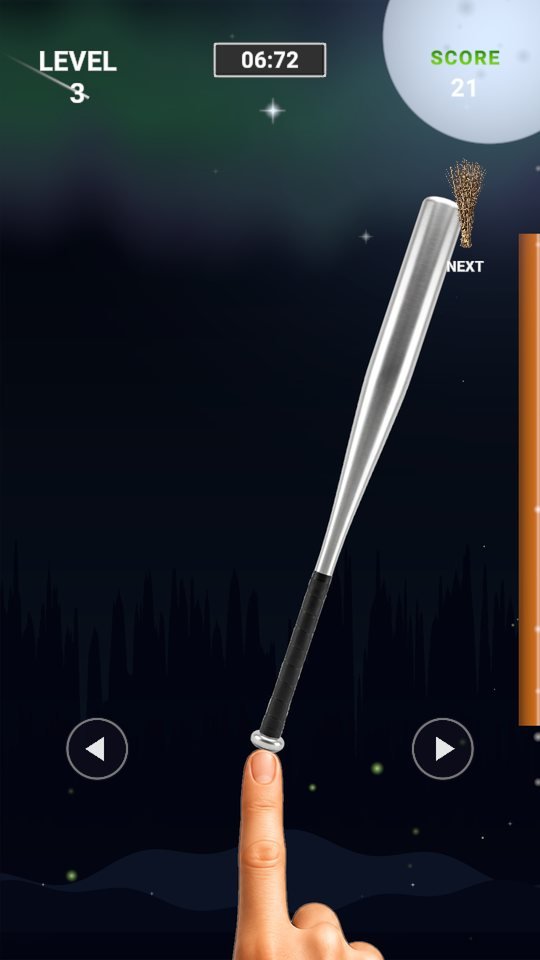
The orange wall at the right edge · the bat leans toward it
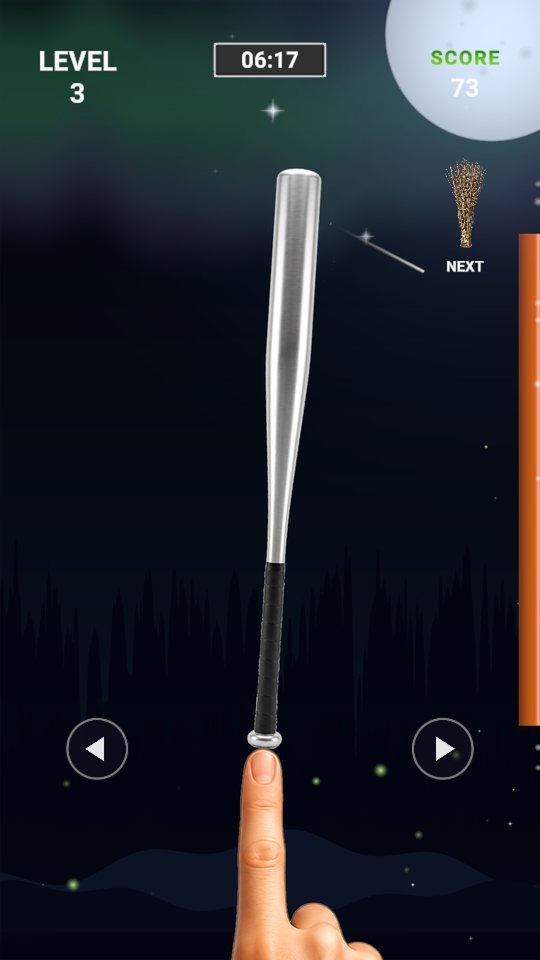
Nearly straight as it passes — now the wall-free left is the danger
These are one-off comparisons with the seed not matched, but when I pushed toward the side without a wall it was game over 1.65 seconds after the push (tilt 77.9°). Toward the wall it took 2.20 seconds — only 0.55 seconds more. Wall closes one way to fall, but the bounced bat runs to the other side even faster (−63°/s is bigger than the +46°/s it came in at).
- The contact angle is set by the object’s width. The code adds the half-width of the collision box (which grows as it tilts) to the object’s centre X and compares it with the screen edge (about 2.8). In this round it touched when the centre was at 1.39, which means the half-width was about 1.4 at that moment — the bat touched at nearly 25°. A wide object should touch earlier and a thin one later (I did not measure other objects).
- Falling toward the wall effectively disappears as a failure, and the other side stays as it was. At the bounce the bat flies past the upright posture to the opposite side, so the value lies in setting the wall side aside and concentrating on one direction.
- It bounces when the bat touches. Nothing happened when the hand went all the way to the wall side (checked in a round where I sent the hand toward the wall).
Speed, 60 coins — ten hands really did become the same speed
Speed sets the hand’s speed target to 16 (world units). Through the screen factor of 0.4 that is 6.4 units per second. To see whether every hand really gets there, I first ran the ten hands to the right with no item, then ran them from the left edge to the right holding Speed and measured the average speed over the same stretch (the bat was held in place so it would not fall).
| Hand | Normal (units/s) | Speed (units/s) | How many times |
|---|---|---|---|
| Man Finger | 2.43 | 6.47 | 2.7× |
| Woman Finger | 3.23 | 6.42 | 2.0× |
| GrandPa Finger | 1.56 | 6.48 | 4.2× |
| GrandMa Finger | 1.63 | 6.26 | 3.8× |
| Child Finger | 4.83 | 6.43 | 1.3× |
| Wood Finger | 2.01 | 6.28 | 3.1× |
| Gini Finger | 2.38 | 6.51 | 2.7× |
| Metal Finger | 2.01 | 6.41 | 3.2× |
| Robot Finger | 2.87 | 6.47 | 2.3× |
| Stone Finger | 1.22 | 6.46 | 5.3× |
- All ten cluster between 6.26 and 6.51. That matches the theoretical 6.4 (it is a stretch measurement, so allow about ±0.1). The normal values (1.22–4.83) also match the real speeds in the complete guide table (1.2–4.8).
- The slower the hand, the bigger the gain. Stone Finger gets 5.3× and Grandpa 4.2×, while Child Finger gets only 1.3×. For the same 60 coins, the value differs about fourfold depending on which hand you draw. Hands come in a rotation, one per round, so across all ten hands the average is about 3×.
- It is a speed that crosses the screen from edge to edge (about 5.5 units) in 0.86 seconds. Normal Man Finger takes 2.3 seconds and Stone 4.6. The hand slowdown in snow rounds is multiplied on top.
Turtle, 50 coins — it doesn’t remove the sway, but the fall gets slower
The cheapest item. The description in the code says it removes the sway entirely, but what the code really does is cut the object’s sideways speed at 1.5 units per second and its rotation speed at 80° per second. I measured how much that cap buys in two ways. First, the time it falls in a round with hands off.
| Same seed | No item (game clock) | Turtle (game clock) | Difference |
|---|---|---|---|
| Seed 21 | 6.39 | 6.76 | +0.37 s |
| Seed 23 | 5.58 | 6.54 | +0.96 s |
* One more run in the same way (seed 22) was an eased round (after repeated failures the game lowers the difficulty) with a shortened target, so I left it out of the comparison. Two comparisons are too few to quote an average.
Second, a hard push. The machine hand held for 1 second, let go and swung the bat at 300° per second (the same seed in both rounds). The tilts in the table are from the first measurement, and the fall times at the bottom are from a second one — with no item it was 1.75 seconds even in the first measurement.
| After the push (real s) | No item: tilt | Turtle: tilt |
|---|---|---|
| 0.4 | 8.7° | 7.7° |
| 0.8 | 24.0° | 15.1° |
| 1.2 | 44.1° | 23.3° |
| 1.7 | 70.7° (about to fall) | 32.6° |
| 2.3 | — | 42.5° |
| Game over | 1.8 s | 3.3 s |
 The bat at about 35° in a round holding Turtle — a purple ring and border, and the Turtle icon at the fingertip
- The tilt grows at a low 17–21° per second. With no item it starts at 34° per second and speeds up to 58°. The time to fall went from 1.8 seconds to 3.3, nearly double.
- What really bites is the sideways cap (1.5). In the no-item round the falling bat’s centre moves at 1.6–2.4 units per second, while in the Turtle round it topped out at 0.9–1.1. The rotation cap of 80°/s was barely reached in this measurement (the spin ended in the 70s while falling).
- That is why it is worth the most when you are pushed hard — it buys one extra beat against a sudden shock such as a lightning hit or a gust. In the ordinary stretches where your hand is holding the bat, the difference is hard to feel.
How many coins do you earn — I ran the bonus round seven times
The bonus coin round opens when you clear level 10, 20 or 30 and press [NEXT]. It is a 10-second shower of coins to catch, and each coin is worth 2 coins and 100 points. From the spawn interval in the code (0.05–0.14 s, 0.095 s on average) about 105 coins rain down in 10 seconds, but you only collect the ones that touch your fingertip. I ran seven rounds with the machine hand (a simple controller that chases the lowest coin).
| Hand | Coins caught | H Coins earned | Bonus score |
|---|---|---|---|
| Child Finger | 30 | 60 | 3,000 pts |
| Child Finger | 13 | 26 | 1,300 pts |
| Child Finger | 34 | 68 | 3,400 pts |
| Child Finger | 37 | 74 | 3,700 pts |
| Child Finger | 12 | 24 | 1,200 pts |
| Man Finger | 19 | 38 | 1,900 pts |
| Stone Finger | 10 | 20 | 1,000 pts |
| Average of seven runs | 22 | 44 | 2,200 pts |

An N Coins counter pops up the moment you catch one

H Coins x 74 — the number is the coins earned (×2), so here 37 coins were caught
- Even with the same Child Finger the result ranged from 12 to 37, more than threefold. The coins fall in random places, so luck and judgment split the outcome widely. A round usually gives 20 to 70 coins, and I use the average of 44 as the yardstick for “one bonus round” from here on. The sample is small, so take the average as a rough feel only.
- The slow Stone Finger (10 coins) was at a disadvantage with its hand speed of 1.2, and the fast Child Finger generally caught more (an average of 50 coins over five runs). The hand is drawn at random in the bonus round too.
- The 100 bonus points attach to the number caught, not to the coins earned, so 22 coins means 2,200 points added straight to your running score.
Nine missions = 190 coins — can one run fill them all?
Today’s missions are nine, each worth 10 coins when done, and filling all nine adds +100, so a day gives 190 coins. Watch an ad to double the claim and it is 380 coins (the code says there is no limit on how many times). They reset after midnight. The conditions are below (the mission text is drawn as pictures, so I read the conditions from the code).
| No. | Condition | Note |
|---|---|---|
| 1 | Clear your first level today | The day’s first clear |
| 2 | Play 5 rounds today | Clears and failures both count |
| 3 | Reach a 1-step Perfect Combo or more, then clear | Perfect Combo, 1 step |
| 4 | Reach a 5-step Perfect Combo or more, then clear | Perfect Combo, 5 steps |
| 5 | Play 10 rounds today | Clears and failures both count |
| 6 | Clear 3 in a row | Falling in between resets the counter to 0 |
| 7 | Climb 10 or more levels today | +10 from the level you first started the day on |
| 8 | Clear 5 in a row | Falling in between resets the counter to 0 |
| 9 | Clear 3 rounds that had weather | Weather appears from level 11 |
To fill all nine in one run you need to climb 10 or more levels (no. 7), hit a 5-step combo (no. 4) once during the 5-in-a-row clears (no. 8), and to fill three weather rounds (no. 9) you have to win three rounds at level 11 or higher in which weather arrives (59% at level 11). Starting at level 6 and climbing to 20 without a fall takes roughly 15 rounds. That path crosses levels 10 and 20, so two bonus rounds open on the way.
How many rounds’ worth can your coins buy
The prices are 50, 60, 60, 70, 80 and 100, an average of 70 coins. Now I put income and prices side by side. Income is the measurement above (bonus average 44) and the code’s values (missions 190, ad +100).
| Item | Price | Bonus rounds needed | Times to watch the +100 ad | With one day of missions (190) |
|---|---|---|---|---|
| Turtle | 50 | 1.1 rounds | 0.5 times | 3 items (150) |
| Wall | 60 | 1.4 rounds | 0.6 times | 3 items (180) |
| Speed | 60 | 1.4 rounds | 0.6 times | 3 items (180) |
| CLEAN | 70 | 1.6 rounds | 0.7 times | 2 items (140) |
| Stop3 | 80 | 1.8 rounds | 0.8 times | 2 items (160) |
| Revive | 100 | 2.3 rounds | 1 time | 1 item (100) |
The bonus average of 44 coins divided by the average price of 70 is 0.63 of an item. Ten bonus rounds’ worth buys you about two-thirds of one round’s item each time. Going from level 1 to 100 without a single fall opens ten bonus rounds, about 440 coins, a little over 6 items.
190 coins over the average price is 2.7 items, and doubling with an ad gives 380 coins, 5.4 items. The conditions are demanding, but this is the biggest single income.
+100 over the average price of 70 is 1.4 items, and one Revive is exactly 100, so one Revive equals one ad. I could not find a limit on the number of times per day in the code. You are paid only when an ad shows.
Your first login of the day gives one random item out of the six. Its average value is 70 coins.
Sketching a day makes it concrete. (A) One day of missions with no ads plus two bonus rounds — 190 + 88 = 278 coins plus 1 free item = about 5 rounds’ worth. (B) The same day with missions doubled by an ad — 380 + 88 = 468 coins plus 1 free item = about 7.7 rounds’ worth. A round lasts 7 to 14 seconds, so with repeated failures this is a game where thirty rounds a day pass quickly. The cost of using an item every round (average 70 × 30 rounds = 2,100 coins) is 4 to 6 times this income. The conclusion is simple — the items are priced to be used on “the one round that matters”, not every round.
So what do you hold, and when
- Levels 1–10 — there is no weather or special mode at all (they start at level 11), and at level 1 the bat lasted 6.4 seconds with hands off. Press [Start without item] in the item window.
- If weather keeps knocking you down at levels 11–200, take CLEAN. At level 20 quiet rounds go from 3 in 10 to 8 in 10. Just remember that modes stay.
- If you fear a last-moment slip in a round that has gone far, take Revive. The revived bat starts at 0° and almost still, so it is easy to carry on from there. In ranges like level 201 and up, where special modes are at 70%, it beats preparing for weather.
- For an expert’s last 3 seconds, take Stop3. It pays off only when you are confident you can hold on yourself until the ice time (target − 3 s). The share of the last 3 seconds shrinks to 32% at level 20, 27% at level 100 and 21% at level 1000, so the higher the level, the smaller the range the same 80 coins insures.
- If you drew a slow hand, take Speed; if you fear hard shocks, take Turtle. Stone, GrandPa and GrandMa get 4–5×, Child Finger 1.3×. Turtle stretched the time to fall by 1.8× when pushed hard.
- Wall only closes one way. The other side is open after a bounce, so check which side the wall is on and keep your hand on the opposite side.
Take on the same level five times and the item is spent five times. When you can’t pass it, take it into the first round, and from the next one use [Start without item] to get a feel.
Each unit you buy has its own 24 hours, so if you stock up, some of it expires after a day. Buy only what you need, when you need it.
Tap a row you don’t own and choose “Watch Ad · Use”, and it costs no coins. One Revive (100 coins) equals one ad.
Every 10 levels it gives an average of 44 coins — not falling at level 9 earns you an item.
Over six stories I have stood the same baseball bat on many hands and measured. The speed of ten hands and the combo multipliers, the ±5° of the Perfect Combo, the weight and sag of thirty-eight objects, the danger raised by weather and special modes, and in this story the items and coins. If you want to read from the start, the complete guide is the place to begin.
Items are not for every round, they are for one round.
100 coins is an undo ticket for a single failure.

Play FingerMaster now
Playing it is much faster than reading about it.
Find the other Master Series games all in one place at hanilab.app.

More from this game
 FingerMaster Round Live Commentary Script: The 7 Seconds of Level 1
 Where does your FingerMaster score go after a fall? Retry, New Game and mercy rounds Q&A
 FingerMaster hazards with no warning: 9 of them, from lightning and ghost to earthquake and strobe
 FingerMaster weather and special modes — measuring the hazards that come with no warning
🌌 Universe stories
 Roddy Universe, Part 2 — Fallen Down, Only One Step Back at the Roadside
 Roddy Universe, Part 1 — One Beat Before Crossing, the Empty Road Between the Cars
 Bombi Universe, Part 2 — Behind You: The Reaper That Walks Through Walls
Try other games
 SnakeMaster
 DalgonaMaster
 LineMaster