
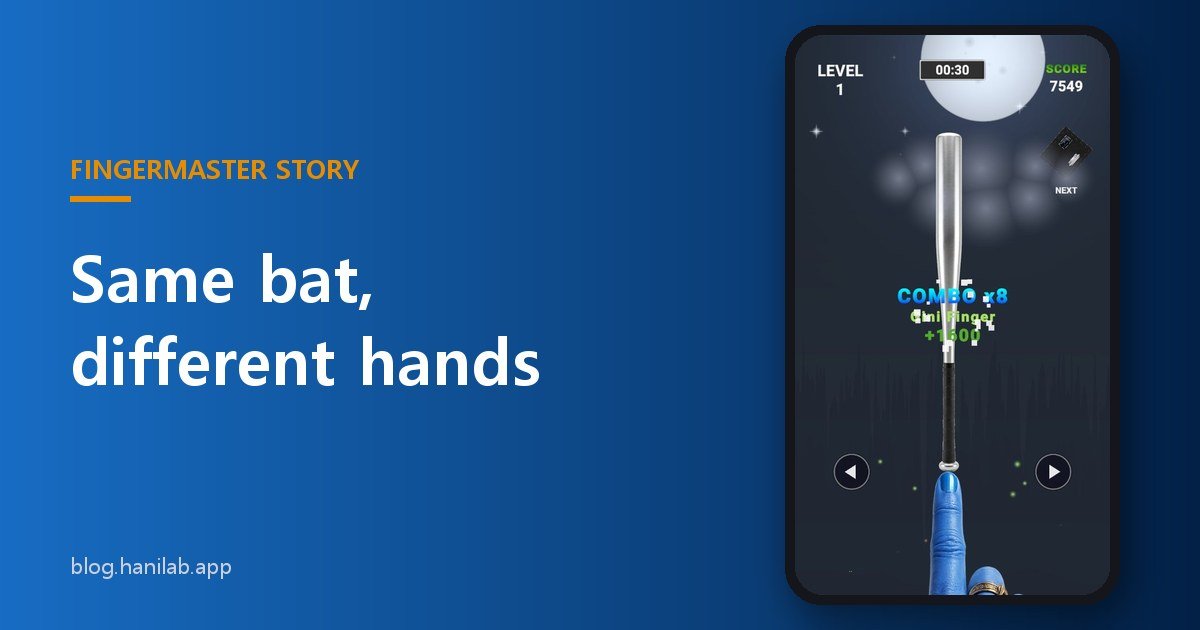
FingerMaster Finger Types — Same Bat, Different Hands: Speed, Unlocks and Combo Multipliers

Same baseball bat,
a different hand
Level 1, a silver bat on your fingertip. The moment you press the right arrow, the Child’s hand hits the wall in the blink of an eye, while Stone’s hand crawls along for over two seconds. And the bat never sits still in the meantime. That is why there are ten FingerMaster finger types — so I built identical conditions and measured exactly what changes from hand to hand.

This is a story about comparing the FingerMaster finger types. How the hand is chosen and when each one unlocks, how many seconds each hand needs to reach the edge of the screen, how wide a tilt each hand allows for a Perfect Combo, and how far apart the scores end up when every hand stacks the same 8 steps — all pulled from real game screens and numbers in the code. The faces of all ten hands and the basic table are in the Complete Guide; here we look at how that table actually plays out in a round.
To keep conditions identical, every shot uses Level 1 and the baseball bat, with only the hand swapped. For the dash I held right from the center and timed the fingertip until it stopped (fingertip travel about 2.83). For the combo comparison the bat’s tilt was pinned by the capture rig, which removes the shake of a human hand. Scores are all counted by the game itself. Each value was measured once, so expect roughly ±0.1 s of wobble.
You can’t pick your hand — one card at a time from a shuffled bag
When a round starts a hand rises into view, but there is no screen where you choose which one. The game puts every unlocked hand into one bag, shuffles it, and draws one at a time. When the bag is empty it reshuffles. I opened rounds back to back and recorded which hands came up.
| Highest level | Unlocked hands | Hands drawn in consecutive rounds (in order) |
|---|---|---|
| 4 | 6 types | Woman · Grandpa · Child · Man · Grandma · Wood | Child · Grandma … |
| 10 | 10 types | Man · Robot · Child · Wood · Woman · Grandma · Metal · Gini · Grandpa · Stone | Child · Grandma … |
* One run each with the same settings, so the order differs every time. Names are shortened from the name the game shows in the combo text (for example “Man Finger” is written Man).
- No repeats within one pass — with 6 unlocked types, every hand came up exactly once in six rounds; with 10 types, in ten rounds.
- Repeats are possible where the bag changes — when the code reshuffles a new bag it does not avoid the hand just used. The same hand can show up twice in a row.
- Locked hands are not in the bag — at highest level 4, Gini, Metal, Robot and Stone never appeared in eight rounds.
The moment a hand unlocks — by highest level
| Unlock condition (highest level) | Hands that unlock |
|---|---|
| From the start | Man · Woman · Grandpa · Grandma · Child · Wood |
| Level 5 | Gini · Metal |
| Level 10 | Robot · Stone |
- The condition is not how many times you cleared that level but the highest level you have reached. The level you reach is recorded the moment a Level 5 round ends — whether you cleared it or the bat fell. Gini and Metal join the bag starting with the round after a fall.
- When a new hand unlocks and the number of cards in the bag changes, the bag is reshuffled from scratch.
- There is no screen announcing a new hand. The drawer’s unlock list covers objects only, so you only find out a hand by meeting it in a round. If you can’t tell which hand you have, its name appears on the middle line of the Perfect Combo text, for example Gini Finger.
From the center to the right edge — 0.75 s versus 2.44 s
How long does a hand at the center need to reach the right edge? I held the right half of the screen and timed it until the fingertip stopped. The fingertip moved about 2.83 (center to right edge, in world units).
| Hand | Move speed | Time to reach the edge | Distance moved after 0.6 s | Bat tilt on arrival |
|---|---|---|---|---|
| Child | 12 | 0.75 s | 2.82 (already at the edge) | 32° |
| Woman | 8 | 0.98 s | 1.79 | 34° |
| Man | 6 | 1.26 s | 1.34 | 36° |
| Grandpa | 4 | 1.85 s | 0.91 | 45° |
| Stone | 3 | 2.44 s | 0.70 | 65° |
Every time is about 0.1 s longer than the theoretical value (distance ÷ move speed × 0.4) — that is the few frames between pressing and the hand actually starting to move. The last column is the tilt when I corrected nothing and just held the button to the end, taken the moment the hand touched the edge.

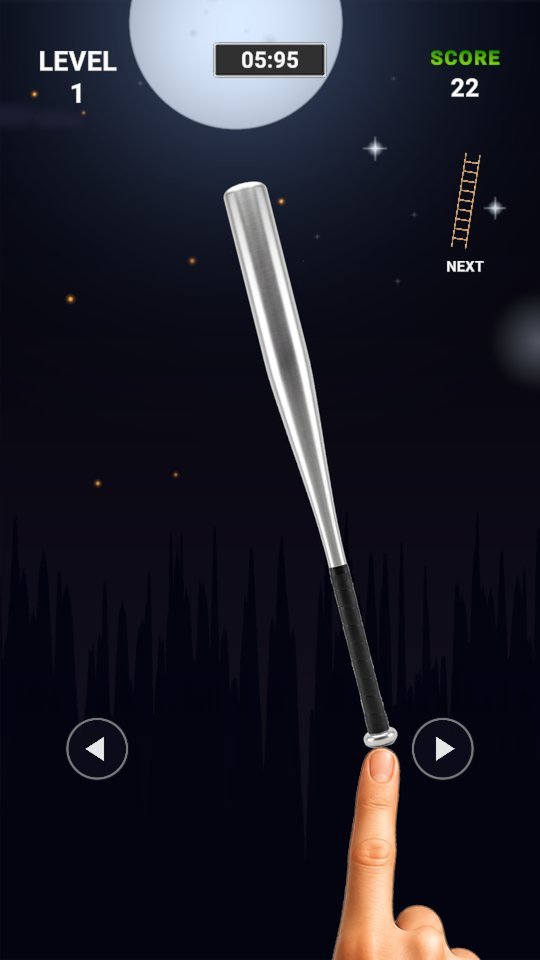


All four are the same 0.6 s after pressing. The bat’s tilt also grows as the hand gets slower — the longer you take to reach the edge while leaning, the longer gravity pulls on the bat. Here is what holding right with Stone looks like.


That does not mean a fast hand is automatically easier. A fast hand also makes the bat feel a stronger inertia — even the Child had the bat leaning 32° when it reached the edge. A slow hand has the opposite problem: once it is pushed to the edge it needs over two seconds to come back. So the advice is exactly reversed.
- Slow hands (Stone · Grandpa · Grandma) — the whole game is not straying far from the center. Move a little early, while the tilt is still small. If you get pushed to the edge, the bat falls before you return.
- Fast hands (Child · Woman) — instead of holding the button, tap in short bursts. One press carries you far in an instant.
With the Speed item, every hand’s speed is scaled by 16 ÷ move speed, so all hands move at 6.4 per second (about 0.44 s from the center to the edge, by calculation). The Child only gets 1.3× faster, but Stone becomes 5.3× faster and the Man 2.7×. It pays off most in a round where a slow hand came up.
Combo tolerance — 5° and 8°
A Perfect Combo steps up by one each time you hold the bat within ±5° of vertical for 0.8 seconds. But the Child Finger alone gets 1.6 times that, 8°. I pinned the bat at an angle (with the capture rig) and watched for 2 seconds.

COMBO x2 +200 · score 396

No combo · score 79

COMBO x2 +260 · score 459

No combo · score 70
| Hand | Tolerance | 4.5° | 6.5° | 8.5° |
|---|---|---|---|---|
| Man (and the other hands) | ±5° | Combo climbs | Broken | Broken |
| Child | ±8° | Combo climbs | Combo climbs | Broken |
Same 6.5°, same 2 seconds: the Man scored 79 and the Child 459. That single difference opened a gap of more than five times. The Child’s hand is fast, so it also shakes more, and this is a correction that widens what counts as “standing straight” to match. In width terms, a 10° window becomes a 16° window, 60% wider.

Note that the reference is always the angle from vertical. It doesn’t matter where the hand is; only how far the bat leans counts. Once the combo breaks, the step count drops to 0 and you start again from step 1, so rather than trusting the tolerance and relaxing, keep holding inside 5° (8° for the Child).
The same 8 steps, scores from 3,949 to 7,549
This time I kept the bat upright and stacked up to 8 steps (6.4 seconds). Same round, same moment, and the score on screen. Only the hand changed.

+800 · 3,949
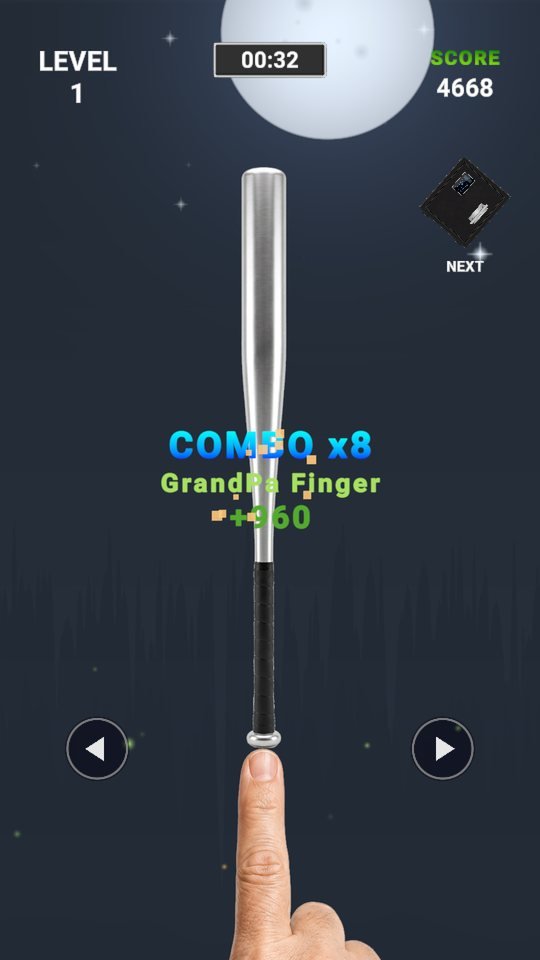
+960 · 4,668

+1,040 · 5,028
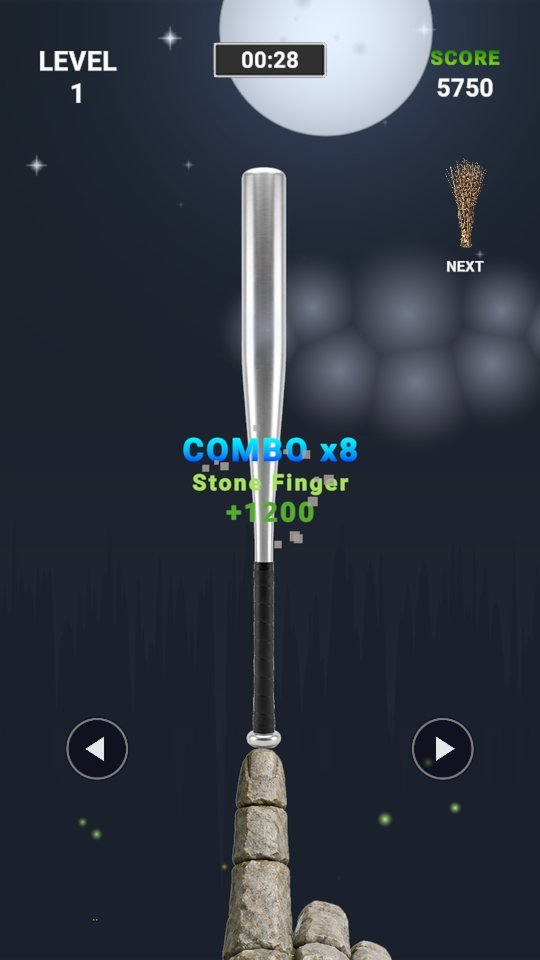
+1,200 · 5,750

+1,440 · 6,829

+1,600 · 7,549
| Hand | Multiplier | Combo points over 8 steps | Score on screen | Steps needed to beat the Man’s 8 |
|---|---|---|---|---|
| Man | ×1.0 | 3,600 | 3,949 | 8 steps (baseline) |
| Grandpa | ×1.2 | 4,320 | 4,668 | 8 steps |
| Child | ×1.3 | 4,680 | 5,028 | 7 steps |
| Stone | ×1.5 | 5,400 | 5,750 | 7 steps |
| Robot | ×1.8 | 6,480 | 6,829 | 6 steps |
| Gini | ×2.0 | 7,200 | 7,549 | 6 steps |
The on-screen score is about 350 points above the combo points (348 to 350 in these six shots) — the base score collected over those 6.4 seconds. The base score is the same whatever the hand, and what spreads out is the combo part. The last column is a calculation: the sum of N consecutive steps is 100 × N(N+1)/2 × multiplier, so Gini’s 6 steps (4,200) already beat the Man’s 8 steps (3,600), and the Robot only needs 6 steps (3,780) too.
Gini at ×2.0 and Metal at ×1.5 unlock at Level 5, Robot at ×1.8 and Stone at ×1.5 at Level 10. The six hands you have from the start have multipliers of 1.0 to 1.3. Before you reach Level 5 the best multiplier is ×1.3, and the ×2.0 Gini only shows up after that.
What to do when a hand comes up — a quick summary
Fast. Tap in short bursts; the Child keeps the combo alive up to 8°, so a little shake is fine.
Average speed (2.4 · 2.0 · 2.0). Man and Wood have a ×1.0 multiplier, so lasting a long time comes first.
Slow (1.6 · 1.6 · 1.2). Staying centered is everything. In return the multipliers are ×1.2 · ×1.2 · ×1.5.
Combo ×2.0 · ×1.8. When you meet them, focus on holding the bat straight. Just 6 steps beat a normal hand’s 8.
- You can’t choose your hand; you can tell which one you have from its shape on screen and the middle line of the combo text.
- Hand data also holds values like stability, but the differences clearly confirmed in these measurements were move speed, combo multiplier and the Child’s tolerance angle.
- In snow the hand slows down (at snow strength 10, to 40% of its speed), so Stone takes close to 6 seconds from the center to the edge (calculated). In that case, guard the center from the very start.
If the hand changes the combo multiplier, how exactly does that combo build up and burst? In the next story we follow the Perfect Combo — ±5°, 0.8 seconds, the 10-step Fever calculation — through a real round.
Even with the same bat, a different hand makes a different game.
Whoever notices first which hand is coming next wins.

Play FingerMaster now
Playing it is much faster than reading about it.
Find the other Master Series games all in one place at hanilab.app.

More from this game
 FingerMaster Round Live Commentary Script: The 7 Seconds of Level 1
 Where does your FingerMaster score go after a fall? Retry, New Game and mercy rounds Q&A
 FingerMaster hazards with no warning: 9 of them, from lightning and ghost to earthquake and strobe
 FingerMaster weather and special modes — measuring the hazards that come with no warning
🌌 Universe stories
 Roddy Universe, Part 2 — Fallen Down, Only One Step Back at the Roadside
 Roddy Universe, Part 1 — One Beat Before Crossing, the Empty Road Between the Cars
 Bombi Universe, Part 2 — Behind You: The Reaper That Walks Through Walls
Try other games
 FanMaster
 BurstMaster
 WingMaster