
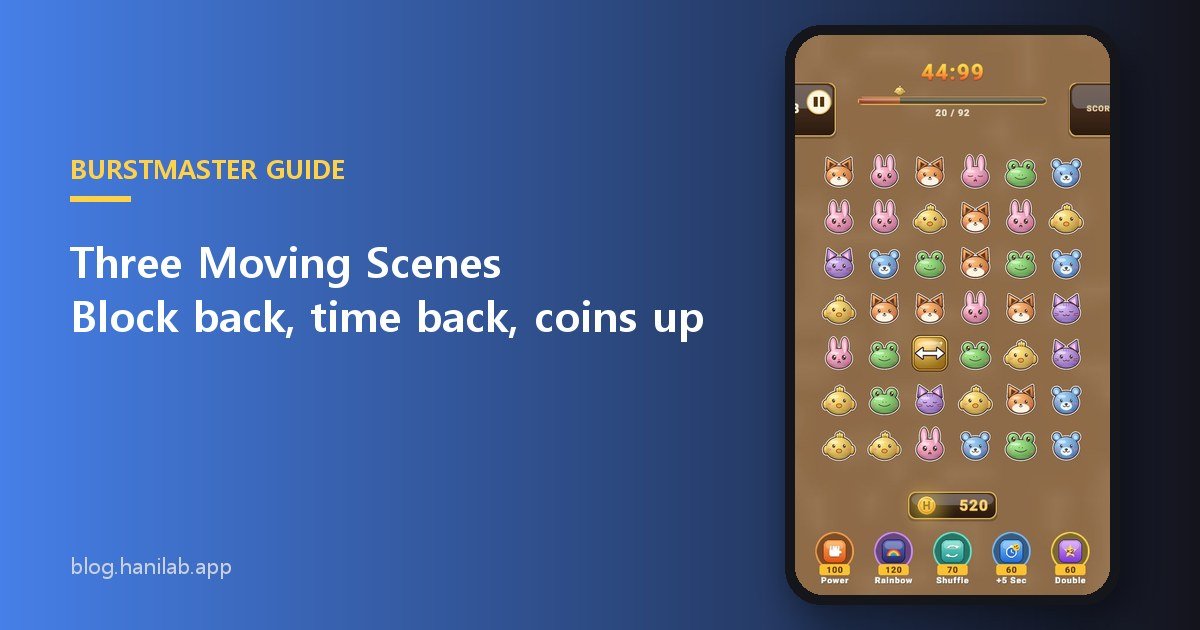
BurstMaster Moving Scenes: The Block That Comes Back, Time Given Back, Coins Counted Up

Three scenes a single photo can’t show,
caught as moving pictures
There are moments in BurstMaster you only understand by watching them. This BurstMaster guide covers three of them: a swap that makes no line and the block coming back, a chain that hands time back to the clock, and the bonus game that counts coins up, which cuts in every ten rounds. Each one is a short moving picture, with the photos around it and the numbers from the source explained.
The moving pictures were recorded by running the real game once at 15 frames per second, and the photos come from the same recording session. Since this is a video-style post, no YouTube link is included (I have no official video link for this game to point to).
When a swap makes no line: the block comes back
If you push a block into the next cell and it forms neither three of a kind nor a special block, the block returns to where it was. There is no penalty, but the clock keeps running the whole time. In the moving picture below the blocks overlap and then slide back, and the clock drops from 44:99 to 44:94. The source treats such a swap the same way: it undoes the move and buzzes once.
Too many of these and only your clock shrinks. That is why the game flashes two swappable cells after 2.5 seconds of doing nothing. A hint is not a sign that you are stuck; it means “swap here and you get a line”.
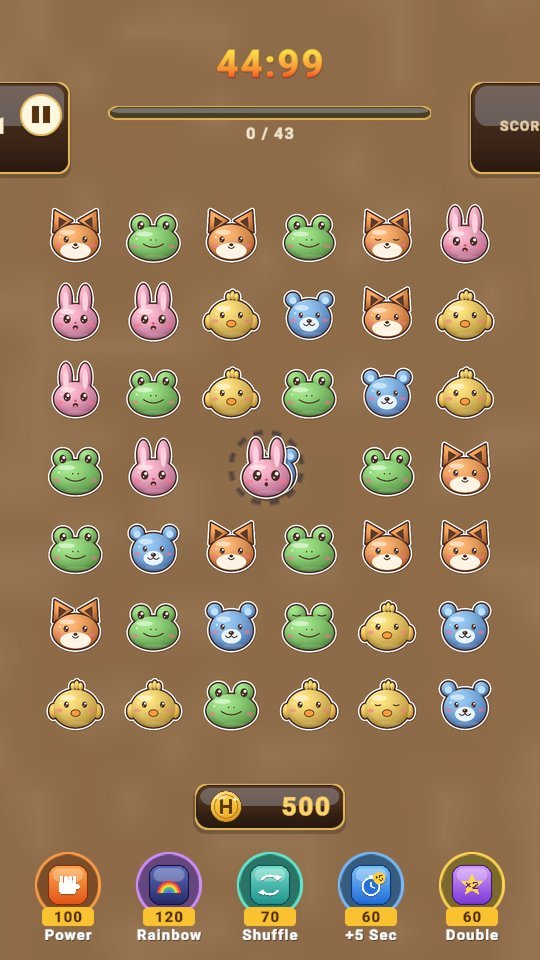
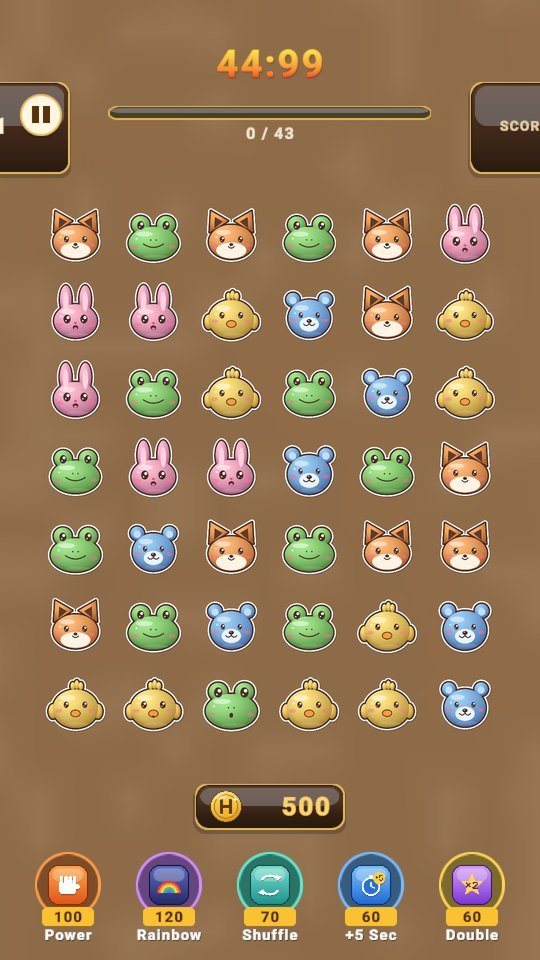
Either drag a block into the next cell, or tap a block and then tap the neighbor. Diagonal swaps are not allowed, and up to three fingers are recognized at once.
When a chain keeps going: the moment the clock gives time back
The second scene is the chain. If blocks that fall in after the first burst form another line, that is a 2-chain, and one more makes it a 3-chain. In the moving picture a pink ring spreads with ×2, +1.0s rises next to the clock, and then the words Nice! 3 COMBO! appear over the board. The clock reads 44:94 at the start and 48:49 at the end.
The time refund follows the table in the source exactly: +1.0 s at chain 2, +1.8 s at chain 3, +2.6 s at chain 4 and +3.5 s from chain 5 up. A plain 3-match (chain 1) gives 0 s, and every special block that fires adds +0.8 s on top. So the eye that builds a big chain protects the clock better than the hand that taps any match fast. A finishing bonus is added when the chain ends: 22 points for a 3-chain, 62 for a 5-chain and 122 for a 7-chain.
| Chain | Clock refund (that step) | Finishing bonus | Score multiplier |
|---|---|---|---|
| 1 | 0 s | none | ×1.0 |
| 2 | +1.0 s | 10 pts | ×1.5 |
| 3 | +1.8 s | 22 pts | ×2.0 |
| 4 | +2.6 s | 40 pts | ×2.5 |
| 5 | +3.5 s | 62 pts | ×3.0 |
| 7 | +3.5 s | 122 pts | ×4.0 |
From a line block appearing to it firing: three photos
This scene reads better as three photos in a row, so it is shown as still shots instead of a moving picture. Match 4 in a row horizontally and the line does not vanish; a horizontal line block (the yellow ↔ arrow) appears in its place. Swap it with any neighbor and it fires even without a line, wiping that whole row. Four in a column makes the vertical line block with a blue ↕ arrow.
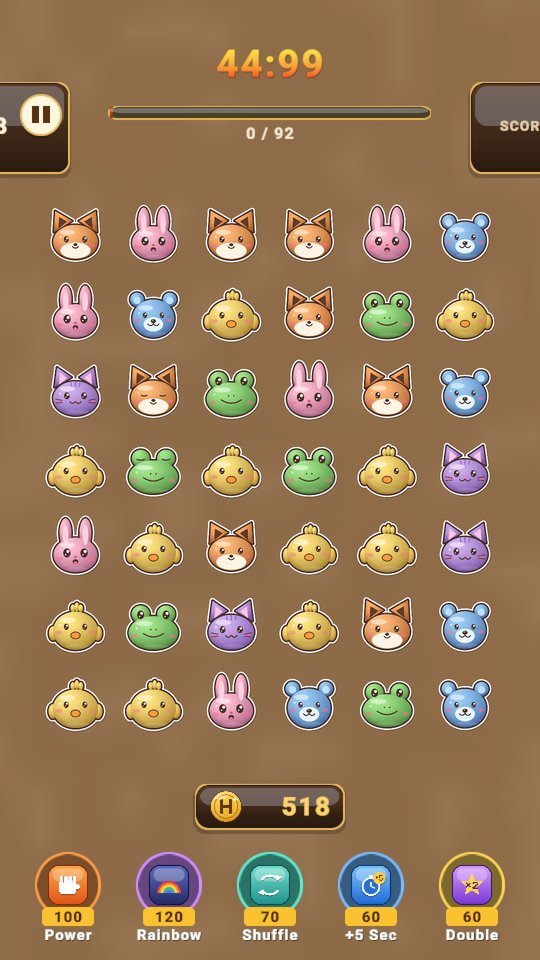
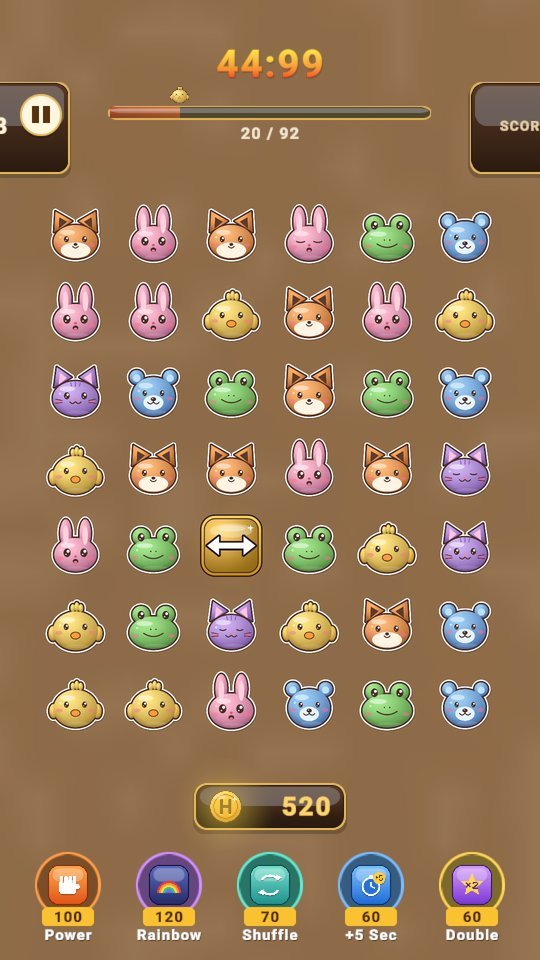
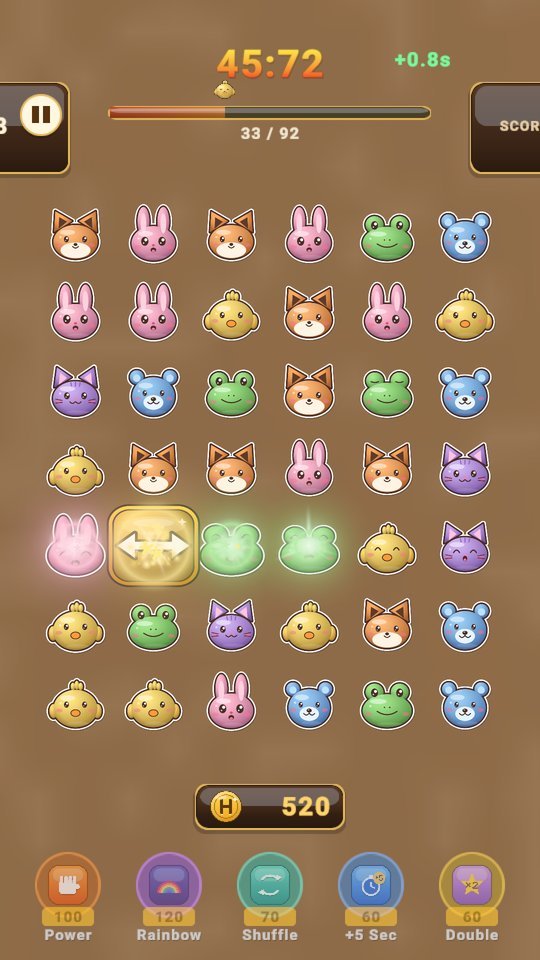
The +0.8s above the firing shot is the refund for one special block: each special block that fires adds 0.8 s. In points, making a special block gives 12 and firing one gives 8.
The bonus game every ten rounds: ten seconds of piling coins
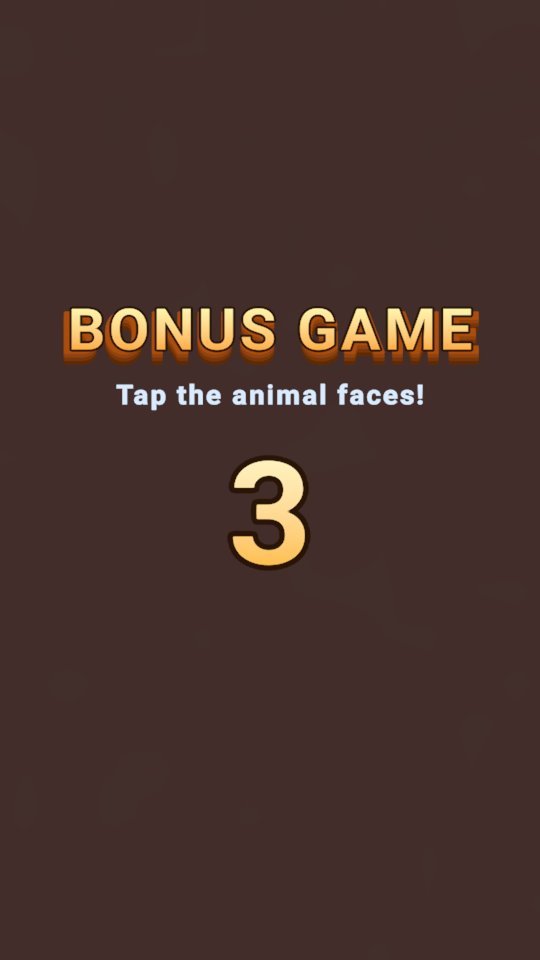
Win or lose, the bonus game cuts in once every ten rounds before the next round. The screen turns dark brown with the title BONUS GAME, the line Tap the animal faces! and a 3 · 2 · 1 countdown. Then for 10 seconds animal faces rain down the screen, and each tap puts 2 H coins straight into your balance. The source has 27 ways for the faces to fall, and they take turns.
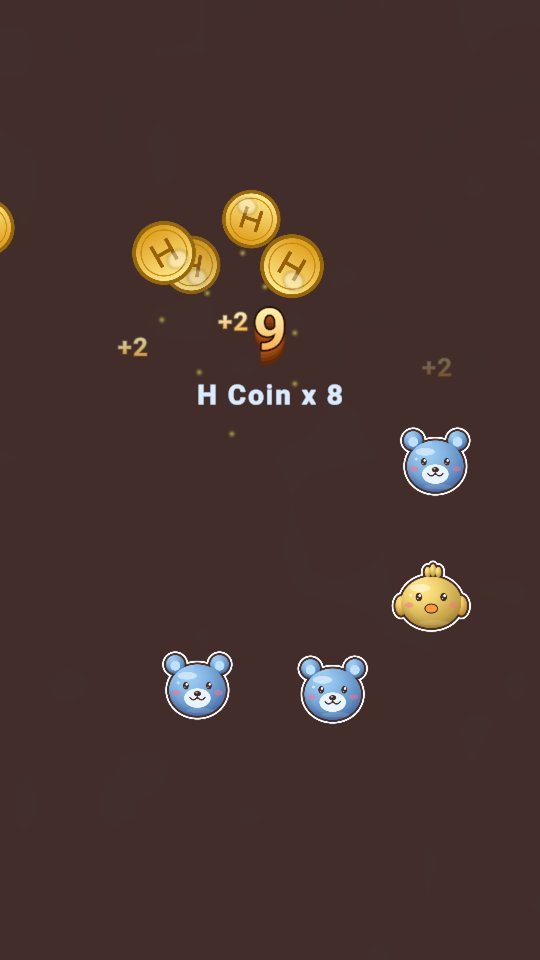
In the moving picture the count reads H Coin x 10, x 14 and x 20 while the big number drops from 9 to 8. When it ends, GAME OVER and H Coin x N appear in large letters, and after about 3 seconds the game moves on to the next round on its own, with no button. A source comment puts one bonus at roughly 20 to 40 coins. My recording did not catch the result screen, so I have no measured payout to show here.
What to know when watching the moving pictures
- The frame differs a little from the photos. The moving pictures were recorded with a cafe-style frame around the top and bottom. The background can differ from a photo of the same round, because it changes every 3 levels.
- The score chip is cut off. In some scenes the Score chip at the top right is half off the screen. I could not confirm whether the game draws it that way or the recording window size causes it.
- The 2.5 s hint, the clock refund and the 10 s bonus are all numbers I checked in the source; the scenes are staged recordings made to show them.
- The moving pictures loop forever. They restart from the first scene, so watch where the numbers shrink.
One round in time order: where these scenes sit
These scenes are not separate; they sit inside the time of one round. When a round starts, the intro shows the animal tiles and the level number, and after a 3 · 2 · 1 countdown the clock starts running from 45 seconds. Inside that you push blocks, a bad swap comes back, a good one bursts, a chain gives time back, and once you reach the goal score the word for success and golden rays appear before the next round starts by itself. On the tenth round the bonus game cuts in.
| Step | What you see | Source rule behind it |
|---|---|---|
| 1 | Animal-tile intro, 3 · 2 · 1 | Round start effect |
| 2 | Clock runs from 44:99 | The clock starts at 45 s regardless of level |
| 3 | Pushing blocks, coming back, hint | No line means back to place; 2.5 s idle shows a hint |
| 4 | 3-match, special block made | 4 makes a line block, 5 a rainbow orb, etc. |
| 5 | Chain, +1.0s, combo words | Clock refund at each chain step |
| 6 | Clock number turns orange | Danger zone at 8 s or less |
| 7 | Success words, golden rays | The round ends the moment the goal score is reached |
| 8 | Bonus game | Once every ten rounds, 10 s, 2 coins per face |
What to look for in the moving pictures
- Scene 1 (the block coming back): watch the clock. It keeps shrinking while the block returns. The clock matters more than the block’s movement.
- Scene 2 (the chain): the words over the board show how deep the chain is, and the green text next to the clock is the time refunded at that step. Read the two together and you see what one chain is worth.
- Scene 3 (special blocks): follow making and firing in one line. 12 points on making and 8 on firing pile up in the board’s score bar.
- Scene 4 (the bonus): the big center number is the seconds left, and “H Coin x N” under it is the running total. The +2 beside a face rises when you catch one.
Two things that are hard to show in motion
The danger zone: a change in number and sound
When 8 seconds or less remain, the clock number pulses orange and the interval between warning beeps shortens from 0.95 s to 0.20 s. I cannot play the sound in this post, but the source makes the beeps denser the closer the round is to ending. The easiest thing to watch is the color of the clock number.
Continue: restart at 22.5 seconds
When the clock hits 0 and the round is over, Continue and Retry appear. Continue costs an ad view or coins (300 as the base), and if you continue, the board and score stay as they are, the clock starts from 22.5 s, and a power fires once. Retry replays the same level from the start. After consecutive failures the goal is reduced by up to 32% (x0.92 after the first failure, x0.84 after the second, x0.76 after the third, x0.68 from the fourth).
Bonus game rules worth knowing
- It cuts in once every ten rounds, win or lose. Both won and lost rounds count toward the ten.
- The time limit is 10 s, each face is worth 2 coins, and they go into your balance the moment you tap.
- The UI above and below the screen is hidden, and after the result shows for about 3 seconds the game moves to the next round by itself.
- One bonus is roughly 20 to 40 coins by a source comment.
Reading the moving pictures one frame at a time
The three moving pictures are short, so it is easy to miss what happens. Here are my notes from reading the recording frame by frame from the start.
The block coming back (about 1.3 s)
In the first frame two blocks overlap where one was pushed into the next cell. In the middle frames the blocks are back in their original cells and the clock has gone from 44:99 to 44:94. The score bar stays at 0 / 58. No change in the score is the proof that the swap was void. This scene is a teal board of the level 1 family.
The chain (about 2.7 s)
The first frame shows the clock at 44:94 and the score bar at 1,176 / 92. About halfway, a pink ring spreads with ×2, the clock reads 47:97 and +1.0s rises next to it. In the last frame Nice! 3 COMBO! floats over the board and the clock is at 48:49. The clock rising from 44:94 to 48:49 is the time the chain gave back. A score far above the goal (92) comes from the recording setup, so do not read the score from it.
The bonus game (about 3.4 s)
Animal faces fall from top to bottom with yellow H coins floating here and there. The big number goes from 9 to 8, and “H Coin x N” under it goes 10, 14, 20. A +2 pops up beside a face as you tap one. The count rises at uneven steps because the taps are not evenly spaced.
What changes in these scenes as levels go up
- The block coming back: independent of level. With no line it always returns, and the clock always runs.
- The chain: the refund table does not depend on level. However, block colors grow from 5 to 6 (level 6) and to 7 (level 14), which makes chains harder to get.
- Special blocks: from level 15, matching 4 has a one in four chance of making a green clock block that gives +2 s.
- The bonus game: the same rules every ten rounds. Coin income does not grow with progress.
The background picture changes every 3 levels. There are 52 themes in a row, like a cafe and a cake shop, and the dark frame above and below the board is the same in all of them. So even when the background of a moving picture differs from a photo, it is the same rules of the same game running.
Three exercises to try yourself
Scenes you have watched only stick once you try them. Start a round and try these in order, one time each.
- Make a swap that fails on purpose. Swap two cells that make no line and the block comes back with one buzz. Feel how fast the clock shrinks. Once you know what that one mistake costs, you will be more careful from the second swap on.
- Wait for the hint. Take your hand off for 2.5 seconds and look at the two flashing cells. At first you lean on the hint; gradually you start to move before it appears.
- Match 4 to make a line block. Four in a row makes a yellow arrow block. Swap it with any neighbor and the whole row disappears, and +0.8s rises next to the clock.
Chains come naturally once those three feel familiar. If you aim for chains from the start, the clock tends to run out. When you match a lower row, the blocks above fall and make new lines by themselves, and if Nice! 2 COMBO! shows up then, that is the start of a chain.
- The block coming back: a void swap returns without penalty, but the clock keeps running.
- The chain: time comes back at each step, and a finishing bonus is added when it ends.
- The line block: make it with 4, and swap it with a neighbor to fire it.
- The bonus game: 10 s every ten rounds, 2 coins per face.
Why these three scenes
Most BurstMaster rules can be explained with one photo: the shape of a special block, the score bar, the item row. But there are three things you can only see over time. First is the swap that comes back. In a photo it is just an ordinary board with blocks in place, so the fact that “the swap was void” never shows. Second is how fast a chain gives time back. The numbers fit in a table, but the rhythm of green numbers rising one by one next to the clock during a chain can only be felt in motion. Third is the build-up in the bonus game. The speed at which the coin count rises and the density of the faces cannot be told from a still.
The line block, on the other hand, was fine as three photos, because before making, after making and the moment of firing each look clearly different. This blog’s rule of thumb is to keep moving pictures to three per post, so I used them only where motion is truly needed.
How to read the numbers on screen
The number at the top center. In this recording it reads like 44:99, with a dot between two numbers, and the first number shrinks as time runs out. At 8 s or less it is orange.
The thin bar under the clock and a number like “0 / 43”. The first is your score so far and the second is this level’s goal.
The number beside the H mark below the board is the coins you own. It rises when the bonus game ends.
The goal for level 1 is 43 points and the clock is 45 seconds. Knowing those two numbers, you can read at a glance what the score bar and the clock in the moving pictures are saying.
Of the 27 ways the faces fall in the bonus game, I saw only one in my recording. I also could not confirm the condition for the exclamation mark on the chain banner, the result screen of the bonus game in this recording, or an official YouTube video link.
The block that comes back, the time that is given back, the coins that are counted up.
The things you only see when they move are the charm of this game.

Play BurstMaster now
Playing it is much faster than reading about it.
Find the other Master Series games all in one place at hanilab.app.

More from this game
 BurstMaster Guide for Beginners: From the Home Screen to Your First Success
 BurstMaster guide: what changes at levels 1, 10, 30 and 100
 BurstMaster chain bonus math: 22 for a 3-chain, 62 for a 5-chain, 122 for a 7-chain
 BurstMaster Items: Three Paths When You Tap a Slot (Owned · Coins · Ad)
🌌 Universe stories
 Roddy Universe, Part 2 — Fallen Down, Only One Step Back at the Roadside
 Roddy Universe, Part 1 — One Beat Before Crossing, the Empty Road Between the Cars
 Bombi Universe, Part 2 — Behind You: The Reaper That Walks Through Walls
Try other games
 TapMaster
 BlockMaster
 SnakeMaster