
BurstMaster chain bonus math: 22 for a 3-chain, 62 for a 5-chain, 122 for a 7-chain

This BurstMaster guide covers the chain bonus: the numbers change how you read the board once you know them. Is ten plain 3-matches worth more than one chain? How many points does the finishing bonus add when a chain ends? How much time comes back? I pulled the values from the source and put them in one set of tables. The short answer: once you get past a 3-chain, points climb steeply, and from a 5-chain up a single chain is worth about thirty 3-matches (see the worked example below).
Points are multiplied three times and added to once
Here is how one burst (one step of a chain) is scored. First you collect 1 point per block. Matching 4 adds 3 points, matching 5 adds 8, an L or T shape adds 6, a special block that fires adds 8 per activation, and each one you create adds 12. That sum is then multiplied by the chain multiplier, the combo multiplier and the item multiplier (only ×2 while Double is on), and rounded.
- Chain multiplier —
1 + (chain - 1) x 0.5, capped at 4. Chain 1 is ×1.0, chain 2 ×1.5, chain 3 ×2.0, chain 4 ×2.5, chain 5 ×3.0, chain 6 ×3.5, and from chain 7 it stops at ×4.0. - Combo multiplier —
1 + best combo x 0.04, capped at 2. If the deepest chain you have already made this round is 5, every score is multiplied by ×1.2. You would need a 25-chain to hit the ×2.0 cap, so in real rounds expect roughly ×1.1 to ×1.4 (by calculation). - Finishing bonus — added once at the moment a chain ends, and only if it was a 2-chain or deeper. It is
chain x chain x 2.5rounded, and no multiplier is applied to it.
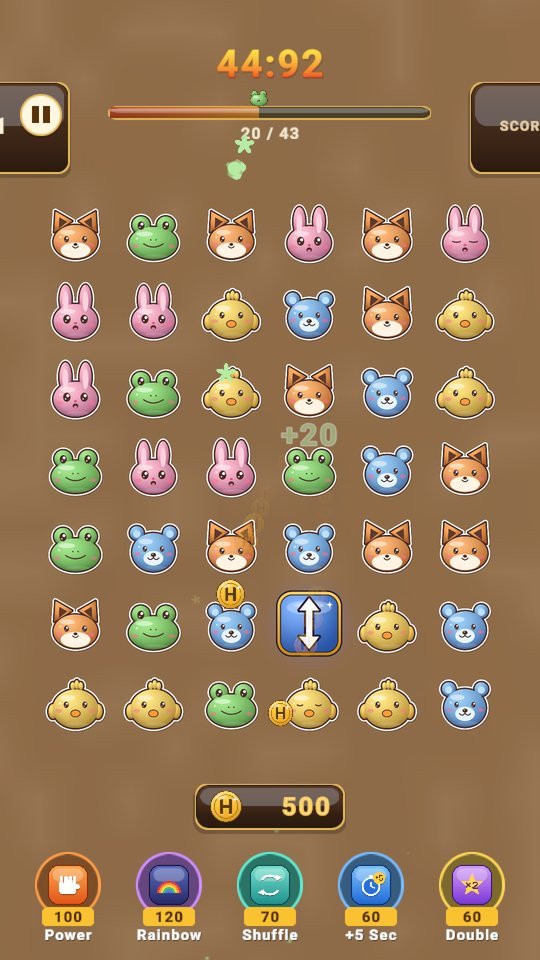 A board in play — a +20 popup floats over the blocks, the clock reads 44:92
The small green +seconds text beside the clock in chain scenes is the time refund. Points and time coming back together is what defines chains in this game, and I will combine them in a table later.
The finishing bonus table: 22, 62 and 122
The finishing bonus is the chain depth squared times 2.5. A 3-chain is 9 × 2.5 = 22.5, a 5-chain is 25 × 2.5 = 62.5 and a 7-chain is 49 × 2.5 = 122.5, which round to 22, 62 and 122. Values that land exactly on .5 round toward the even number, which is why you get 22, 62 and 122. The table below uses the same formula.
| Chain depth | Finishing bonus | Chain multiplier | Word on screen |
|---|---|---|---|
| 2 | 10 | ×1.5 | Nice! |
| 3 | 22 | ×2.0 | Nice! |
| 4 | 40 | ×2.5 | Great! |
| 5 | 62 | ×3.0 | Awesome! |
| 6 | 90 | ×3.5 | Awesome! |
| 7 | 122 | ×4.0 | Amazing! |
| 8 | 160 | ×4.0 | Amazing! |
| 9 or more | 202 + | ×4.0 | Legendary! |
The praise word first changes at a 4-chain, and the banner only shows at chain 2 or higher. Score units are now one tenth of what they used to be, so read these numbers against level 1’s goal of 43 points.
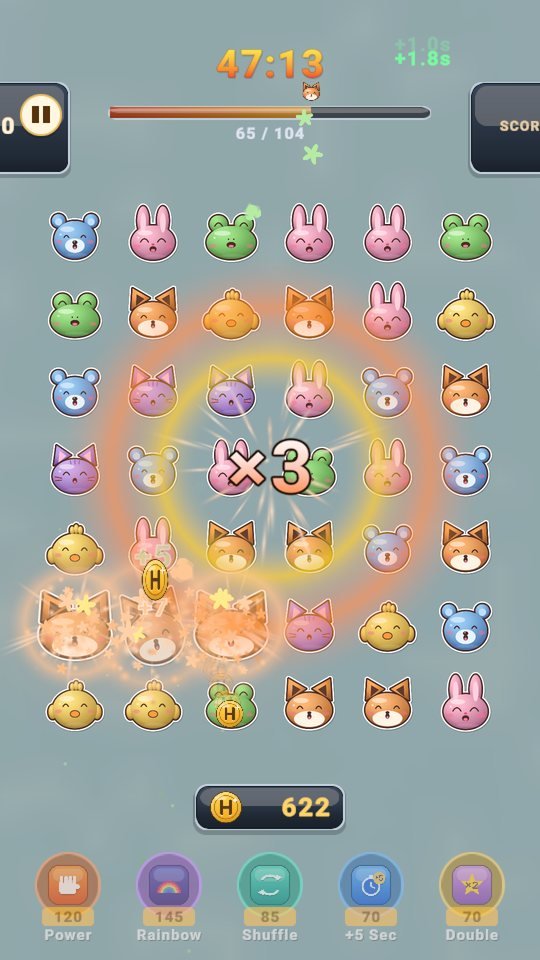
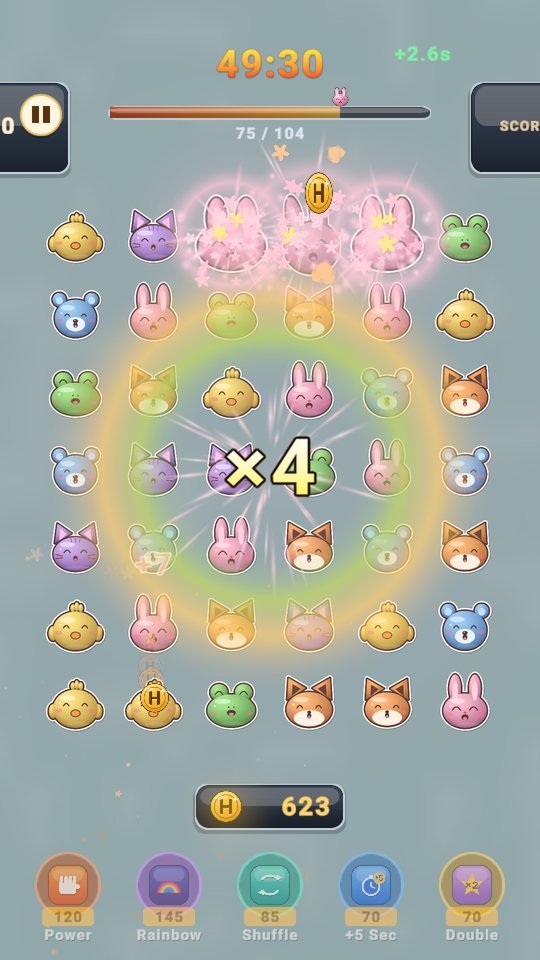
How many 3-matches is a chain worth? A worked example
Assume only three blocks pop at every step (real boards vary). I keep the combo multiplier at 1.0, round each step’s score, add them up, then add the finishing bonus. One 3-match is 3 points, so dividing the total by 3 gives the value in 3-matches.
| Chain depth | Sum of step scores | Finishing bonus | Total | In 3-matches | Total clock refund |
|---|---|---|---|---|---|
| 1 (plain 3-match) | 3 | 0 | 3 | 1 | 0 s |
| 2 | 7 | 10 | 17 | about 6 | 1.0 s |
| 3 | 13 | 22 | 35 | about 12 | 2.8 s |
| 4 | 21 | 40 | 61 | about 20 | 5.4 s |
| 5 | 30 | 62 | 92 | about 31 | 8.9 s |
| 6 | 40 | 90 | 130 | about 43 | 12.4 s |
| 7 | 52 | 122 | 174 | about 58 | 15.9 s |
The total clock refund is the time returned at each step added up in order (+1.0 s at chain 2, +1.8 s at chain 3, +2.6 s at chain 4, and +3.5 s for chain 5 and beyond). If special blocks fire in the same chain, each adds +0.8 s. The clock is capped at 99 seconds.
Using these numbers on the board
One chain can fill the goal by itself
Level 1’s goal is 43 points. The 5-chain total in the table is 92, so on the first board a single 5-chain can clear the goal with room to spare. Even at level 10’s goal of 104 or level 30’s 182, one or two 6- or 7-chains reach it. The goal stops climbing near 250, so what gets harder is not the number but the colour count (5, then 6, then 7 colours) and the clock.
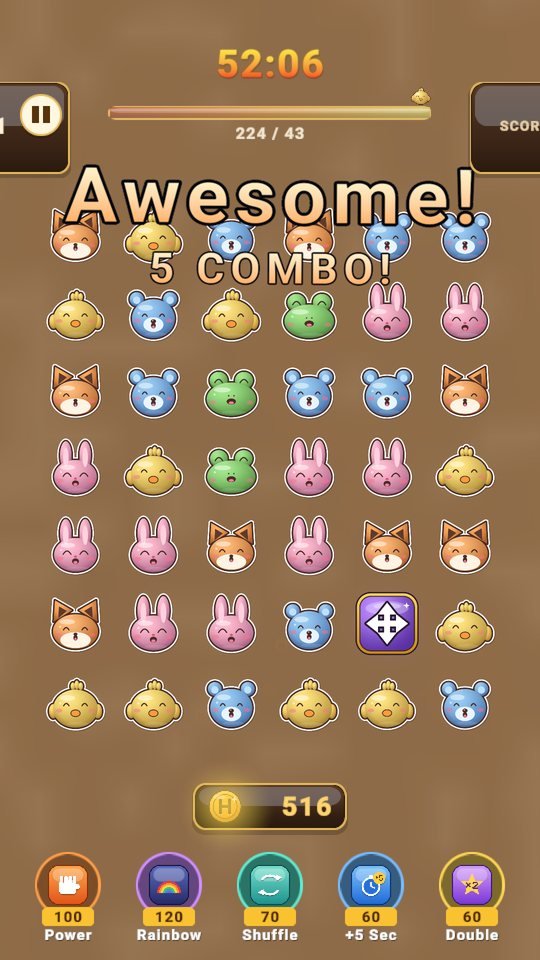 A 5-chain in progress — the Awesome! 5 COMBO! banner is up and the clock reads 52:06
This is a mid-shoot scene and does not represent typical play. The point to take from it is that the round ends the instant the score reaches the goal.
When time runs short, a chain is a clock
When 8 seconds or less remain, the clock pulses orange and the warning beeps get faster. Hurrying through any match will not bring time back, because refunds start at chain 2. In the danger zone, aiming for one 3-chain (2.8 s total) or 4-chain (5.4 s total) is the way back to safety.
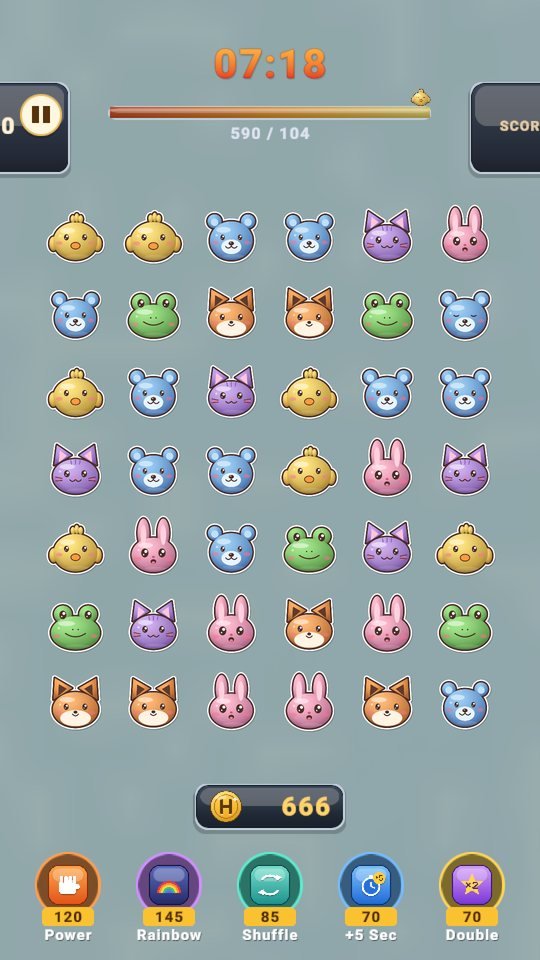 Under 8 seconds — the clock reads 07:18 and has turned orange
Clock blocks and the +seconds of special blocks
From level 15, matching 4 has a one in four chance of making a green clock block instead of a line block. It leaves the board alone and just adds 2 seconds. The scene below is the moment special blocks fire and small green text rises beside the clock.
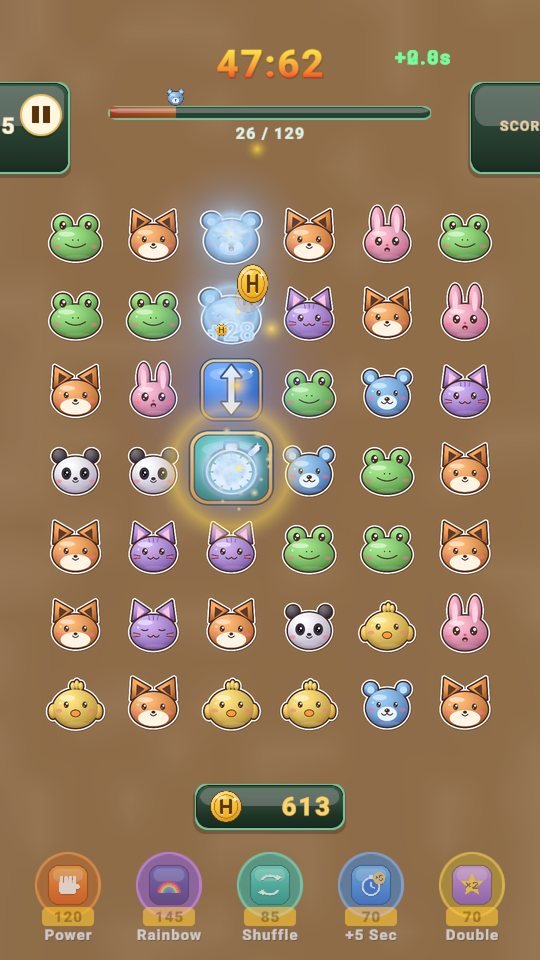 Special blocks fire together — clock 47:62, small green +0.8s text beside it
In motion
The clear score includes the time you have left
When you fill the goal and clear the round, the board stops, the SUCCESS text and golden rays show for about two seconds, and the game moves to the next round on its own. The clear score adds 4 points per second left (remaining seconds are rounded). Finishing with 20 seconds left gives 80 points. So a chain that returns time does not only fill the goal faster, it also raises the score after you finish. The excess over the goal also earns a 35% bonus, but because the round ends the moment you reach the goal, only the last chain’s share counts and it is small.
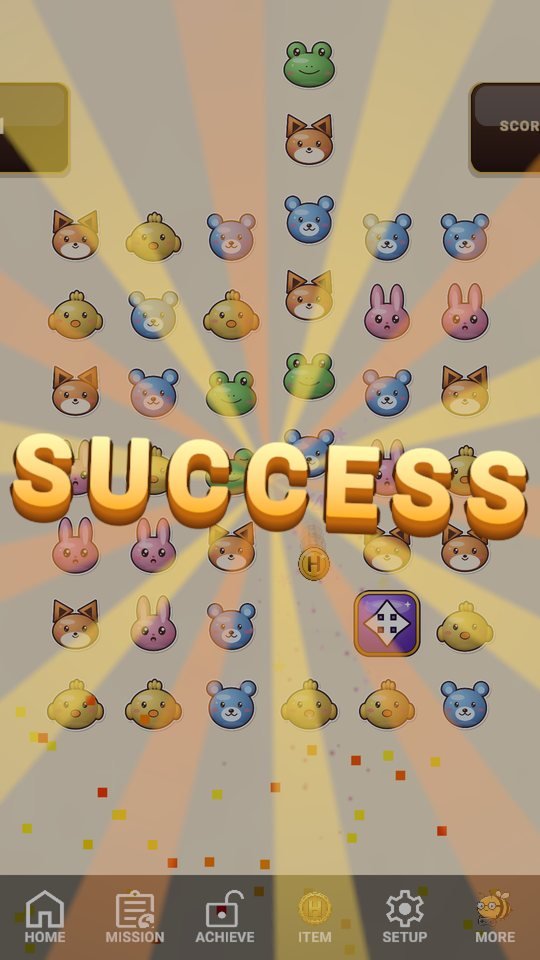 After the goal is filled — SUCCESS over golden rays, with no result window before the next round
- Past a 3-chain the finishing bonus is 22 or more. A 5-chain is 62, a 7-chain is 122.
- Points grow twice with depth: through the multiplier and through the bonus at the end.
- Time returns from chain 2, and from chain 5 up it is 3.5 s per step.
- In the danger zone (8 s or less), reading for one chain beats mashing quick matches.
How far the combo multiplier climbs — it builds within a round
The combo multiplier feels odd the first time you read it, because every score rises in proportion to “the deepest chain you have already made this round”. A round starts at 1.0, and once you have made a 3-chain every step score is multiplied by ×1.12. The source adds best combo times 0.04, so the value accumulates within the round.
| Best chain this round | Combo multiplier | Meaning |
|---|---|---|
| 0 to 1 | ×1.00 to ×1.04 | A round with no chain yet |
| 3 | ×1.12 | After making a 3-chain once |
| 5 | ×1.20 | After making a 5-chain once |
| 7 | ×1.28 | After making a 7-chain once |
| 10 | ×1.40 | After making a 10-chain once |
| 25 or more | ×2.00 | Cap |
So your first big chain enlarges not just “that chain” but every burst after it, a little at a time. The bar calculation above sets the combo multiplier to 1.0, so real rounds come out a bit higher.
How the game helps when chains will not come
Making chains can sound hard, so here are the two helps the game gives. One is the hint: after 2.5 seconds without a touch, two swappable cells flash. The other is the refill assist: if the last 5 moves had no chain at all, each new block falling in has a 34% chance of stacking the same colour as the two cells directly below it, building a shape that chains easily. As soon as a chain pops, the assist switches off. People who chain often will hardly notice it, and it only works for people stuck without chains.
An eye for chains: three habits
- Look at the bottom first — blocks have to pop low so the shape above drops as a whole and forms new lines. If you only clear the top rows, nothing falls and your chance of a chain shrinks.
- Gather special blocks — when a special block fires and another is in the blast range, it fires too. Each activation is 8 points, each creation 12 points, and the clock gets +0.8 s each time.
- Make bigger matches — matching 4 adds 3 points, matching 5 adds 8, and an L or T shape adds 6. Coins also scale: 1 for 3 blocks, 2 for 4 and 3 for 5 or more. Even the same 3-match is worth more when you make it bigger.
Stacking with the Double item
The Double score item adds ×2 to the score multiplication for 15 seconds. Switch it on for the 4-chain in the table (step score sum 21) and the step scores become 42. I could not confirm whether the 40-point finishing bonus also gets ×2: if it does the total is about 122, and if not it is 82 (worked example). Either way, using it right before a chain pays the most. While it is active a yellow ×2 floats over the board, so you can see its state.
Frequently asked
10 points. The finishing bonus starts at chain 2 and never applies to a 1-chain (a plain 3-match).
It goes Great! at a 4-chain, Awesome! at 5 to 6, Amazing! at 7 to 8 and Legendary! from 9.
No. The moment the score reaches the goal the round ends and SUCCESS appears.
Splitting a 45-second round around chains
Finally, let me lay these numbers over one round. The table below is not a confirmed answer, just one scenario that follows from the rules. Say the clock is 45 seconds and level 10’s goal is 104 points.
| Stretch | What to do | Why the rules point there |
|---|---|---|
| First 10 seconds | Match along the bottom rows and make one big chain | The first big chain raises the combo multiplier and enlarges every later score |
| Middle 25 seconds | Make special blocks and fire them together | +0.8 s and +8 points per activation, +12 points per creation |
| Last 8 seconds or less | Read for a 3-chain or deeper instead of a quick 3-match | A 1-chain returns no time; only 3-chains and deeper refund meaningfully |
| Just before the goal | Check whether one chain covers the remaining points | The round ends the moment you reach the goal, so the last one matters |
That does not mean following this table always wins. Chains are something the board hands you, and some boards cannot be read. Still, asking each time “is this match a 1-chain, or the start of a chain?” changes the same 45 seconds. When Nice! N COMBO! shows on the board, a chain has already started, and from then on the green numbers beside the clock stack up.
How these numbers change as levels rise
The chain numbers in this guide do not depend on level. The chain multiplier, finishing bonus and clock refunds all stay the same. What changes with level is the goal score (starting at 43 on level 1 and converging near 250), the number of block colours (5, then 6, then 7) and the arrival of clock blocks (from level 15). One chain is worth the same, but the score you need and how hard chains are to make both change, so late on the weight of a single chain stays the same or grows.
| Level | Goal score | Share filled by one 5-chain (worked example, 92 points) |
|---|---|---|
| 1 | 43 | Exceeds the goal |
| 10 | 104 | About 88% |
| 30 | 182 | About 51% |
| 100 | 245 | About 38% |
The goal climbs 43 → 104 → 182 → 245 between level 1 and level 100. Even late, two chains of 6 or deeper reach it by calculation, so an eye for chains is worth more the higher you go.
How the numbers change when special blocks join a chain
The tables above assume plain 3-matches at every step, so adding special blocks makes them bigger. When a special block fires, each block its effect removes adds 1 point, the activation itself adds 8 and each block you created adds 12. These points go into that step’s sum, so the chain multiplier and combo multiplier apply to them too. Even a 3-chain gets a bigger step sum when special blocks are mixed in.
| Special block | Shape that makes it | When it fires | Score · time |
|---|---|---|---|
| Row line | 4 in a row horizontally | Clears that horizontal row | create +12 · fire +8 · +0.8 s |
| Column line | 4 in a row vertically | Clears that vertical column | create +12 · fire +8 · +0.8 s |
| Rainbow orb | 5 in a straight line | Clears every block of the colour it is swapped with | create +12 · fire +8 · +0.8 s |
| Cross | L or T of 5 | Clears a row and a column at once | create +12 · fire +8 · +0.8 s |
| Bomb | L or T of 6 | Blasts the surrounding 3×3 | create +12 · fire +8 · +0.8 s |
| Big bomb | 6 or more in a line, or L or T of 7 or more | Blasts the surrounding 5×5 | create +12 · fire +8 · +0.8 s |
A special block fires when swapped with any neighbour even without a line, so you can make one and keep it until the middle of a chain. When another special block is inside the blast range it fires too, so setting off several you have gathered at once pays +8 points and +0.8 s several times. These values are added separately from the chain’s clock refund.
The clock block is also an option
From level 15, matching 4 has a one in four chance of making a green clock block instead of a line block. It leaves the board alone and gives only 2 seconds. If you happen to make one in the danger zone, firing it straight away to bank 2 seconds is the better move. A source comment estimates about one per round on average.
Ten 3-matches versus one chain, measured in time
Let me compare by time and not only points. If one 3-match takes about 1.5 seconds, ten take 15 seconds, and in that time you earn 30 points. A single 5-chain takes a few seconds until its animation ends, but it returns 8.9 seconds of clock and gives 92 points (worked example). That is nearly three times the points, and the time comes back. Pausing to read a chain can feel like wasted time, but by the rules the pause pays.
Of course, as the hint appearing at 2.5 seconds shows, pausing too long drains the clock. Take one look and push if a chain candidate shows; if none does, going for the biggest matches (4 or 5 blocks) is the safe choice.
The numbers in this guide on one sheet
| Item | Value | When it applies |
|---|---|---|
| One block | 1 point | Every time it pops |
| Bonus for 4 · 5 · L/T shape | +3 · +8 · +6 | When you make that shape |
| Special block fire · creation | +8 · +12 | When it fires · when you make it |
| Chain multiplier | ×1.0 to ×4.0 | Every step |
| Combo multiplier | ×1.0 to ×2.0 | In proportion to this round’s best chain |
| Finishing bonus | chain² × 2.5 | Chain 2 or deeper, when the chain ends |
| Clock refund | +1.0 · +1.8 · +2.6 · +3.5 s | Steps of chain 2 · 3 · 4 · 5 or deeper |
| Time left at clear | 4 points per second | When the round ends |
You do not need to memorise this table. One line is enough: the deeper the chain, the points multiply, time comes back at every step, and a bonus follows at the end.
Every number comes from the source, and score units are the current ones, one tenth of the old scale. If this differs from older posts or from big numbers you remember (a chain bonus of several hundred points, say), the unit changed, so do not let it confuse you.
Assuming three blocks at every step is a simplification for easy arithmetic, so real scores differ. The combo multiplier and special block points are not in the tables. I could not confirm the condition under which the exclamation mark appears on the chain banner text.
It is not the hand that taps fast,
but the eye that reads once more, that brings the clock back.

Play BurstMaster now
Playing it is much faster than reading about it.
Find the other Master Series games all in one place at hanilab.app.

More from this game
 BurstMaster Items: Three Paths When You Tap a Slot (Owned · Coins · Ad)
 BurstMaster Live Broadcast: 45 Seconds and the Chain That Gives Time Back
 BurstMaster Themes — 52 Cafe Backgrounds Change Every Three Levels, and the Weather Is Off
 BurstMaster special blocks — four makes a line, five a rainbow, L and T a cross and a bomb
🌌 Universe stories
 Roddy Universe, Part 2 — Fallen Down, Only One Step Back at the Roadside
 Roddy Universe, Part 1 — One Beat Before Crossing, the Empty Road Between the Cars
 Bombi Universe, Part 2 — Behind You: The Reaper That Walks Through Walls
Try other games
 TapMaster
 BlockMaster
 SnakeMaster