

TenMaster Crisis — Dark Edges at 36 Cells, Special Cubes at 40: How to Read a Closing Board

Eight empty cells,
and nowhere to put anything
There are still eight empty cells on the board, yet two of the pieces in the tray have gone dim. Every one of those cells is a single-cell hole, and there is not one spot with two cells side by side. This is how a TenMaster crisis arrives — not because you ran out of cells, but because you ran out of the right shape of cells.

This TenMaster crisis story is about the moment the board closes in: the thresholds where the game changes as the board fills, the fact that a level can start you right next to one of them, how to read a board full of holes, how a single brick can block a 3×3 spot, and the order in which to use Time Freeze, Hint and Refresh — all from the game’s code and real gameplay screens.
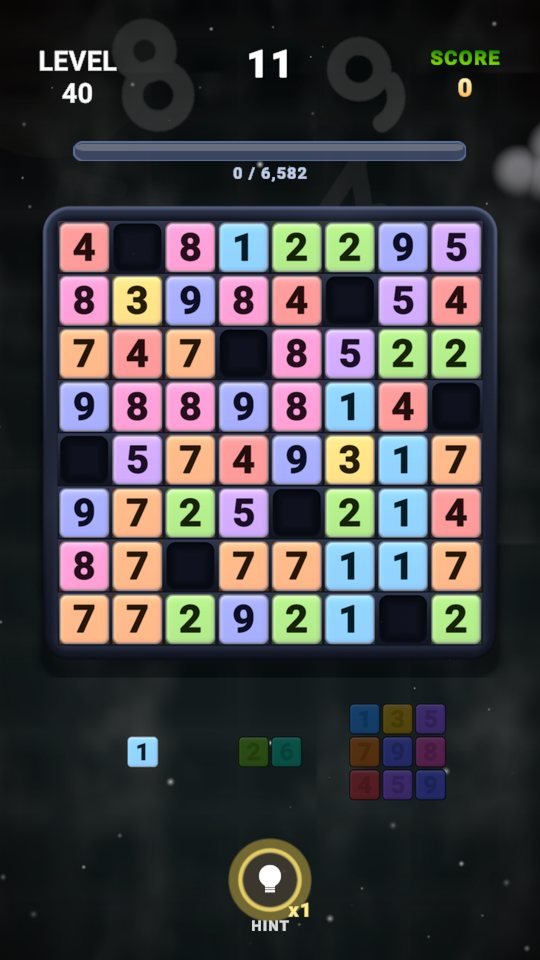 8 empty cells, all single holes — only the one-cell piece is bright, the two-cell and 3×3 pieces are dim (the holes were set up for this shot)
The thresholds — how many of the 64 cells
An 8×8 board has 64 cells. The code keeps measuring how full the board is (bricks included) and changes the game at a few points. Converted to cell counts:
| Filled | Ratio | What happens |
|---|---|---|
| 29 + | over 45% | The chance that a new piece contains a special cube starts to climb from 8% |
| 36 + | over 55% | The edges of the screen begin to darken and thicken |
| 40 + | over 62% | If special-cube budget is left, each new piece has a 55% chance of bringing one early |
| 55 + | over 85% | The base special-cube chance has climbed to its 28% maximum |
| 58 + | over 90% | The edges are at their darkest (they do not get any darker) |
The two signals are different in nature. The edge is a status display — in the code’s own words, slow and not blinking, because showing a blink and a state the same way makes both unreadable — while the red squeeze three seconds before a brick falls is a momentary warning. The edge darkens, and only at the very end does a little red come back into it.
Bomb, row-clear, column-clear and magnet cubes show up only a few times per game — none before level 8, 2 for levels 8–29, 1 from level 30 on. The code lets that budget be spent earlier the fuller the board gets. The design reason, from the code: when things are comfortable, the fun of pure decision-making is left alone; when you are cornered, an exit opens. So the deeper the crisis, the more likely a one-cell special cube slips into your tray — but only while budget remains.
You start close to a threshold

Whenever a board is freshly laid out (new game, continue, retry), numbers are pre-filled according to the level. From level 10 that is 26 cells (41%); from level 130 it is 34 cells (53%). The screen on the left is a board freshly started at level 130.
Hold it against the thresholds and the level 130 opening is just two cells short of 36, where the edges begin to darken. Place a first piece (two or more cells) that makes no match and you are already over the line.
(The table of how many cells are laid out is in the earlier story, TenMaster Numbers.)
Then bricks pile on, one cell at a time. One brick is 1.6% of 64 cells — it looks small, but it is never cleared and only comes off when you finish the level, so the longer you linger on a level, the only direction things move is over the thresholds. Bricks themselves were covered in the earlier brick story; here, just remember that “a brick counts as a filled cell”. The code does not subtract bricks when it measures the ratio.
Holes — empty cells and places to put things are different
Back to the screen from the opening. Eight empty cells, 56 filled — 87.5%, so the edges are already nearly at their darkest. The tray on this board:
- One-cell piece — bright. It fits any hole.
- Two-cell piece — dim. There are no two empty cells side by side anywhere on the board.
- 3×3 piece — dim. Needless to say.
The way the code checks “can it be placed” is simple. Every cell of the piece must land on an empty cell, and it tries every position on the board. The number of empty cells does not matter at all. Place the one-cell piece here and both remaining pieces will most likely still be dim, which leaves the sequence below.
The moment only one piece can still be placed, LAST MOVE appears in the middle of the screen.
If none can be placed, the tray is cleared once per level and you get three new pieces (NEW PIECES).
If still nothing fits, NO MOVES — game over. A continue is still available.
The trick to not building a board full of holes is one thing. Do not use one-cell pieces to chew into a big open area — fill the holes that are already isolated first. Empty cells have to touch for a two-cell piece to fit. When holes scatter, the kinds of pieces you can use shrink sharply even if the total number of empty cells is the same.
Bricks go for the 3×3 spot

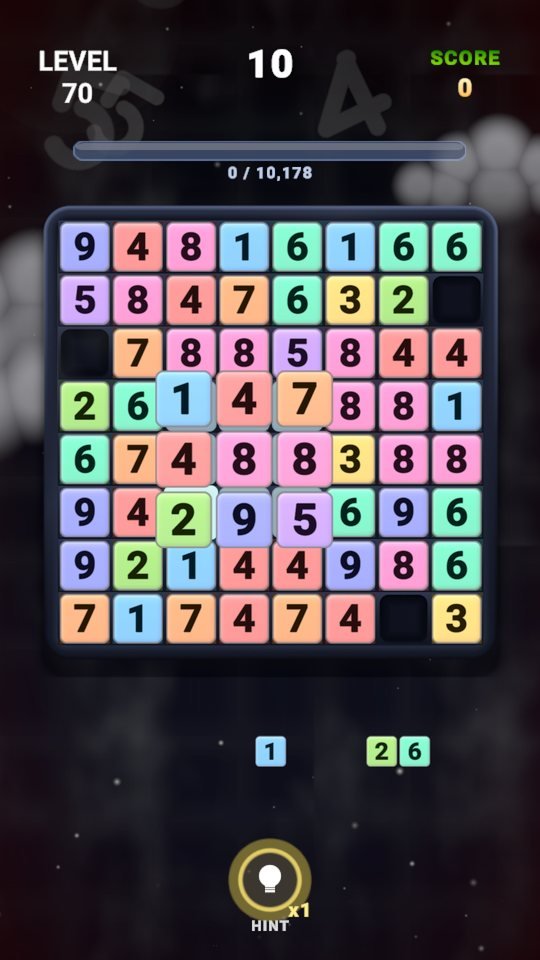

On the left is a level 70 board with one empty square left over for a 3×3 (the open area and the brick were set up for the shot). In the middle, the piece is lifted over that spot; on the right is the same board with a brick sitting in the centre cell. The rest of the gap is still empty, but the 3×3 now fits nowhere on the board. The earlier story said “from level 70, keep a spot for the 3×3” — and the point of this chapter is that bricks go for that spot first.
Bricks pick their cell by a score
The formula for choosing a brick cell is right there in the code. Every empty cell gets a score, and the brick goes into the highest one.
- Centre score × 1.0 — the four middle cells are 0.86, and it drops by 0.14 for each step away from the centre, down to 0 in the corners.
- Isolation score × 0.6 — starts at 1.0 and loses 0.22 for every brick among the eight surrounding cells. Cells away from existing bricks are better.
- Luck × 0 to 0.55 — a little random is added each time.
So when the middle of the board is empty, the brick almost always goes there. The code’s own explanation is accurate — “an edge brick sits on a cell you rarely use anyway so it doesn’t hurt, while a centre brick splits the board in two.”

When you leave an empty square for the 3×3, put it toward a corner, not the middle of the board, and it becomes a bad spot under the brick’s score formula. Even the cell closest to the centre inside a corner 3×3 scores only 0.57 — a long way from the dead centre’s 0.86. (This is a tendency from the formula. If the centre is already blocked, or luck is strongly on its side, a brick can still land in a corner.)
Time Freeze — the number goes from 11 to 25


The shop’s Time Freeze (70 coins) says it adds 15 seconds to the time left before the next brick drops. As of this writing the code does exactly what it says: it adds 15 seconds and only stops the total from passing 99 seconds. On the screens above, 11 jumped straight to 25 (about a second passes in between, so roughly 15 seconds were added). You can also see the count of items in the bag going from 2 to 1. (In an earlier version the value was clipped to this interval, which in effect just reset the clock.)
- If you use it while the brick warning (last 3 seconds) is showing, the warning is lifted the moment the time passes 3 seconds. A “falling soon” sign next to a longer timer would be a lie.
- One brick is one cell — on a board that is already one cell short, 15 seconds buys you the skip of one brick. That is longer than the 12-second interval at level 1.
- This game has no time limit, so the item does not buy you time to think — it postpones one brick.
Which tool, when — the order of a crisis

Hint — one free move
You get one free per level. Press it and one tray piece and the place to put it light up. By the code, the “best spot” is the one that creates the most matches (sum of 10), and on a tie, the one toward the edge.
On the left is Hint pressed on a board where only the top two rows are open. You can also see that the three-cell vertical piece on the right is dim — with only two rows open there is no column for three in a row. The hint count has become x0, and the icon beside it is the Time Freeze in your bag (2 of them).
| Situation | Reach for | Price |
|---|---|---|
| Past 36 cells and the edges are darkening | Clear cells with moves that make matches (not an item) | – |
| You cannot see your move this turn | Hint | 1 free |
| A brick warning is up and one cell is precious | Time Freeze | 70 |
| Last move — all three pieces are awkward | Refresh | 90 |
| The middle is clogged and the big piece will not fit | Bomb (clears a 3×3) | 150 |
| A line is full of numbers but nothing pairs up | Row Clear / Column Clear | 120 |
| NO MOVES — game over | Continue (an ad, or 300 H coins) | 300 |
Bomb, line clears and Magnet skip bricks. A board blocked by bricks cannot be freed except by the continue bomb. If you had to pick just one tool, at high levels where bricks fall faster Refresh earns its price. It swaps all three pieces at once, so the mismatch between the shape of the empty cells and the shape of the pieces is solved in one go.
Reading a crisis in five lines
- The thresholds are 29 · 36 · 40 · 58 cells. Special cubes rise, the edges darken, the budget is spent early, and the edges reach their darkest.
- A restarted board is also near a threshold. 26 cells from level 10, 34 from level 130 — be careful from the very first piece.
- It is the shape of the empty cells, not their number. When holes scatter, two-cell and 3×3 pieces go dim first.
- Keep the 3×3 spot away from the centre. Bricks chase the centre and isolated cells by score.
- Time Freeze = postpone one brick. 15 seconds (99 at most); if a warning is up, the warning is lifted too.
When the edges darken, the player who does not hurry wins. This game has no clock, after all.
Not empty cells — the shape of empty cells.
The move that keeps holes from scattering.

Play TenMaster now
Playing it is much faster than reading about it.
Find the other Master Series games all in one place at hanilab.app.
More from this game
 TenMaster Number Waiting Room: A 4-Act Script of Blocks That Must Sum to 10
 TenMaster TEN: From 3 + 7 to the 1 + 1 + 2 + 2 + 4 PERFECT TEN, How to Read a Sum-of-10 Run
 TenMaster Numbers — The 18-Card Bag, the Share of 5s, the Wild ★ Odds and the Starting Board
 TenMaster Levels — Carry-Over Boards, Rising Targets and 24 Night Skies That Change Every 4 Levels
🌌 Universe stories
 Roddy Universe, Part 2 — Fallen Down, Only One Step Back at the Roadside
 Roddy Universe, Part 1 — One Beat Before Crossing, the Empty Road Between the Cars
 Bombi Universe, Part 2 — Behind You: The Reaper That Walks Through Walls
Try other games
 FanMaster
 BurstMaster
 WingMaster