

(On the desk. The kid takes a deep breath. The FlipMaster ddakji already has something to say.)
Ddakji Hold on. Let me make my excuses before you blow. When a FlipMaster ddakji won’t flip, it isn’t stubbornness. There is no “flip animation” anywhere in this game. Flipping is just the result of your breath meeting my body.
Puu I’ll hear your excuses after the round. Phoo~!
This story explains why a ddakji flips and why it doesn’t, as a script of excuses from the ddakji that wouldn’t turn over. The lines are made up, but the names, numbers and on-screen text in each “Source note” all come from the game source.
Act 1 The Edge
(The kid sweeps a finger upward in front of the ddakji. Its front edge lifts a little.)
Ddakji See? It lifted! If you’d pushed the middle, I’d only have slid. The wind has to get under my edge so one side rises while the opposite edge presses the desk and becomes the hinge. That’s how “lift” turns into “flip”.
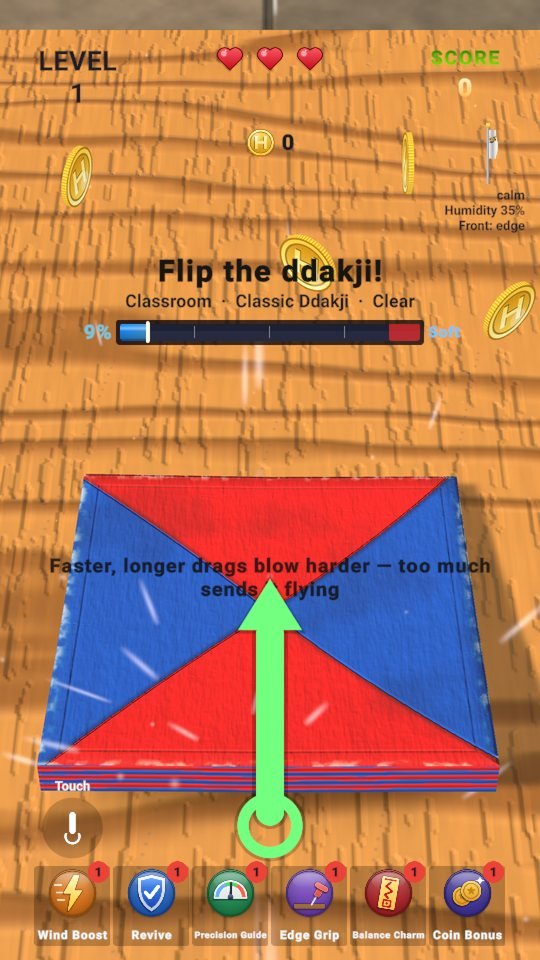 Dragging up from the start ring: the strength bar fills.
- One force at the exact center would only slide the ddakji and never flip it. So the game works out the force separately at dozens of points on the surface and adds them up.
- When only one side catches the wind, a turning force appears by itself. There is no flip animation anywhere.
- If the edge lies flat on the desk with zero curl, the wind has no gap to get into, so no amount of blowing helps; it only slides. According to the source, a new ddakji is almost flat, while a well-used one has corners lifted 1–3 mm (the default Classic Ddakji has 1.6 mm).
- Once flipped, the ddakji’s curl becomes an upside-down bowl with no gap. That’s why it rarely comes back, and why “just get it over” wins.
Act 2 The Corner
(The kid blows at a pointy corner. The ddakji doesn’t budge. Text appears at the bottom of the screen.)
Puu Why won’t it flip?!
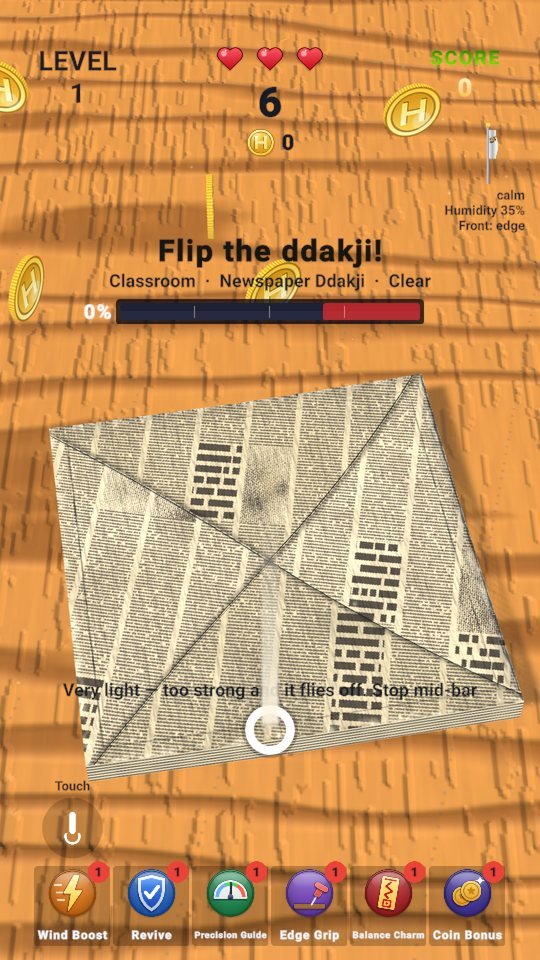
Ddakji You set me up as a diamond. With a corner in front, the wind splits. The game says so itself: “A corner faces the wind — turn the view so a flat edge leads”.
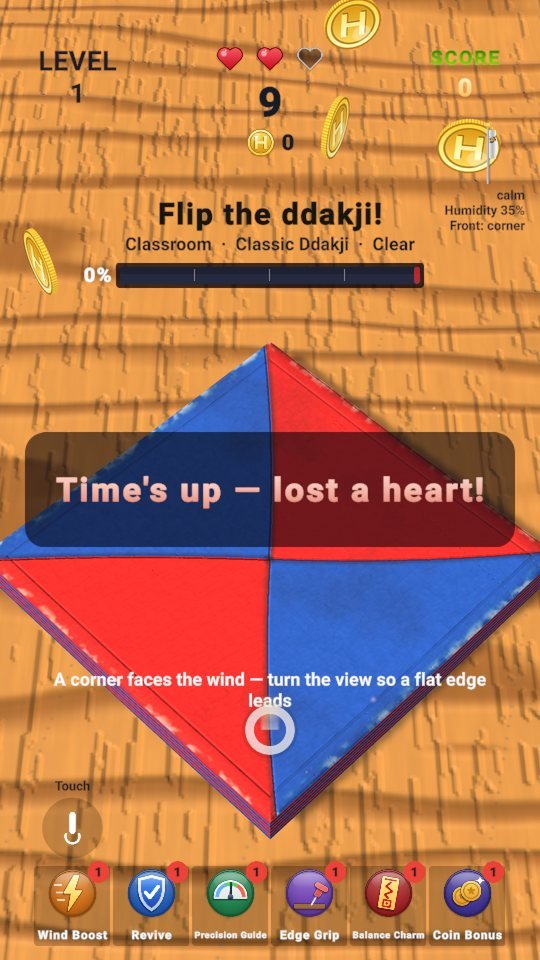 A corner in front: the hint tells you to turn the view so a flat edge leads.
- Meet the wind with an edge head-on and the incoming-angle value is 1; with a corner it is 0.7. Pressure scales with its square, so the gap grows even wider.
- The suction spot that forms on the front of the top surface when air separates at the leading edge is also strong with an edge facing the wind and weak with a corner (the angle value is multiplied in once more).
- So when it won’t flip, drag sideways and turn the view before you blow harder.
 Seen from the side: the front edge is lifted.
Act 3 Weight — The Case of the 12 Ddakji
Ddakji Now hear out my friends. Same breath, different results, and there’s a reason: our bodies are different.
| Ddakji | Size | Thickness | Weight |
|---|---|---|---|
| Classic Ddakji | 8.8 cm | 7.6 mm | 7.5 g |
| Spring Ddakji | 8.58 cm | 7.2 mm | 7.0 g |
| Newspaper Ddakji | 9.02 cm | 6.8 mm | 5.8 g |
| Calendar Ddakji | 9.46 cm | 9.2 mm | 11.8 g |
| Milk Carton Ddakji | 8.8 cm | 8.4 mm | 10.5 g |
| Golden Ddakji | 8.8 cm | 8.0 mm | 9.0 g |
| Star Disc (round) | 6.16 cm across | 2.6 mm | 3.4 g |
| Golden Disc (round) | 6.38 cm across | 2.8 mm | 4.3 g |
Calendar Ddakji I’m 11.8 g. In the same wind, I stay put. Blow harder.
Star Disc I’m 3.4 g. Even a bit too much and I’m gone. Go easy!

- 6 square: Classic, Spring, Newspaper, Calendar, Milk Carton and Golden Ddakji. 6 round: Star, Target, Lightning, Flower and Sun Disc, and the Golden Disc.
- A heavy, well-folded ddakji also has more inertia (the source’s FlipResistance value, 1.10 for the Calendar).
- High humidity adds weight and friction and reduces curl. With 0.35 humidity as the baseline, each unit of humidity changes weight by 20% and friction by 30%.
Act 4 The Objects Object
(A slice of bread sits at one side of the desk. The ddakji whisper among themselves.)
Bread Slice I’m the heaviest and the biggest. 12 cm and 25 g. You’ll need everything you’ve got.
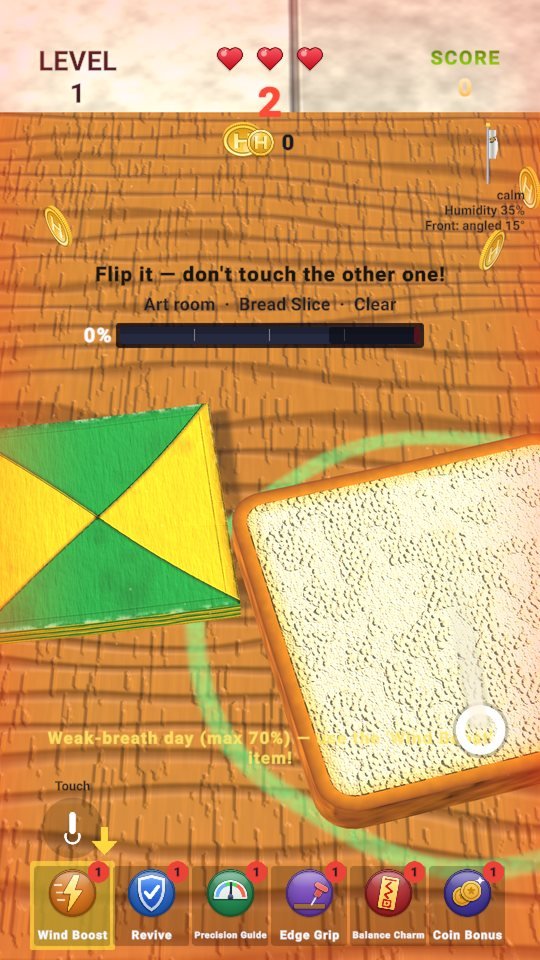 Bread Slice: the heaviest and biggest object.
Transit Card I’m slick plastic, so I slide. One strong breath, please.
Kitchen Sponge I’m squishy and I grip. Keep pushing steadily. I used to just slide too, so they laid my long side forward and gave my rim a curl like a well-used sponge.
Hwatu Card Long side forward, please! Blow at the short side and I flip over, then come right back.


 Hwatu Card: keep its long side facing the wind.
- The 10: Sticky Notes, Lunchbox Seaweed, Kitchen Sponge, Cracker, Rice Cracker, Transit Card, Hwatu Card, 5 Playing Cards, Wooden Coaster and Bread Slice.
- The test was “is there a breath strength that actually flips it?” In simulation, thin light things like a single playing card, a photo card or roasted seaweed lifted and flew away whole, so they were dropped.
- Gimbap slices, a smartphone and a keyboard weigh around twenty times more per area than a square ddakji (9.5 Pa), so a human breath wouldn’t move them, and they were left out.
- The source lists weight per area as 6.6 Pa for Lunchbox Seaweed, 11.7 Pa for the Transit Card, 17.0 Pa for the Bread Slice and so on.
Act 5 The Face Tells You
(One breath is over. The ddakji is still where it was. Puu’s face stiffens.)
Puu It didn’t flip…!
Ddakji The game tells you why. It records how far I tilted this breath, how far I traveled, whether my other side ever faced up, and how many degrees I turned.
| What’s recorded on my body | What the game says |
|---|---|
| Flipped once and turned over 300 degrees | Too strong — it spun right back over! |
| Flipped, then came back | Flipped, but landed back face-up |
| Tilted more than 12 degrees | It lifted! A little stronger |
| Pushed over 10 cm by a strong breath | Too strong — it just got shoved! |
| Moved over 2 cm | It only slid. Get air under the edge |
| Barely moved | Too weak — it didn’t budge |
Ddakji The order matters. Both are “didn’t flip”, but “ran out of strength” and “so strong it spun one time too many” are opposites. So the game adds up every angle I turned to tell them apart.
Puu So what do I do next time?
Ddakji If it was too weak, a Wind Boost. If it was too strong or I came back, a Balance Charm. If I only slid, Edge Grip or the Precision Guide. The game suggests whichever item fits the result.
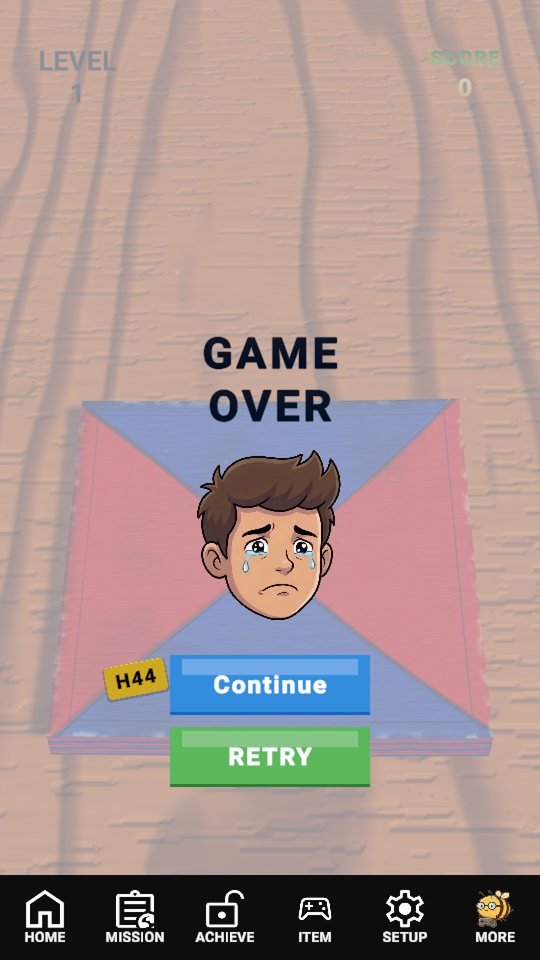 After the last heart: a crying Puu with Continue and RETRY.
- After two game overs on a stage, help mode switches on (it was cut from 3 to 2 on 2026-10-28).
- The game saves why you lost that stage (the last result) and, when you reopen it, tells you in one line, for example: “Last time the blow was too strong. Stop before the bar reaches the red end and blow a bit softer.”
- When you win, that stage’s loss count is cleared.
Final Scene Back on the Desk
(Puu turns the view and lines up a flat edge in front. One short stream of breath.)
Puu Phoo~
Ddakji …It flipped. Excuses withdrawn.
Play FlipMaster now
Playing it is much faster than reading about it.
Find the other Master Series games all in one place at hanilab.app.
More from this game
 FlipMaster Breath Class: A Four-Period Teacher and Student Script on How to Flip
 Where Do You Earn and Spend Coins? FlipMaster Coin Q&A in Five Questions
 FlipMaster First Game Diary: From the Home Screen to Level 1 Clear
 FlipMaster Blocker Countermeasures Meeting Minutes: Chalk Circle to Surrounded, 7 Agenda Items
🌌 Universe stories
 Roddy Universe, Part 2 — Fallen Down, Only One Step Back at the Roadside
 Roddy Universe, Part 1 — One Beat Before Crossing, the Empty Road Between the Cars
 Bombi Universe, Part 2 — Behind You: The Reaper That Walks Through Walls
Try other games
 FanMaster
 BurstMaster
 WingMaster