
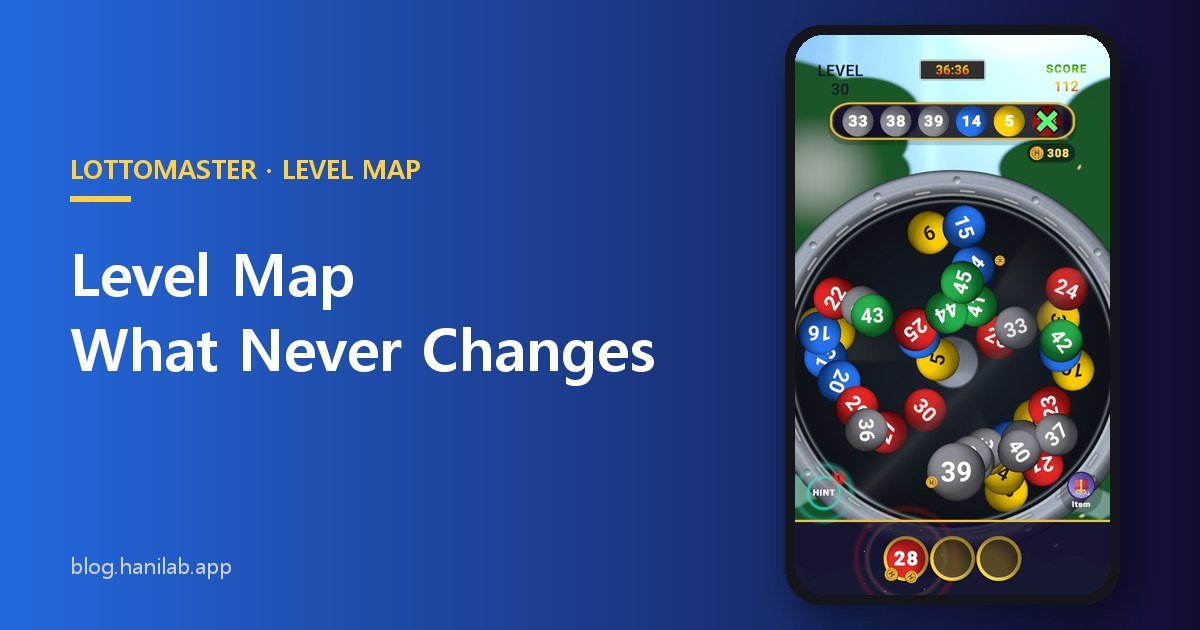
LottoMaster Level Map: Five Things That Never Change and the Obstacles Stacked by Level Range

The balls never get faster as you level up
So what gets harder?
LottoMaster has a single level number and no maps or named stages. Yet a level 1 round and a level 150 round clearly feel different. This LottoMaster guide draws the level map straight from the source numbers. First we confirm what never changes, then we follow the unlock points of the obstacles that get stacked on, one level range at a time.
This LottoMaster guide covers a puzzle game with no real money and no prizes. The country rules and numbers in this post are in-game settings and have nothing to do with real lotteries or gambling.
Five things that never change
You might expect balls to speed up or slots to multiply as levels rise. This game does the opposite. The reason in the source comments is clear: difficulty built from speed turns into luck, not skill. A very fast ball crosses its own width in 100 milliseconds, while human reaction time is 200 to 250 milliseconds. So speed stays fixed, and time and obstacles carry the difficulty.
| Element | Level effect | Value |
|---|---|---|
| Ball speed | None | 42% of the base range 1.5 to 3.5, about 0.63 to 1.47 |
| Drum rotation | None | 20 to 30 degrees per second x 2.4 display multiplier, one turn in 5 to 8 seconds. A visual effect unrelated to ball physics |
| Balls in the drum | None | 32 per round (winning numbers + decoys) |
| Slots to fill | None | All the numbers of that country, 6 to 7 slots |
| Interstitial ads | None | Every few wins, and never after a failed round |
The base ball speed is a server setting, so it can change without an update. The source comments record that it started at a base of 0.85 and was lowered several times to today’s 0.42. After ball-to-ball collisions were removed, it was tuned to an average of about 1.0 unit per second, which is 1.2 ball diameters per second.
The one thing that changes: the time limit curve
Time shrinks along a logarithmic curve. The formula is 80 − 20 × D(level), where D is (log10(level+1) ÷ 3.0004)^1.8. Seven-slot countries multiply that by 7/6. The values below are calculated from the source formula (retry bonus not included).
| Level | D | 6-slot country | 7-slot country |
|---|---|---|---|
| 1 | 0.016 | 79.7 s | 93.0 s |
| 10 | 0.149 | 77.0 s | 89.9 s |
| 22 | 0.241 | 75.2 s | 87.7 s |
| 50 | 0.363 | 72.7 s | 84.9 s |
| 100 | 0.484 | 70.3 s | 82.0 s |
| 300 | 0.709 | 65.8 s | 76.8 s |
| 1000 and up | 1.0 | 60.0 s | 70.0 s |
Even at level 100, a 6-slot country still has more than 70 seconds. The real core of difficulty is how much of that time the obstacles make you spend. From here on, we look at which level each obstacle starts at.
The map by level range
| Level | What gets added | In one line |
|---|---|---|
| 1 to 2 | Guidance | A golden glow on the correct ball and an arrow to its slot (default up to level 2, a server setting) |
| 6 | Decoy flash | One wrong ball flashes for 0.5 s. Every 4.5 to 6.2 s from level 6 to 25, every 3.2 to 4.6 s from 26 |
| 14 | Weather | Rain, snow and wind. Starts at a 30% chance |
| 22 | Clouds | A big cloud crosses the drum for 4.2 s. It does not block input |
| 30 | Mild special modes | Screen shake, fog veil, slow motion |
| 40 | Medium special modes | Speed burst, earthquake, flash, narrow vision |
| 50 | Strong special modes | Darkness, reversed drag direction |
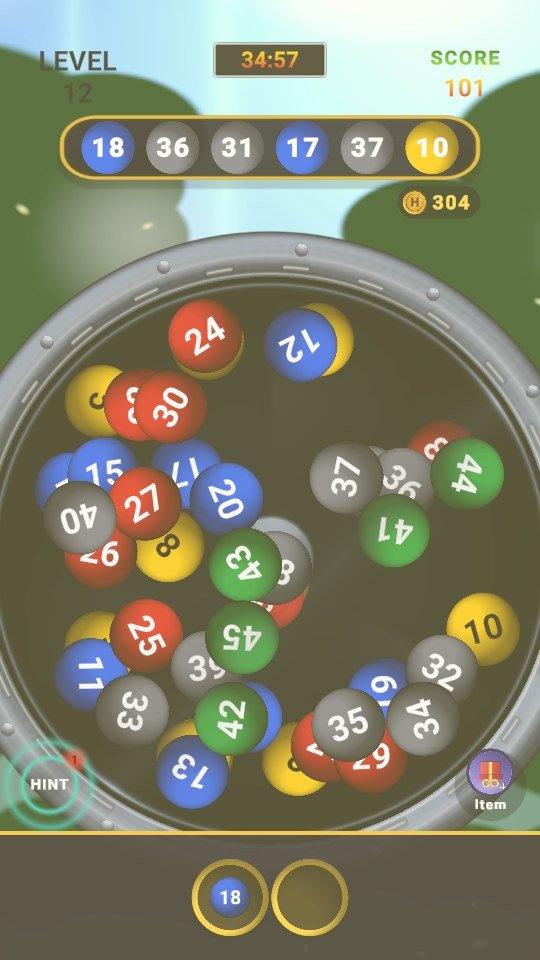
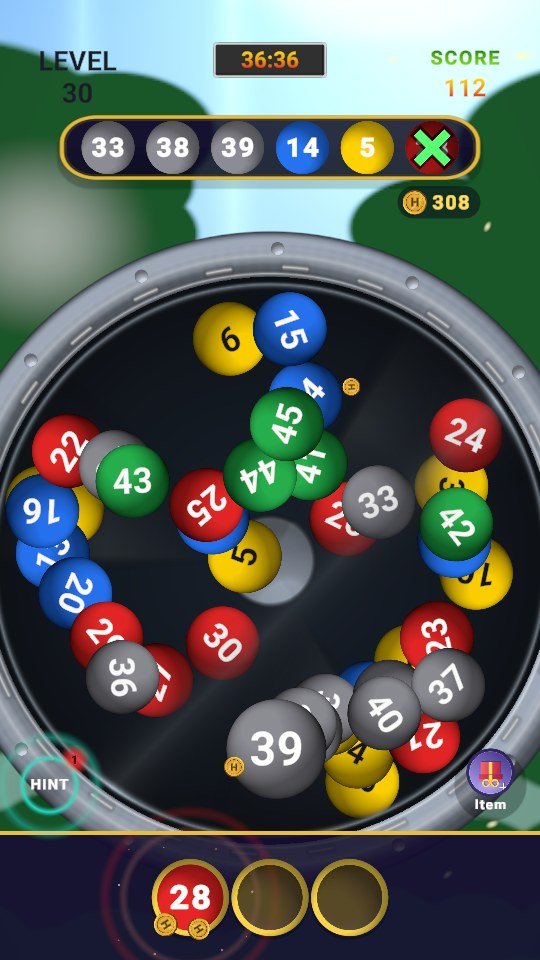
The level shown on the screens above was set by the capture rig, so it has nothing to do with real play progress. Notice that the level 12 and level 150 screens use the same drum shape, and you get a feel for what does not change.
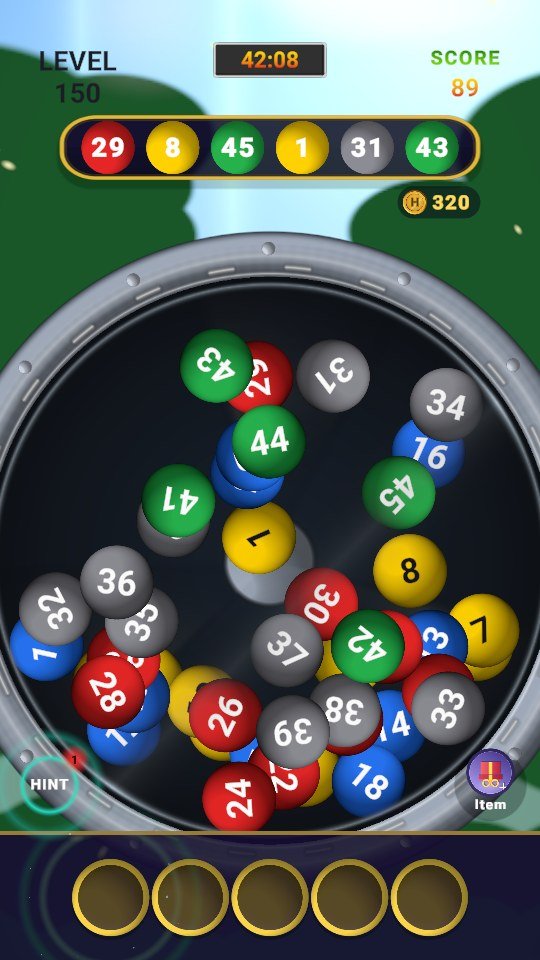 Level 150 display
Weather: from level 14, and it stops growing past 100
There is no weather in levels 1 to 13. From level 14, rain or snow starts 1 to 2 seconds into the round, and wind follows 2.5 seconds later with a direction arrow as a warning, then ramps up in 8 steps over 2 seconds to its final strength. The tier stops rising near level 100.
| Level | Chance of weather | Combination | Strength (1 to 10) |
|---|---|---|---|
| 14 to 20 | 30% | Single | 1 to 2 |
| 21 to 30 | 50% | Single | 2 to 3 |
| 31 to 45 | 65% | Single 60% / double 40% | 2 to 4 |
| 46 to 60 | 75% | Double | 3 to 6 |
| 61 to 80 | 83% | Double 50% / triple 50% | 4 to 7 |
| 81 to 100 and up | 88% | Double 30% / triple 70% | 5 to 8 |
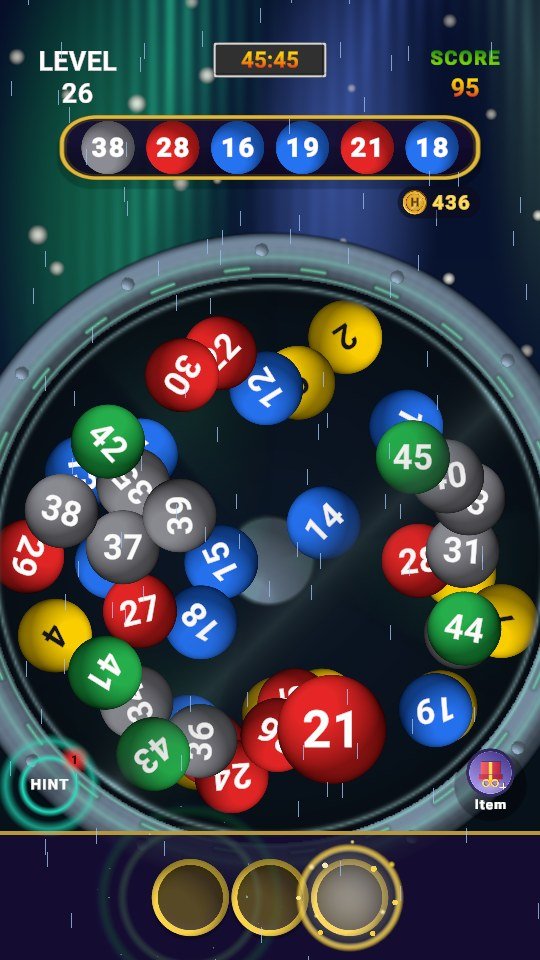 A rainy round (level 26 display)
The only weather confirmed to affect gameplay is wind. In proportion to wind strength, the balls drift in that direction inside the drum, and the held ball’s drag position is nudged a little as well. Rain and snow are visual and sound effects, and I found no code where they influence judging.
Special modes: from level 30, at most one per round
| Level | Chance of a special mode |
|---|---|
| 1 to 29 | 0% |
| 30 to 49 | 15% |
| 50 to 100 | 25% |
| 101 to 200 | 30% |
| 201 and up | 35% (+10% after 8 or more wins in a row) |
- If you lost on the same level, it eases off. After one loss the chance is halved, and after two or more losses it is 0%. You should never keep getting special modes on a level where you are stuck.
- There are 9 kinds. Level 30 unlocks screen shake, fog veil and slow motion, level 40 unlocks speed burst, earthquake, flash and narrow vision, and level 50 unlocks darkness and drag reversal.
- The screen never shows the mode’s name. One second before it starts, only a “Disruption!” pill appears at the top.
- Short modes switch on when matching starts. This keeps them from running out during the shuffle, the number reveal and the 3 · 2 · 1.
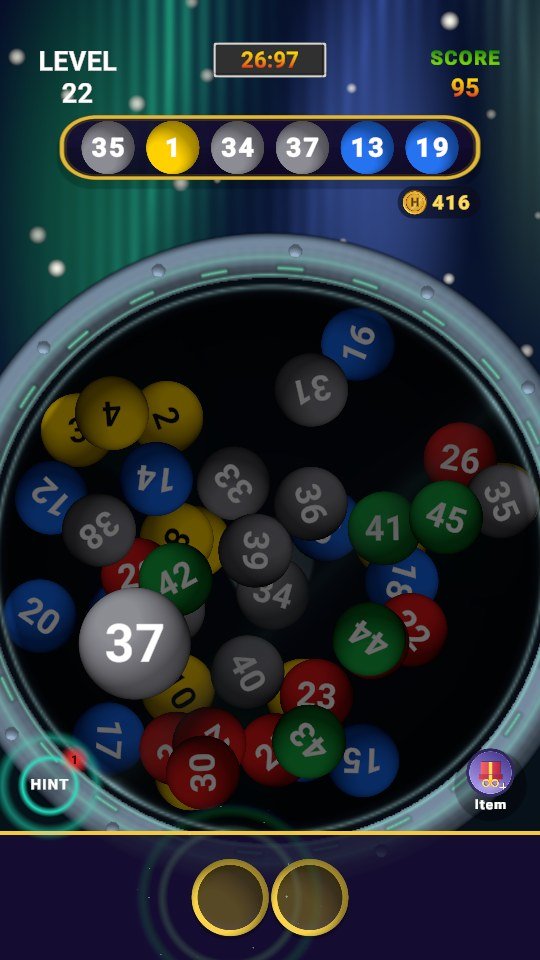 Darkness mode: a dark veil covers only the drum, so the numbers blur
In slow motion the time limit slows down too. Speed burst and earthquake last only a few seconds, so it is better to pick after they end. Against the dark types, slow the balls with Freeze or Turtle, and use the Magnifier to make the correct ball glow so you can find it.
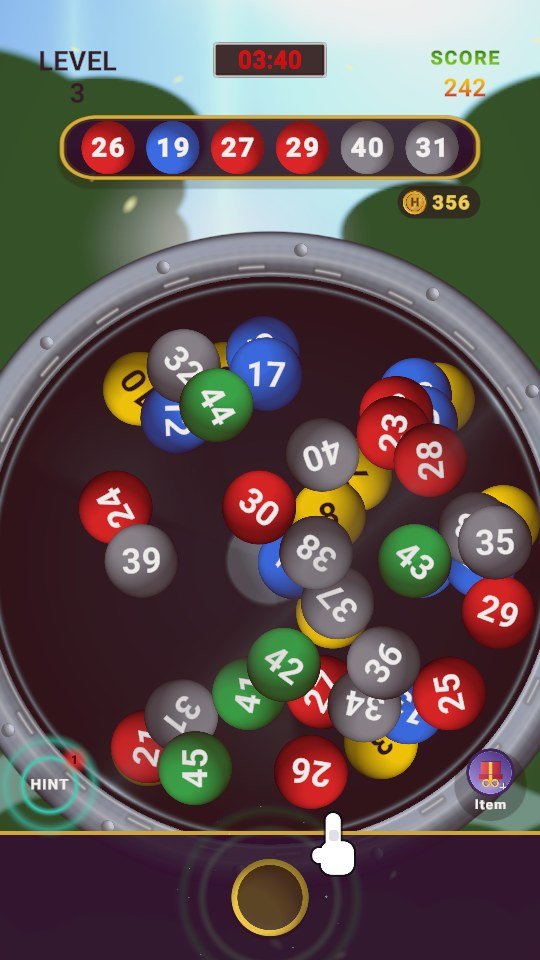 Under 4 seconds: the timer turns red and the screen edge flushes red
A bonus game every 5 levels, and a stage that changes every round
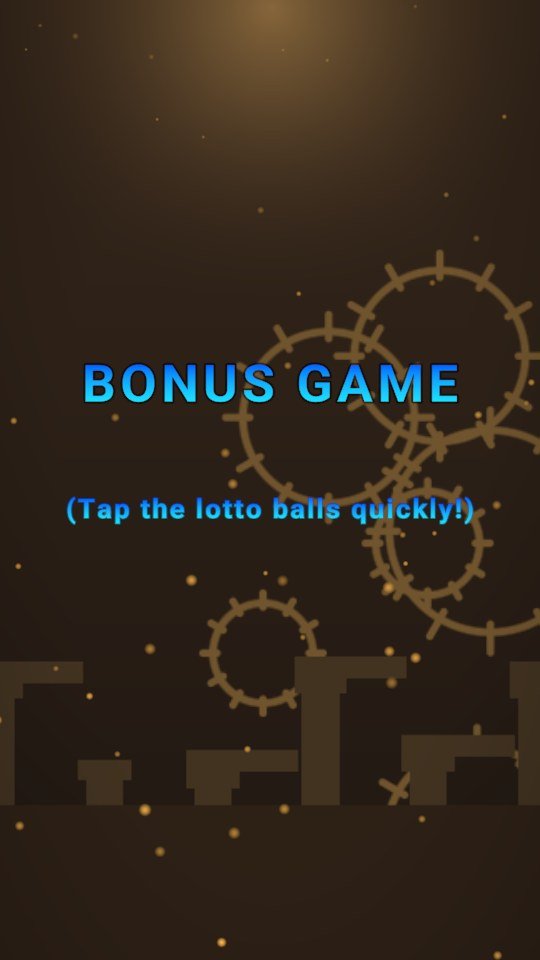
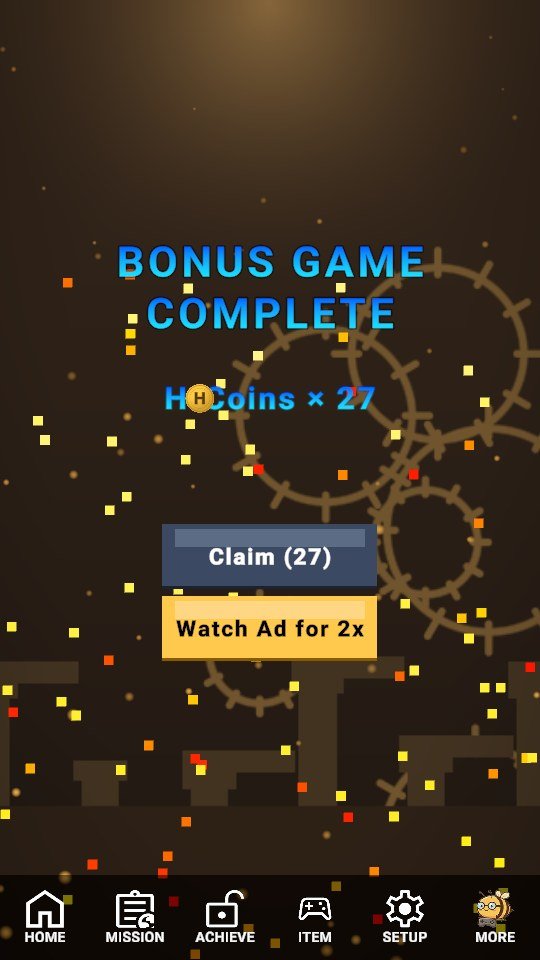
When the level you cleared is a multiple of 5 (5 · 10 · 15 and so on), a bonus game kicks in. After a 2-second intro and a 3 · 2 · 1, you tap golden lotto balls for 10 seconds. Each ball you catch is 1 H-Coin, and at the end you choose “Claim” or “Watch Ad for 2x”. A new ball appears every 0.20 s, up to 14 at once, and each lasts 1.5 s.
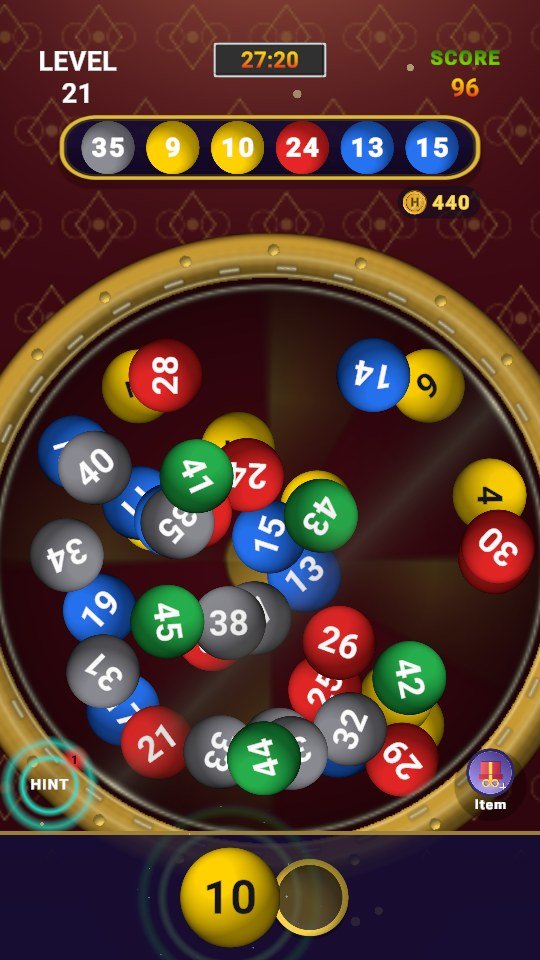
The backdrop changes too. There are 24 themes, and they change every round. After you clear a round, a swap is scheduled and carried out while the next level’s intro covers the screen. The 24 are shuffled into one lap (24 rounds) with no repeats, and adjusted so that three or more dark themes never come in a row. One background and one drum skin change together.
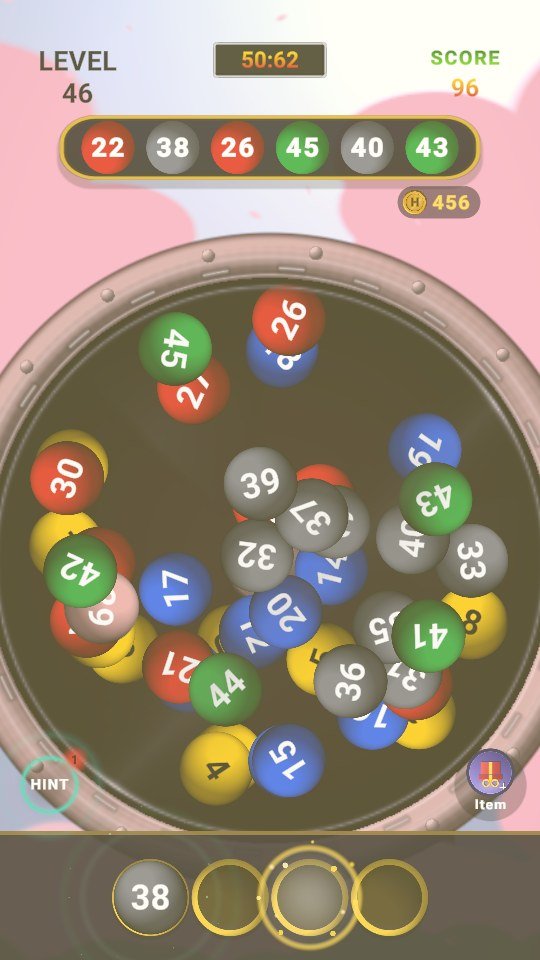
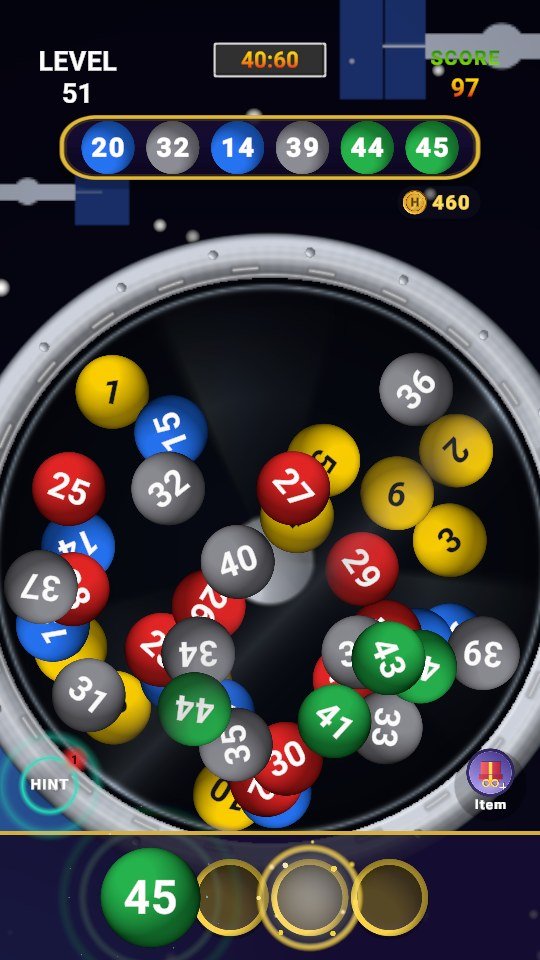 Space theme (level 51 display)
How round length depends on the country
There is one level regardless of country, but the country decides the length of a round. Whether the slot count is 6 or 7 sets the time at 7/6 and changes the starting values of the revive cost and item prices.
| Slots | Countries | Item price (starting value) |
|---|---|---|
| 6 slots | Korea · Brazil · Colombia (5+1) · USA (5+1) · UK · Japan · France · Russia · Turkey · Mexico and most others | 60 coins |
| 7 slots | China (6+1) · Germany (6+1) · Spain (6+1) · Switzerland (6+1) · Israel (6+1) | 70 coins |
Prices are tuned automatically and recalculated only when a round ends and when the app starts. They go down the more a player struggles, so the starting values above are only starting values, not fixed prices.
One-line strategy by level range
- 1 to 5: trust the guide arrow and the golden glow, and get used to the basic controls.
- 6 to 13: decoy flashes begin. A flashing ball has nothing to do with judging, so don’t let it steal your eyes.
- 14 to 29: weather and clouds mix in. When wind blows, the balls drift to one side, so pick the balls on that edge first.
- 30 to 49: special modes appear with a 15% chance. When “Disruption!” shows, you have one second to spare.
- 50 and up: darkness and drag reversal become possible. That is a reason to save your Magnifier, Freeze and Turtle.
- Multiples of 5: collect coins in the bonus game after clearing.
Decoys, clouds and the occasional speed-up in detail
Of the obstacles, weather and special modes are the easiest to notice. But the three that disturb a round’s rhythm the most are the ones you notice less.
- Decoy flash (from level 6): one ball that is not the answer, or one you already found, flashes for 0.5 seconds. Its color differs from the answer highlight, and it has no effect on judging. It appears every 4.5 to 6.2 seconds at levels 6 to 25 and every 3.2 to 4.6 seconds from level 26. That interval stays the same after level 100. In other words, the decoy is an obstacle that does not get faster as levels rise.
- Clouds (from level 22): a big cloud crosses the height of the drum over 4.2 seconds and hides your view at a maximum alpha of 0.85. It does not block input, so you can still pick balls behind a cloud. It comes every 9 to 13 seconds at levels 22 to 40 and every 7 to 10 seconds from level 41.
- The occasional speed-up: once every 12 to 22 seconds during matching (the first one 10 to 18 seconds after matching starts), all the balls speed up by 1.12x for 1.4 seconds. The setting (default 112, range 100 to 150) is a server option. It is not triggered while Freeze or Turtle is active.
For all three, once you reach the range where the interval is constant, they get no harder as levels go up. At level 26 or level 600, the decoy interval is the same. What grows is the number of things that overlap. In a round past level 80, wind, rain and snow come together, a special mode may trigger, and decoys and clouds pass through. The right end of the map is hard not because individual elements get stronger, but because so many overlap at once.
What the game does to help when you are stuck on a level
The source includes several cushions for stuck players.
- Extra time: each time you lose on the same level, the time limit grows by 10%, up to 20%.
- Easier special modes: after one loss on the same level the chance of a special mode is halved, and after two or more losses it is 0%.
- Penalty-free drops: a ball dropped far from the card is not counted as a mistake.
- Price tuning: even if you fail a round, its partial earnings go into the price calculation, so item prices go down the more you struggle.
So if you have lost three times in a row on one level, a special mode is not what is beating you. In that range, it is better to solve the weather, visibility and time problems with items. You can use the Magnifier 3 times per round, Freeze and Turtle once each, the Hourglass twice and the Magic Wand once. The 10 seconds added by the Hourglass are subtracted from the clear bonus score, so you cannot buy time to raise your score.
Example: the order of events in one level 50 round
The source has no minute-by-minute timeline, because obstacles are decided by level range and probability. Still, the order of events within a round is fixed, so here is a round around level 50 in sequence (a 6-slot country, based on about 72.7 seconds).
- Level intro and shuffle: about a 2.1-second intro, then a 2-second shuffle. During this, weather (rain or snow after 1 to 2 seconds) may start first.
- Number reveal and 3 · 2 · 1: a reveal at 0.28-second intervals, then 3 seconds. In a round with a special mode, a “Disruption!” pill appears about 1 second before the reveal.
- Matching starts: the time limit runs. Short modes such as slow motion, speed burst, earthquake and flash switch on at this moment. Long modes such as screen shake, fog and darkness last until the end of the round.
- Mid-matching: a decoy flashes every 3.2 to 4.6 seconds, a cloud passes every 7 to 10 seconds, and once between 12 and 22 seconds the balls speed up for 1.4 seconds. Wind strengthens over 2 seconds starting 2.5 seconds in.
- The last 4 seconds: the timer pulses red and a warning sound plays once.
Knowing this order makes “what is happening now” much less surprising. For example, when an earthquake starts it dies down to 15% strength over 4 seconds, so rather than forcing a pick in that window, it is reasonable to pick after it ends. In slow motion, time runs at half speed for 3.5 seconds and the time limit slows with it, so it is actually a chance to catch your breath.
How different are 6-slot and 7-slot rounds?
At the same level, a 7-slot country has one more slot to fill, but the time limit is 7/6 as long (93.0 seconds at level 1). Converted to time per slot, a 6-slot country gets about 13.3 seconds and a 7-slot country gets about 13.3 seconds, almost the same, because the source scales time in proportion to the slot count. So picking a 7-slot country does not make you more rushed or more relaxed. You do have one more number to remember in a round, and it is good to know that the bonus slot’s number range differs by country (Spain and Germany use 0 to 9, China 1 to 16, Switzerland 1 to 6 and Israel 1 to 7).
Because the Spain and Germany bonus is 0 to 9, a “0” can show in a slot. I confirmed this in code but not on screen.
The same eye training at any level: the ball color rule
Of the things that never change, the most useful to a player is ball color. Numbers cycle through five colors in groups of 10. 1 to 10 are yellow, 11 to 20 blue, 21 to 30 red, 31 to 40 gray and 41 to 50 green, and 51 to 60 return to yellow. The bonus ball is magenta. Level 12 or 150, the rule is the same. So even when a dark special mode blurs the numbers, as long as a faint color remains you can still narrow it down to “one of the blue ones.” The same holds when weather or clouds cover the numbers.
This rule is nearly the only way to save time at high levels. In a round with 32 balls circling, reading the numbers one by one is a different speed from first choosing one of five color groups and then reading the number. As levels rise and obstacles overlap, that difference grows.
In short, levels in this game go up by “more overlap,” not “faster.” Tidy eyes and the timing of your items, not hand speed, are the keys to getting through the level ranges. In the first few dozen levels, just remembering this cuts out needless hurry.
The distance to high levels
The time limit curve converging to 60 seconds at level 1000 means the design assumes rounds continue past level 1000. The achievement screen has a title, which advances one tier for every 1000 of your best level and a sub-tier for every 10 levels. The title names are serialized in the scene, so they cannot be known from the source alone. Level and score are merged into one regardless of country, so progress does not split when you switch countries.
The best way to read this map is to first see which range your best level is in. Below level 6 there are almost no obstacles, at levels 14 to 29 you only need to watch weather and clouds, and from level 30 up you must also mind special modes. If it suddenly feels harder at the first level of a new range, that is not your skill, it is a new element being stacked on for the first time.
The level shown on the capture screens was set by the capture rig, so it may differ from real progress. The source comments say the official rule documents for Israel and Peru could not be checked directly, so this post carries over only Israel’s 7 slots as the source values have them. All rules and numbers are in-game settings and have nothing to do with real lotteries.

Play LottoMaster now
Playing it is much faster than reading about it.
Find the other Master Series games all in one place at hanilab.app.
More from this game
 LottoMaster Live Broadcast Script — A Round of 32 Spinning Balls, Called by a Caster and an Analyst
 LottoMaster Themes — 24 Stages That Change Every Level, and a Bonus Game at Every Fifth
 LottoMaster Special Modes: Nine Disruptions That Even Touch the Clock
 LottoMaster Items: Five on One Bar — Magnifier, Freeze, Turtle, Hourglass and Magic Wand
🌌 Universe stories
 Roddy Universe, Part 2 — Fallen Down, Only One Step Back at the Roadside
 Roddy Universe, Part 1 — One Beat Before Crossing, the Empty Road Between the Cars
 Bombi Universe, Part 2 — Behind You: The Reaper That Walks Through Walls
Try other games
 TapMaster
 BlockMaster
 SnakeMaster