
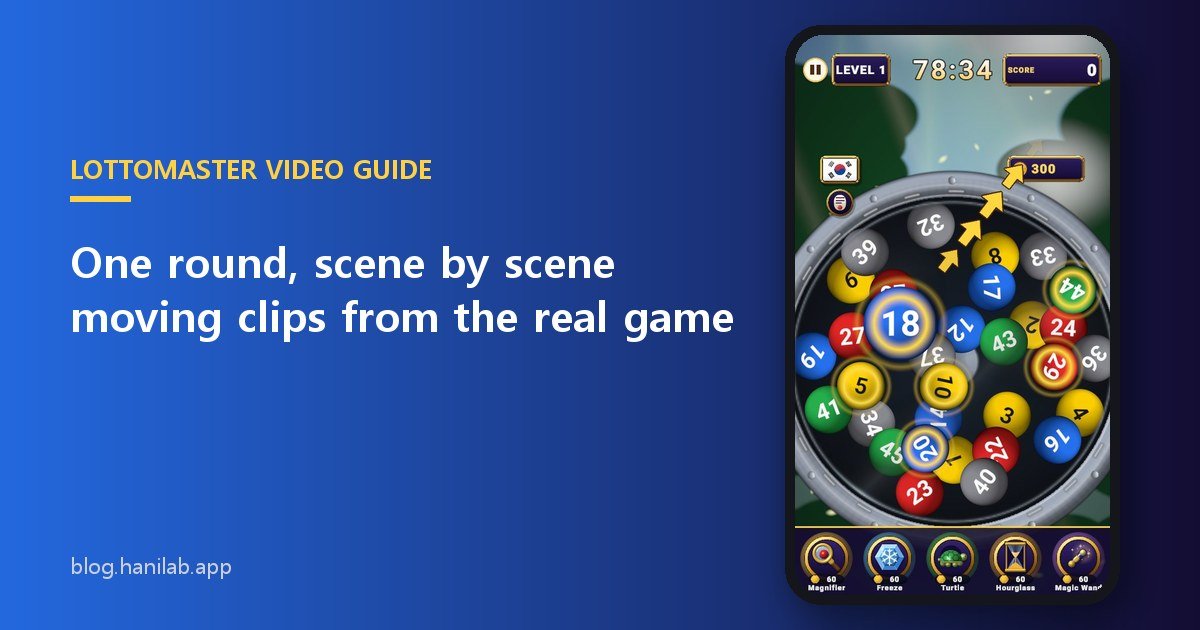
LottoMaster guide: follow one round with moving clips (picking, combo, revive)

The scenes that were hard to picture in text,
one moving clip at a time
The rules of LottoMaster fit in one line. Numbers are revealed at the top, and you pick the ball with the same number out of the spinning drum and drag it toward the slots. But things like “the judgment happens the moment you let go”, “where a combo breaks” and “the 20 seconds after a revive” are hard to feel from words alone. This LottoMaster guide follows one round with two moving clips and two still screens, all captured from the real game.
A note first for this LottoMaster guide. LottoMaster is a puzzle game with no real money or prizes, and the numbers on screen have nothing to do with any real lottery draw. Every scene below was captured by running the game itself, not from a produced video. I describe only what is visible, and what cannot be seen on screen is written separately from what I confirmed in the source.
The moment you pick up a ball and drag it
A round flows in this order. The level intro lasts about 2.1 seconds, the instruction text and the drum shuffle take 2 seconds, and then the target numbers appear in the slots one by one at 0.28-second intervals. After that 3, 2 and 1 each take one second, and only then does the matching phase, the part where the time limit runs, begin. The clip below shows the first few seconds of that matching phase. There are six number slots at the top and a drum full of balls below, and the ball you pick up grows while guide arrows appear.
 Moving clip: picking up a ball (captured from the real game)
There are three things to check while you watch.
- A picked-up ball grows to 1.35x. It is there to make the number easier to read. If no ball is exactly under your finger, the nearest ball within 1.35 times the ball radius is picked instead, so tapping a gap between balls is not a wasted tap.
- You do not have to drop it on a slot. Drop it near the number row (the cards) at the top and the ball goes by itself into the empty slot that carries its number.
- The judgment happens the moment you let go. Nothing happens while you are still dragging.
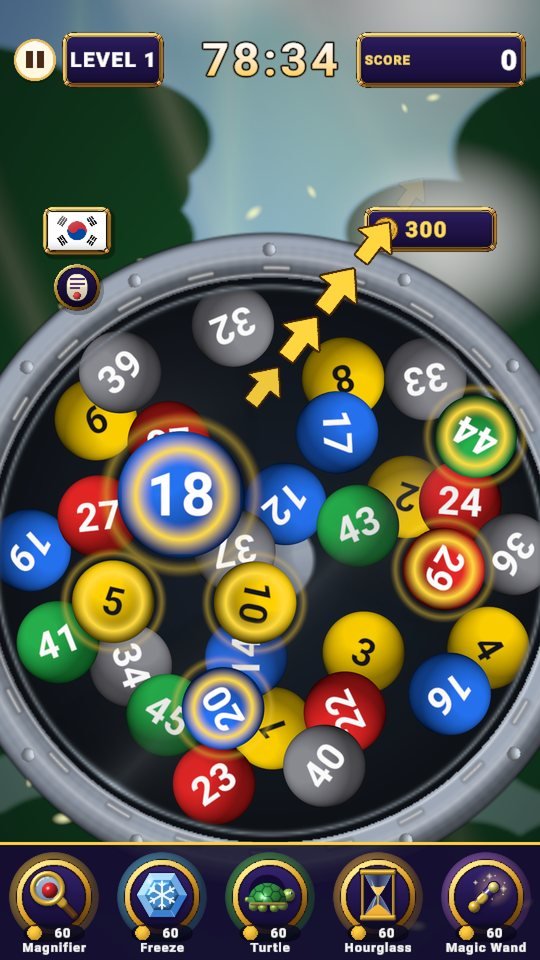 Still screen: the ball picked up on level 1 and the arrows pointing up. The first two levels carry this guidance
On the first two levels, the correct balls you have not found yet glow with a gold outline, and five arrows flow from the next ball to fill toward its empty slot. Those are the arrows in the picture above. From the third level on, this guidance disappears.
When the combo keeps going
A combo is “the number of times in a row you filled a slot without a mistake”. It goes up by 1 every time you hit by hand, and from combo 2 the words “Combo x2!” and “In a row!” appear in the middle of the screen.
Checking the source shows that a combo multiplier on the score is effectively not working right now. The combo is an on-screen effect, and the only place it is really used is the judging of Daily Missions (combo 1 time / 5 times). Scoring is +1 per slot, +10 for a clear plus the seconds left, and +5 for a perfect, all small numbers.
A combo breaks in only one case: when you drop a wrong number’s ball near the number row. If you drop it far from the row, the ball simply returns to the drum with no penalty, so you can try a ball you are unsure about by letting go halfway instead of bringing it up to the row.
Perfect and the time bonus
If you clear with zero mistakes, “PERFECT! No-Miss Clear” shows for 2 seconds and +5 points are added. A round won through a revive shows the popup but gives no score. When you clear, the seconds left (rounded) become your score, and at that moment the “Time Bonus” text appears.
This capture did not include the perfect and time bonus screens in English. Working out how big a score gets, the maximum for a 6-slot round is 6 + 10 + seconds left + 5 = 21 + seconds left. That means saving time is almost the whole score. The 10 seconds you add with the hourglass are not counted in this bonus.
When time runs out: game over and the revive
The time limit is about 80 seconds on level 1 and converges to 60 seconds as levels rise. If you cannot fill all the slots by 0 seconds, it is game over. The result screen then shows two revive buttons and one retry button. The button that revives with an ad carries an AD mark, and the button that revives with coins carries a coin price badge (H240).
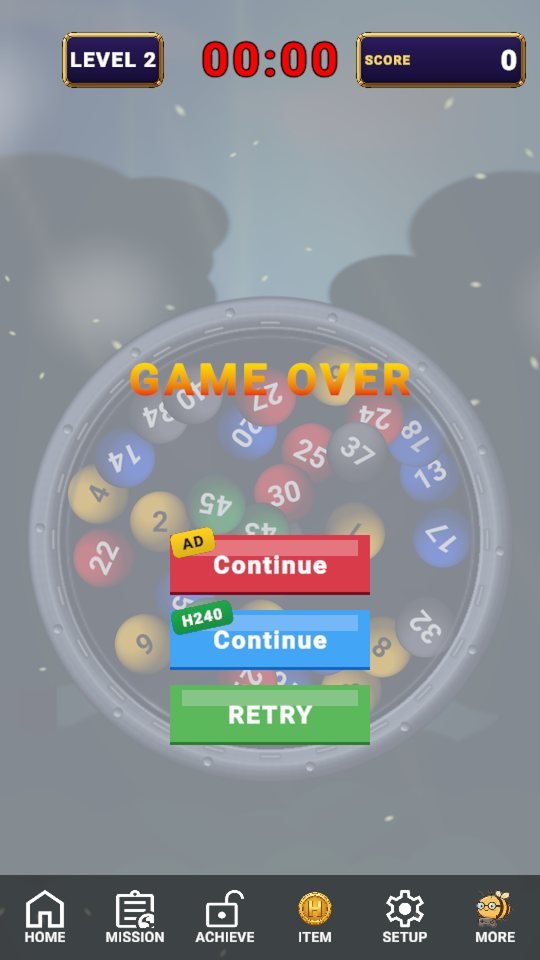 Game over: Continue (AD), Continue (H240) and RETRY
A revive is allowed once per game over, and when you revive, the round’s remaining time starts fresh at 20 seconds (it is a 20-second timer, not 20 seconds added). The slots you already filled and the winning numbers stay as they were. The clip below shows the flow after a revive. You can see the number row at the top, the partly filled slots and a timer number close to 20 seconds.
 Moving clip: right after the revive the timer starts near 20 seconds and counts down
A round won through a revive has a time bonus of 0 and no perfect +5. You get only the 10 points for the win. The coin cost of a revive is calculated as 4 times the item price, which at the starting values is 240 for a 6-slot country and 280 for a 7-slot country. Reviving with an ad is free. The conclusion you can read from the source is that it is most efficient to use it when time runs out with just one slot left.
After watching: a one-line summary per scene
| Scene | What you see on screen | What the source confirms |
|---|---|---|
| Pick up | The ball grows and arrows appear | 1.35x, tapping a gap still picks the nearest ball |
| Drop | Drop near the number row and it goes into the slot | Judged when you let go, a rough position is fine |
| Combo | The “Combo x2!” text | Effect and missions only, not a score multiplier |
| Perfect | “PERFECT! No-Miss Clear” | +5 points only with zero mistakes |
| Time left | The seconds-left popup | The seconds left count directly as score |
| Game over | Two kinds of revive and a retry | One revive, a fresh 20 seconds |
What I could not confirm on video
This post does not embed a YouTube video, because I could not find the official main video’s address in the source. The two moving clips were made by joining captured consecutive frames, so their speed matches the real game, but their length is shortened. The combo, perfect and time bonus scenes (they could not be captured in English), the full clear-result screen, the cloud and weather scenes and the special-mode scenes are not included, because I could not get usable footage of them in this capture.
How to read the clock
The timer at the top of the footage shows seconds and hundredths of a second in large digits, like “78:19” or “70:02”, not minutes and seconds. The first number is seconds and the second is hundredths. At first glance it looks like 78 minutes, but it really means 78 seconds left. The time limit is about 80 seconds on level 1 and never goes below 60 seconds however high the level climbs.
When the time left drops to 4 seconds or less, the digits turn red and pulse bigger, a red frame blinks and a warning sound plays once. This is the last moment to decide whether to use an item or to think about a revive. One lesser-known fact is that when the slow-motion special mode is active, the time limit also drains more slowly.
| Level | 6-slot time limit | 7-slot time limit |
|---|---|---|
| 1 | 79.7 s | 93.0 s |
| 10 | 77.0 s | 89.9 s |
| 50 | 72.7 s | 84.9 s |
| 100 | 70.3 s | 82.0 s |
| 300 | 65.8 s | 76.8 s |
| 1000 and up | 60.0 s | 70.0 s |
The table above is calculated from the formula and does not include the extra time added after losing several times in a row on the same level, or any server options. That is also why the 78-second reading on level 1 in the footage looks close to the 79.7 seconds in the table.
What is the number row at the top of the screen
At the top of the captured scenes, six round numbers sit in a row. These are the winning numbers for this round, and regardless of level they are always the full set of numbers for that country. A country where you match 6 numbers has six slots, and a country with a separate bonus ball, such as China, Germany, Spain, Switzerland and Israel, has seven. The footage was captured with the rules of Korea (Lotto 6/45).
When a round starts the numbers appear one by one at 0.28-second intervals, and the time limit only runs after all of them have appeared and 3, 2 and 1 have passed. You do not need to fill the numbers in order, so you can start with the easy ones. Ball colors cycle through five colors in steps of 10 (1 to 10 yellow, 11 to 20 blue, 21 to 30 red, 31 to 40 gray, 41 to 50 green), so you can narrow down a number’s range by color first. In the footage the yellow balls are in the 1 to 10 range, the blue ball is in the mid-10s and the red ball is in the 20s.
What the video does not show: when the disruptions start
This capture did not include the disruption scenes, but the timing confirmed in the source is worth writing down. The decoy flash starts at level 6 and makes one wrong ball sparkle for 0.5 seconds to draw your eye. Weather starts at level 14 and mixes rain, snow and wind. Clouds start at level 22 and cross the drum for 4.2 seconds, but they do not block input, so you can still pick a ball behind a cloud. Special modes start at level 30, and a warning appears 1 second before one kicks in.
The round in the footage looks relatively calm because the level is low. Levels 1 to 5 have no disruptions, and levels 6 to 13 have only the decoy. Keep in mind that the footage above was captured on levels 1 to 2 and 40.
About the speed of the moving clips
The two moving clips were made by fixing game time to a constant step, keeping the frames and joining them, so they are set to match real play speed. Even so, a real player’s fingers are more irregular and the balls overlap more closely. The footage is for understanding the idea, and the biggest difference you will feel in practice is that the radius with which your finger picks up a ball is 1.35 times wider.
Balls do not collide with each other, and when they overlap by less than 80% of the diameter they slide past one another. A round has 32 balls by default, no two balls share a number, and the winning numbers are drawn only from within those 32. A 6/45 game does not mean 45 balls are spinning.
Frequently asked questions
Do the arrows in the footage always appear?
They appear only on the first two levels. The correct ball glows gold and arrows flow from the next ball to the empty slot. From the third level on they disappear.
What happens to my score if I revive?
A round won through a revive has no time bonus and no perfect score, and you get only the 10 points for the win.
Is the score the same with a high combo?
The combo is not reflected in the score multiplier. It is used for the effect and for judging Daily Missions.
What if I miss the save-my-numbers button?
If you do not press it within 4.5 seconds after the clear, you cannot save. If the combination is already saved, the button does not appear.
One round from start to finish in order
| Order | Phase | Length | What the player does |
|---|---|---|---|
| 1 | Level intro | about 2.1 s | Just watch: a big ball with the level number appears |
| 2 | Instruction text and drum shuffle | 2 s | “Drag the ball that matches a winning number to the slot below” |
| 3 | Number reveal | 0.28 s per number | Watch the numbers appear in the slots one by one |
| 4 | 3 · 2 · 1 | 3 s | Look for the balls with your eyes first |
| 5 | Matching | about 60 to 80 s | Pick up balls and drop them near the number row |
| 6 | Result | n/a | On a clear, the score and buttons; on a fail, revive or retry |
The part of this table to notice is the 3, 2, 1 phase. The time limit is not running yet, but all the numbers are already revealed, so these 3 seconds are “free time in which you can search with your eyes before the clock runs”. If you skim which numbers are which color, your first moves after matching starts get faster. Among the special modes, the short ones (slow motion, speed burst, earthquake and flash) are deliberately switched on at the moment matching begins. The design keeps them from being used up during the shuffle, the reveal and the countdown.
Shaking: a free trick not in the video
I could not capture it, but if you shake the phone the balls get pushed to the side opposite the shake and then scatter, and when it ends the overlapping balls spread out in a sunflower pattern. You can use it when the balls are bunched in the middle and hide the numbers, or when the balls look stuck. Walking or hand tremor is ignored, so you have to shake fairly firmly for it to work. The exact sensitivity can only be known on a real device, so I could not confirm it.
Practice to try scene by scene
After watching the footage, here is one exercise per scene that you can try right away. I recommend doing all of them on easy rounds at levels 1 to 2.
- Pick-up practice: deliberately tap the gaps between balls. You can feel for yourself that the nearest ball within the 1.35x radius gets picked.
- Drop practice: drop a ball far from the number row. It returns to the drum with no penalty. Dropping a wrong ball close to the row breaks the combo, so learn that difference by feel.
- Combo practice: hit easy numbers in a row and bring up the combo 2 display. The order does not matter.
- Perfect practice: get into the habit of dropping only balls you are sure of. Not dropping is better for a perfect than being wrong.
- Time bonus practice: clear the same level while saving time, and watch the seconds left turn into score.
- Revive practice: deliberately run out of time for a game over, and revive with just one slot left. You can see the 20-second timer start fresh.
A few notes on the screens in the footage
Both moving clips were captured with the game language set to English and the Korean Lotto 6/45 rules. In the item bar at the bottom you can see five icons from the magnifier to the magic wand, each with its owned count. At the top there are the level box, the time and the score, and at the top right your coins appear with an H mark. The flag button next to it leads to the country selection window, and the small number-plate button below it leads to My Lotto Numbers. Pressing these buttons pauses the game’s time.
Cautions when reading the footage
The moving clips are scenes staged with a capture tool. The same round does not always flow exactly the same way, because the ball positions and disruptions differ every time. The number row or ball colors in a clip may not match real play, and the timing at which the combo or perfect appears is also different when a person plays by hand. What you should take from the footage is “what happens in what order”, not “do this and you will win”.
One more thing: the score box at the top of the still screens shows a different value from round to round. The captured scenes may have come from different rounds, so do not read them as one continuous record of a single round.
Each of the two still screens is meant to show one fact. The drag scene shows the size of the picked ball and the guide arrows, and the game over scene shows the two kinds of revive and the price badge. You only need to check one thing per scene. For a scene you are curious about, the most accurate way is to play a round yourself and compare.
Finally, here is the meaning of the ball colors once more. The numbers cycle through five colors in steps of 10, so seeing a red ball on screen is a hint that the number is roughly in the 20s. Color alone cannot settle a number, but it is enough to narrow down the candidates. If you follow a red ball in the footage, you can confirm that it carries a number in the 20s.
If you play a round after reading this, try to be conscious of just one of the scenes above.
One last time: LottoMaster is a puzzle game that has nothing to do with real lotteries or gambling. The numbers on screen mean something only inside the game and guarantee no result of any kind. If anything in the scenes above makes you curious, play a round yourself and compare them one by one.

Play LottoMaster now
Playing it is much faster than reading about it.
Find the other Master Series games all in one place at hanilab.app.
More from this game
 LottoMaster Daily Routine: 8 Things to Grab Each Day, From Daily Items to the Bonus Game
 LottoMaster Item Combos: Ten Pairs of Magnifier, Freeze, Turtle, Hourglass and Magic Wand
 LottoMaster Level Map: Five Things That Never Change and the Obstacles Stacked by Level Range
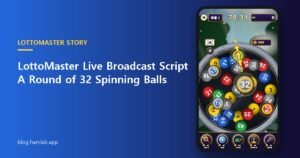 LottoMaster Live Broadcast Script — A Round of 32 Spinning Balls, Called by a Caster and an Analyst
🌌 Universe stories
 Roddy Universe, Part 2 — Fallen Down, Only One Step Back at the Roadside
 Roddy Universe, Part 1 — One Beat Before Crossing, the Empty Road Between the Cars
 Bombi Universe, Part 2 — Behind You: The Reaper That Walks Through Walls
Try other games
 TapMaster
 BlockMaster
 SnakeMaster