

One cell sits in two equations.
There is exactly one answer
Across, 7 + 5 = 12. Down, 12 ÷ 3 = 4. The 12 in the middle belongs to both equations at once. That single cell is why every number you pick in MathMaster has to satisfy two equations at the same time — it is a cross-math puzzle. Think, then fill.
This is the complete MathMaster guide. It covers what a cross equation looks like, how to place tiles, the time limit and the three hearts, the level bar, decoy tiles, boss boards, the five helper items plus the Joker, H-coins, the daily gift, and even the 12th-grade-level Advanced mode — everything in the game, in order. The numbers and wording come from the game’s code, and the screens are real game screens. In a hurry? Jump to Six tips for first-time solvers at the bottom.
- What a cross equation is — one cell, two equations
- The screen — where to look
- Controls — drag, tap, swap
- The operator zoo
- The 5 game modes
- The time limit — a clock worked out for each board
- Hearts, the level bar and Continue
- Decoy tiles — wrong pieces mixed in on purpose
- Boss boards — the rule is the clue
- Five items and the Joker
- Prices rise with your level
- H-coins, score, the daily challenge and the daily gift
- Advanced mode — 12th-grade step-by-step problems
- Languages and mood
- Six tips for first-time solvers
What a cross equation is — one cell, two equations
An equation is always five cells: number · operator · number · = · result. These equations run both across and down, but only on fixed lines. The grid is a 3×3 cross shape, so across equations sit only on rows 0, 2 and 4, and down equations only on columns 0, 2 and 4 — which means an across equation and a down equation always share a cell.
No negatives, no decimals. 7 − 9 is not −2; it is simply an equation that does not hold.
An equation holds only if the division comes out even. The smallest tile is 1 — there is no 0 — and every number is 99 or less.
You never have to rely on color alone, because the shapes differ. Number tiles go only in number cells, and sign tiles only in sign cells.
Every board is checked by a solver and used only if it has exactly one solution. Boards with two or more solutions, or ones the solver cannot finish checking, are thrown away.
The single answer matters for a reason: a correct tile is never marked wrong, and a wrong tile can be judged wrong the instant you place it. That judgment comes back in the hearts chapter.
The screen — where to look
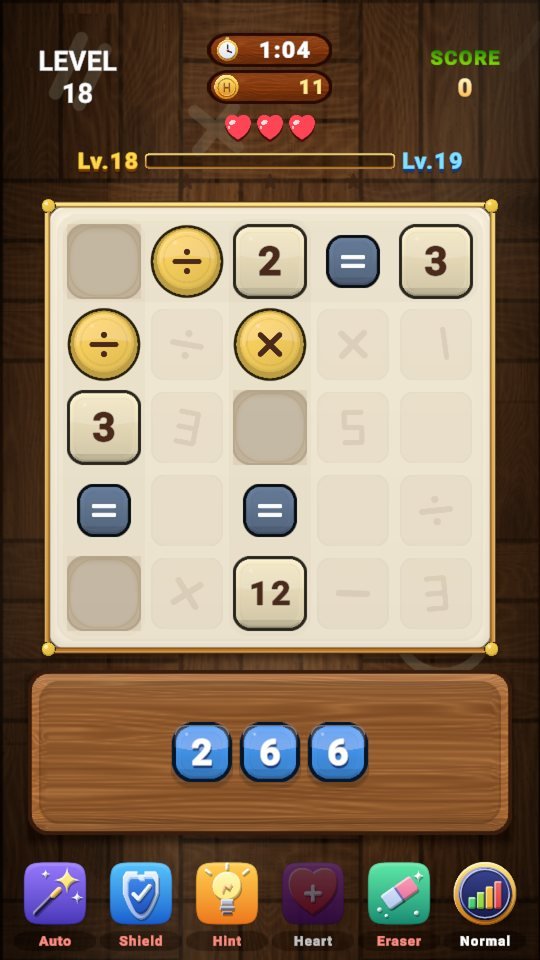
- Level · clock · H-coins · score — the top row. LEVEL and the level number on the left, the time remaining (m:ss) with the gold H-coin pill in the middle, and SCORE on the right.
- Three hearts — the row below. One disappears each time you place a wrong tile.
- Level bar — Lv.N ━ Lv.N+1. It fills as you solve boards, and when it is full you move up a level.
- The cross grid — in the middle. Placed numbers are squares; signs are round gold circles.
- The tray — the wooden tray under the board. Blue number tiles and orange-toned sign tiles sit here, and you drag them from here.
- The item row, 6 slots — at the very bottom. From the left: Auto-fill · Shield · Hint · Heart · Eraser, then the mode slot labeled with the current mode name (here Normal).
The background is a dark wooden table with signs drifting across it, and weather such as snow, rain and wind sometimes passes through. The H-coin number next to the clock shrinks whenever you buy an item, so keep an eye on it.
Controls — drag, tap, swap
Grab a tile in the tray and drag it to an empty cell. Number tiles go only in number cells, sign tiles only in sign cells. If you get it wrong, the game tells you Number tiles go in number cells or Operator tiles go in operator cells.
Tap a tile once to pick it, then tap an empty cell once. The level 1 hint is exactly this method — Tap a tile, then tap an empty cell. Level 2 shows You can also drag a tile into place.
Drop a tile onto a cell that already holds one and the two trade places. The displaced tile goes to the spot your tile just left.
A placed tile can be dragged out, or tapped, to send it back to the tray.
Because every board has one answer, a wrong tile is taken straight back by the board and you lose a heart. While an equation is still half-filled, nothing is marked wrong. When you place the last tile, the whole board is checked again from the start to decide whether you have won.
In Beginner and Normal, short hints pop up as speech bubbles at certain levels. Levels 1–3 show a ghost tile flying into a cell for 60 seconds, and then: level 3 says Signs go into sign cells — plus, minus, times, divide, level 5 says Stuck? Tap the lightbulb for a hint, level 7 says Several equations — complete them all, and level 10 says A shared cell sits in two equations — one tile must fit both! Pro and Master skip the basic hints.
The operator zoo
Beyond the four basics (+ − × ÷), more signs appear depending on the mode. The first board that uses a new sign shows an explanation bubble that stays until the board is done.
| Sign | Name | On-screen note |
|---|---|---|
| + − × ÷ | The four basics | Division holds only when it comes out even. Multiplication appears from Normal level 11, division from level 16 |
| ^ | Power | New: powers — 2^3 means 2 x 2 x 2 |
| % | Remainder | New: remainder (%) – what is left after dividing. 17 % 5 = 2 |
| G | Greatest common divisor | New: G = greatest common divisor. G(12, 18) = 6 |
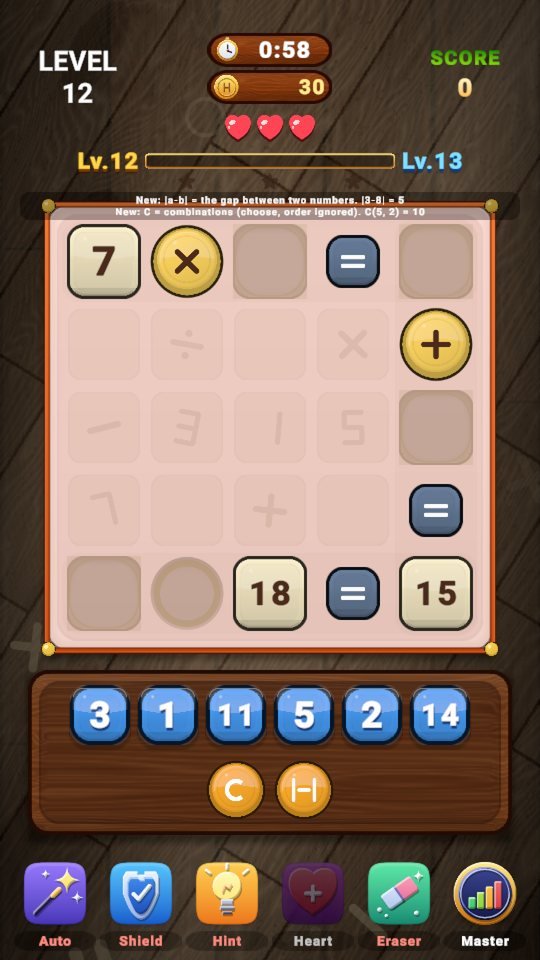
| |a-b| | Gap between two numbers | New: |a-b| = the gap between two numbers. |3-8| = 5 |
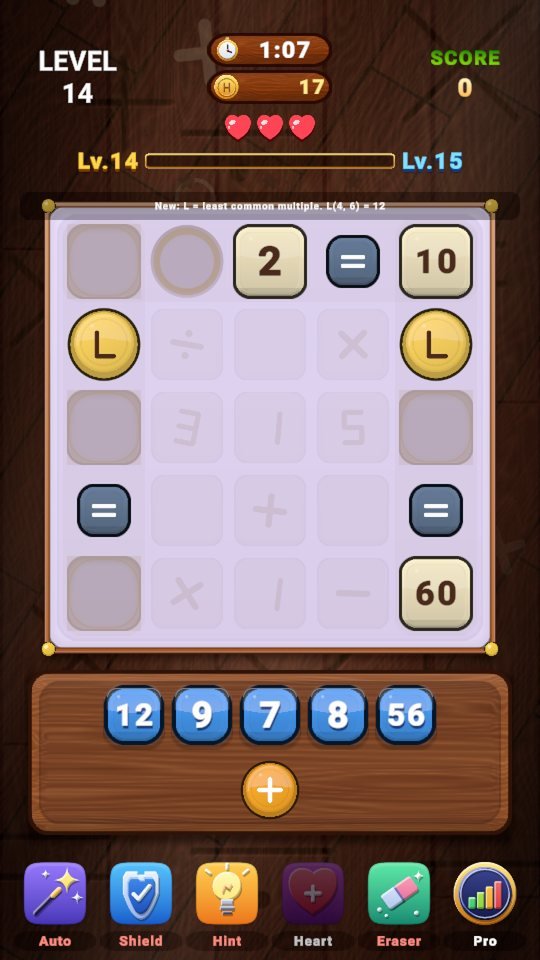
| L | Least common multiple | New: L = least common multiple. L(4, 6) = 12 |
| C | Combinations | New: C = combinations (choose, order ignored). C(5, 2) = 10 |
| P | Permutations | New: P = permutations (ordered picks). P(5, 2) = 20 |
| log | Logarithm | New: log = logarithm. log(2, 8) = 3 because 2 x 2 x 2 = 8 |
Parentheses and negative numbers are never used, because an equation is fixed at five cells.
The 5 game modes
Tap the mode slot at the bottom right (the round gold-rimmed bar-chart icon) and the game pauses and the Game Mode window opens. Each card shows which level you are on in that mode (Lv.N), and the mode you are playing carries a Playing badge.

Five cards run from top to bottom in the order Beginner · Normal · Pro · Master · Advanced. In this screen Normal is the mode marked Playing (Lv.10), and Close at the bottom shuts the window.
Each mode saves its own level, score and best record. When you switch modes you pick up at the first board of the level that mode was last on, and even at the same level each mode serves different puzzles. Every mode is endless — after stages 1–100 comes Endless mode.
| Mode | Description (as the game words it) | Features |
|---|---|---|
| Beginner | Elementary school level: only add, subtract, multiply, divide. Lines grow slowly, plenty of time. | Four basics only. No bosses. Time ×1.45 · floor 35 s |
| Normal | The classic climb. Decoys from level 30, powers from level 41. | Bosses from level 20, every multiple of 10. Time ×1 · floor 20 s |
| Pro | Middle school to 1st-year high school: powers, greatest common divisor, least common multiple, distance between numbers. | Level 1 ×, 3 ÷, 6 ^, 10 G, 14 L, 18 |a-b|, 24 %. Bosses at 10 · 20 · 30…, time ×0.85 · floor 20 s |
| Master | High school years 2-3 level: combinations, permutations, logarithms and powers, with many decoys. A boss every 5 levels, tight clock. | Level 4 C, 8 P, 12 log, 16 G, 20 L, 24 %. Time ×0.72 · floor 18 s |
| Advanced | 12th-grade level: multi-step problems on series, calculus, probability and logarithms. Pick the right answer at each step. | Not a cross puzzle but four-choice questions. Explained in chapter 13 |
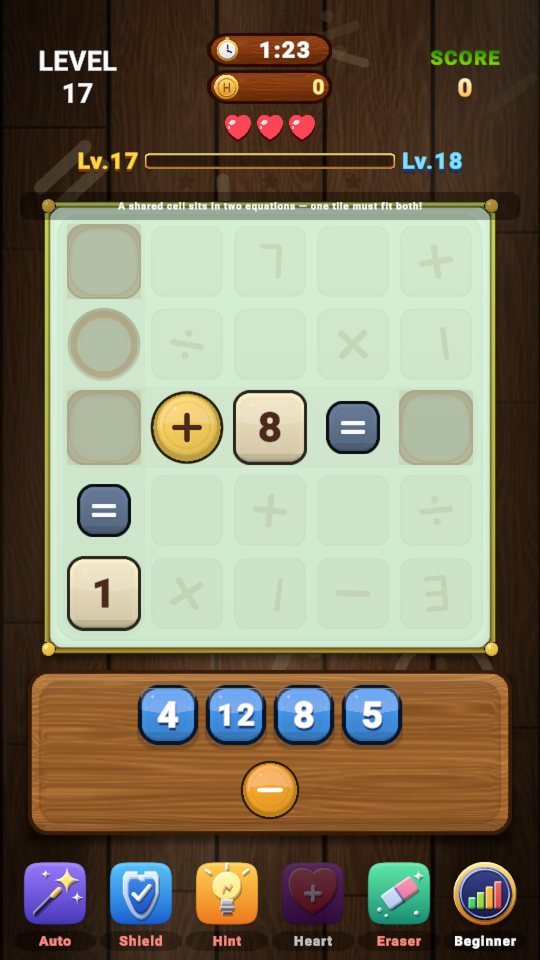
How Normal mode ramps up
| Level | What changes |
|---|---|
| 1–2 | One equation, one number cell. Addition and subtraction |
| 3 | Sign cells start to be empty — learning sign tiles |
| 4–6 | One equation, 1–2 blanks. From level 6, up to 1 decoy tile |
| 7–9 | Two equations that have nothing to do with each other |
| 10 | The first L-shape — one across and one down equation share a cell |
| 11–15 | Multiplication appears (11). From 14, shapes where three lines meet are mixed in |
| 16–20 | Division appears (16) |
| 21–35 | L and U shapes mixed in. Decoy tiles get serious from 30 |
| 36–50 | A cross of three equations |
| 51–75 | Four equations, repeated numbers, blank operators, 2–3 decoys |
| 76–100 | Five to six equations, many blank operators, 3 decoys |
| 101~ | Endless mode — the share of blanks rises every 10 levels, 3–5 decoys |
Stages show a Stage N banner, and past 100 an Endless N banner appears. Endless mode serves different boards every time you launch the app.
The time limit — a clock worked out for each board
Every board has a time limit, and its length is set by the board’s “weight”.
blanks + 2 × (equations − 1)
18 + 7 × weight (seconds). Minimum 25 s, maximum 150 s
Unchanged up to level 10, then 0.6% shorter per level — about half at level 93
Beginner ×1.45 · Normal ×1 · Pro ×0.85 · Master ×0.72
| Normal mode · level 10 or below | Weight 1 | Weight 5 | Weight 10 | Weight 19 or more |
|---|---|---|---|---|
| Time limit | 25 s | 53 s | 88 s | 150 s (cap) |
Each mode also keeps the time from dropping below a floor (Beginner 35 s · Normal 20 s · Pro 20 s · Master 18 s). If there is not even time to read the board, you would be punishing slow hands rather than skill.
When the clock reaches 0 it is instant game over, however many hearts you have left and whether or not you hold a shield. The message is Time’s up!. That is different from a wrong tile, which costs only one heart. Not even a shield stops a timeout.
The clock stops during the countdown, the solved animation, the level-up animation, pause, game over, while the mode window or item window is open, and while an ad plays. In the last 10 seconds you hear a ticking sound.
Hearts, the level bar and Continue
One wrong tile, one heart. With a shield, the shield blocks it instead of a heart. When all are gone it is game over, and the screen changes 0.7 seconds after the last heart pops.
Solving a board fills the bar by board weight ÷ level capacity. Capacity is 3 + level × 3/4 (capped at 60), so early on a level takes two or three boards, and later three, four or five.
After a board is solved there is a solved animation (about 0.95 seconds) and then straight on to the next board. Only when you level up does a LEVEL N flourish appear in the middle of the screen.
The three choices on the game over screen
| Choice | What happens |
|---|---|
| Continue with coins | You pay H-coins and carry on on the same board with three hearts and a full clock. It costs 140 at level 1 (and gets pricier as you level up) |
| Continue with an ad | Watch a rewarded ad and carry on the same way |
| Retry | Start over from the first board of that level with an empty bar and three hearts |
Decoy tiles — wrong pieces mixed in on purpose
The tray deliberately holds tiles that are not part of the answer, to give you something to choose between. After decoys are added, the solver runs again, and if a decoy could take the place of a correct tile in some solution, that board is thrown away. So even with decoys, there is still exactly one answer.
| Mode | Number of decoys |
|---|---|
| Beginner | Up to 1 |
| Normal | Level 6~ 0–1 · 30~ 1–2 · 51~75 2–3 · 76~100 3 · Endless 3–5 |
| Pro | Starts at 0–1 and reaches 3–4 late |
| Master | 2–5 |
The game prefers to mix in a sign that is different from the signs already in the tray. If there are two or more sign tiles and they are all the same sign (a + and a +), it sometimes adds one more, different sign. From level 21 onward, number decoys and sign decoys alternate.
Boss boards — the rule is the clue

A boss appears on the first board of a level. At first a large BOSS PUZZLE title and a one-line rule fill the middle of the screen, and afterwards the rule stays in a note over the board until you finish. This screen is Master mode level 5, with the red-tinted boss board and the note Rule: every result is EVEN above the grid.
Bosses come at levels 20 · 30 · 40… in Normal, 10 · 20 · 30… in Pro, and 5 · 10 · 15… in Master. Beginner and Advanced have no bosses. The reward is coins and score doubled (Boss clear! x2).
Four rules take turns, in this order.
- Rule: every result is EVEN
- Rule: every result is 12 or more
- Rule: every equation uses the SAME sign
- Rule: every result is DIFFERENT
The key is that the rule is a condition that decides the answer. Layouts that break the rule do not count as solutions, so reading the rule is itself a clue. That is why a boss board can have more blanks than usual and still leave only one answer. Read the rule once before you start.
Five items and the Joker
These are the helpers in the bottom row. No item is free. The moment you use one you pay H-coins, and if you have bought stock, the stock is used first. If an item turns out to have no effect, your payment is returned. The row runs Auto-fill · Shield · Hint (middle) · Heart · Eraser.
| Item | Effect | Usable when | Price at level 1 |
|---|---|---|---|
| Hint | A three-step hint (explained below) | Always during a board | 40 |
| Auto-fill | Places one correct tile for you. Auto-fill! | While a cell still needs an answer | 80 |
| Shield | Blocks your next mistake. Shield on — next mistake is free | When you have no shield yet | 70 |
| Heart | Restores one heart. +1 heart | When you have fewer than 3 hearts | 110 |
| Eraser | Removes the extra pieces from the tray. Extra pieces removed | When there are decoys | 55 |
The Eraser removes only decoys and never touches the tiles used in the answer. If you press it when there is nothing to remove, it turns into a single Hint and spends an Eraser from stock or coins. When a shield blocks a mistake, you see Shield blocked it!
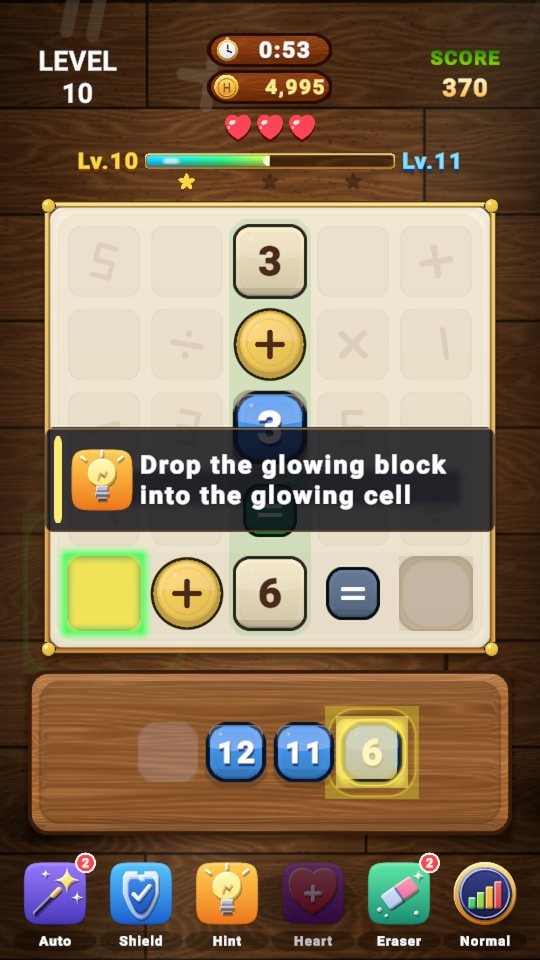
Hints come in three steps
Press again on the same cell within 25 seconds and the step goes up. Steps 1 and 2 shine a yellow light for 7 seconds on the blank and the tile that fits it, say Drop the glowing block into the glowing cell, and show a ghost tile flying into the cell. On the third press it places that tile for you (Placed one for you). If there is nothing left to point out, you get Nothing left to hint.
Each step is paid for separately. And a board where you used a hint loses its no-hint bonus and breaks your streak.
The Joker — a gift for a streak
The Joker, which appears as a golden button to the right of the hearts, is not something you buy. Solve 4 boards in a row without a mistake and you get one (Joker earned! Tap it to fill a cell). Tap it and it fills one correct cell. If you make a mistake or time runs out, the streak goes back to the start.
Item nudges
If you leave your hands off the screen for a while, the item slot that would help most right now blinks, and a soft chime plays about every 9 seconds. It only recommends things you can use and afford. For example: with 1 heart or fewer and no shield, after 7 seconds stuck it suggests Shield (or Heart if you have no shield); with under 30% of the time left and 5 seconds stuck, Auto-fill (or Hint); stuck 14 seconds, Hint; stuck 20 seconds, Eraser.
Prices rise with your level

This is the ITEM window that the item tab opens. At the top is My H-coins (500 in this screen). Below are five rows — 3 Hints · Auto-fill · Shield · Heart · Eraser — and each row shows its name, description, coin price and Owned N. The window’s note reads Buy helpers with H-coins. They are used in your next puzzle. When an ad is ready, a green Watch an ad +160 H-coins button also sits at the top (not showing in this shot).
Whatever you buy builds up as stock. Auto-fill and Eraser are pre-equipped, one each, when the next puzzle starts, and the 3 Hints are added to your hint stock. The prices on screen (100 · 70 · 65 · 100 · 50) are bundle prices, a little under the single-item values below.
An item’s price is its base value × the level multiplier, rounded to the nearest 5. The level multiplier is 1 + 0.040 × (level − 1) and stops at 4.5× (around level 89). The same Hint gets pricier the higher your level.
| Level | Multiplier | Hint | Auto | Shield | Heart | Eraser | Coin Continue | Ad coins |
|---|---|---|---|---|---|---|---|---|
| 1 | ×1.00 | 40 | 80 | 70 | 110 | 55 | 140 | 160 |
| 10 | ×1.36 | 55 | 110 | 95 | 150 | 75 | 190 | 220 |
| 30 | ×2.16 | 85 | 175 | 150 | 240 | 120 | 300 | 345 |
| 50 | ×2.96 | 120 | 235 | 205 | 325 | 165 | 415 | 475 |
| 100 | ×4.50 | 180 | 360 | 315 | 495 | 250 | 630 | 720 |
The values above are the single-item prices from the game’s formula. Shop bundles are a little cheaper — the 3-Hint pack is single price × 3 × 0.85, and the rest are single price × 0.9. On the other hand, the income curve (1 + 0.033 × (level − 1), stopping at 3.8×) is gentler than the price curve, so coins get slightly scarcer the further you go.
When you are short of coins, an ad is ready and you are online, the game asks Watch an ad, then buy the item? Say yes and watch the ad, and the item fires at once without spending any coins or stock. With no ad available you get Not enough H-coins. The only ads in this game are rewarded ones like these, and they are optional.
H-coins, score, the daily challenge and the daily gift
How to earn H-coins
| When | How many (level 1) |
|---|---|
| Instantly, for each number cell you get right | 2 |
| Instantly, for each sign cell you get right | 3 (one more, because signs have fewer choices and are harder to hit) |
| When you solve a board | (10 + 2 × blanks + 5 if you used no hint) × income multiplier, minimum 5 |
| Speed bonus | coins × share of time left × 0.5 (Speed +N) |
| Boss board | coins and score ×2 |
| Daily challenge | coins and score ×3 + a streak-day bonus |
| Each Advanced answer you get right | max(2, 2 × income multiplier) |
A cell reward is paid once per cell per board, and cells filled by an item pay nothing. A sound plays as the coins fly in and arrive, and the pitch climbs as the count grows.
Score
- +40 each time you complete an equation
- Solving a board gives a base of 100 + 20 × blanks. Solve it with no hints and half the base is added (No hints! +N)
- A run of no-hint boards adds a streak bonus of 10 × min(streak, 5)
- The total is multiplied by ×2 for a boss or ×3 for the daily challenge. If both apply, ×3
Scores build up separately per mode. On the mode info page (My Game Modes) you can see Level · Best level · Score · Best score · Puzzles solved · Best streak.
The daily challenge
If the first board you play that day is level 5 or higher and is the first board of its level, it becomes the daily challenge. The seed is the date, so everyone who plays the same level on the same day meets the same board. On success you see Daily clear! x3, a bonus that grows with your streak of days (10 × min(7, streak days)), and Day N in a row. This game has no leaderboard.
The daily gift
On your first launch of the day a gift popup appears, and a free item is dropped into your stock. If the gift is a hint it comes as 2. On the day you first install the game nothing is given; the gifts start the next day.
Advanced mode — 12th-grade step-by-step problems
It is not a cross puzzle but step-by-step problem solving. One problem is split into 3–5 steps, and at each step you pick the right answer from four choices.


- Topics: sequences · quadratics · derivatives · integrals · counting · limits · exponents and logs · sets · probability. Fourteen problem templates are mixed in — sigma sums, recurrences, roots and coefficients, extreme values, definite integrals, the y-intercept of a tangent, the binomial theorem, infinite geometric series, limits, log equations, three-set inclusion-exclusion, and conditional probability.
- Wrong answers: a wrong choice is switched off for that step and you lose a heart.
- Items: Hint removes two wrong choices (Two wrong answers removed), Eraser removes one (One wrong answer removed), and Auto-fill and the Joker fill in this step’s answer (Answer filled in).
- Time: 30 + 28 × steps seconds per problem (60–240 s). After level 10 it shrinks 0.5% per level and stops at 60%. There are no bosses.
- Coins: coins come in each time you get a step’s answer right.
Expressions are written the way people write them (a coefficient of 1 is dropped, and negatives use - with no parentheses). Only problems whose answer has been checked a second time by a method different from the solver make it in, so you never have to worry that the correct choice is wrong.
Languages and mood
- 10 in-app languages — English · Korean · Chinese · Japanese · German · French · Russian · Spanish · Portuguese · Turkish.
- Music — a laid-back tune while waiting and on game over, a calm one while you solve, and a focused one on boss boards, in Master mode, and when the clock is nearly out or only one heart is left.
- Ads — only rewarded (optional) ones, used for Continue, coin top-ups, and buying an item when you are short of coins.
- No server needed — the puzzles are generated inside the app, not by a server.
Six tips for first-time solvers
- Start with the shared cell. A cell that belongs to two equations has the fewest candidates left. Solve from there and the rest follows.
- Sign cells can be blank too. Like the level 76 hint, Signs can be missing too — check every equation.
- Suspect the decoys. A tile left over in the tray is a decoy. With one answer, you do not have to use every tile.
- One wrong tile is one heart. If you are unsure, work out both the across and the down equation in your head before you place. A timeout ends the game no matter how many hearts you have, so watch the clock too.
- On a boss board, read the rule first. The rule is the clue.
- Spend coins on Hints and Shields. Four boards in a row with no mistakes earns a free Joker, and solving with no hints brings a score bonus.
One cell sits in two equations, and there is exactly one answer. Think, then fill.

Play MathMaster now
Playing it is much faster than reading about it.
Find the other Master Series games all in one place at hanilab.app.
More from this game
 Who Checks That a Puzzle Has Only One Answer? — MathMaster Unique Answer Check
 MathMaster Decoy Tiles — Five Rules for Mixing In Deliberately Wrong Tiles
 One Line Becomes the Clue — MathMaster Boss Puzzle: ‘Every Result Is EVEN’
 Following One Problem Step by Step — How MathMaster Advanced Mode Plays
🌌 Universe stories
 Roddy Universe, Part 2 — Fallen Down, Only One Step Back at the Roadside
 Roddy Universe, Part 1 — One Beat Before Crossing, the Empty Road Between the Cars
 Bombi Universe, Part 2 — Behind You: The Reaper That Walks Through Walls
Try other games
 FanMaster
 BurstMaster
 WingMaster