

Q. Everyone says every MathMaster puzzle has exactly one answer. Who actually checks that?
A. Not a person, but a solver. Here is how the MathMaster unique answer check works: before the game serves a cross math puzzle, a solver plays that board itself and lets it through only when it finds exactly one solution. This post lays out that process as questions and answers, read straight from the source.
Q1. What is wrong with two answers?
A. It would be unfair if your answer were right and the game still called it wrong. The rule in the source is simple: a board without exactly one answer is never served. Stages and the endless run follow the same rule.
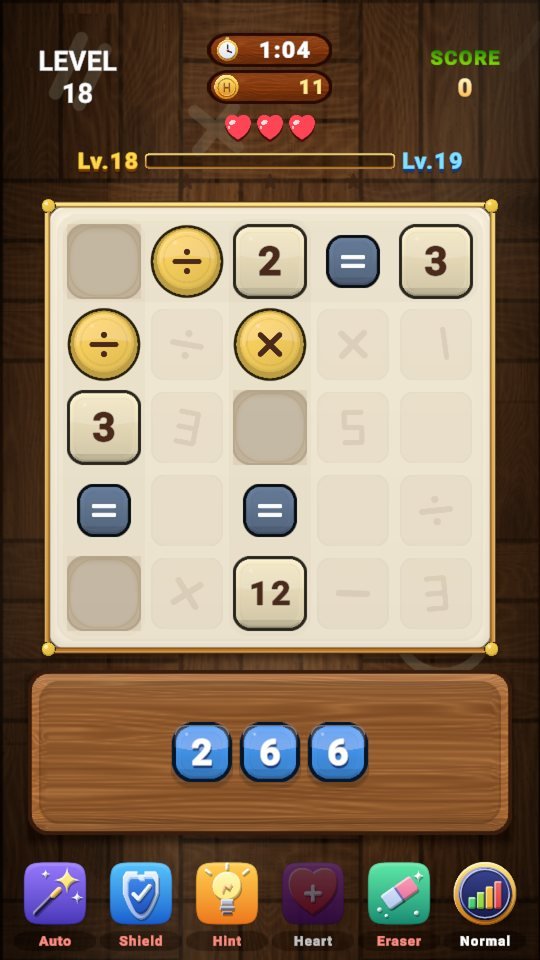 Normal mode, level 18. The tray holds 2, 6 and 6, and there are three empty cells.
Look at the screen. In the top row, □ ÷ 2 = 3 needs a 6. In the left column, □ ÷ 3 = □ takes a 6 on top and a 2 below, and 2 × □ = 12 in the middle column needs another 6. Every tile fits exactly one place, and that is what a board with one solution looks like.
Q2. How does the solver count?
A. Two things stand out.
- It counts by “face”, not by tile. Swapping two tiles of the same kind and value (say, two number 3s) counts as the same solution. Otherwise a board would seem to have more answers than it really does. The two 6s in the screenshot above are exactly this case.
- It fills the most constrained cell first and drops any path whose results cannot work out early (backward pruning).
It also stops on the spot once it finds 2 solutions. The question is not “how many answers are there?” but “is there only one?”
Q3. What if the solver cannot finish?
A. The search has a limit (8000 nodes), and when it hits that limit the board is treated as not unique and thrown away. A board nobody is sure about is never served.
| Stopping rule | Value |
|---|---|
| Solver search limit | 8000 nodes (board is discarded when reached) |
| Solutions found before stopping | 2 |
| Generation attempts per board | 40 |
| Hiding attempts (per graph) | 10 |
Q4. How is a board built?
A. The generator picks a template, builds a finished equation graph that is the answer, places it on the grid, and hides some cells. After hiding, the solver checks the result, and if it is not unique, another hiding is tried. At the end decoy tiles are added and the board is solved one more time. If a decoy could take the place of a right tile and make a new solution, that board is thrown away.
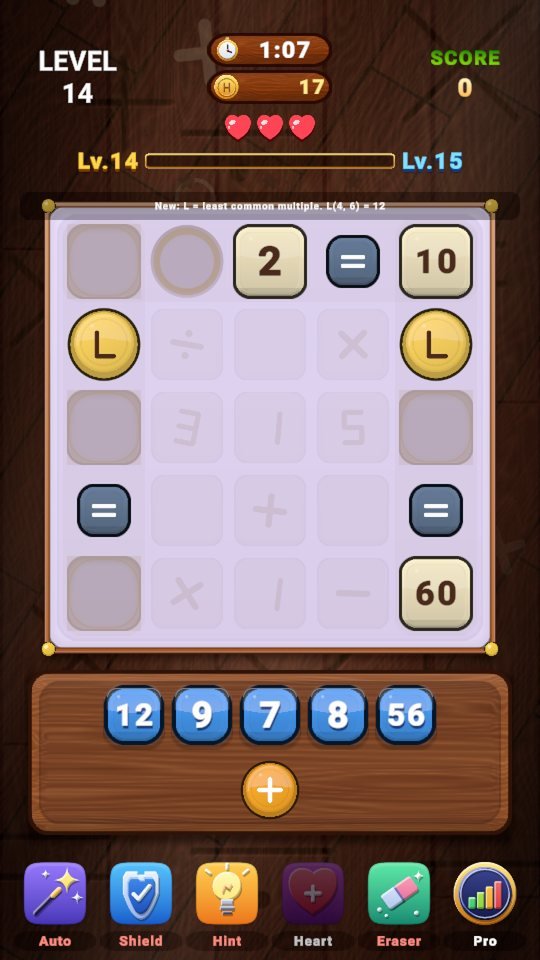 Pro mode, level 14. The tray holds five number tiles and one operator tile. Even with that many pieces, there must be one solution.
If all 40 attempts fail, a last safety net (Fallback) steps in: one equation with a single empty number cell and a single tile, so it can only be unique.
Q5. Why not just stop after some time?
A. The source deliberately stops by count, not by time. A time cut-off would make the same level a different puzzle on a fast phone and a slow one. Instead, the same (level, seed, generator version 5) always gives the same puzzle. The number of the last puzzle is also kept, so when a problem report comes in, the same board can be built again.
Q6. What do we gain from a unique solution?
A. One thing: the game can judge a wrong tile wrong the moment you place it. With one solution there is no “it turned out to be a different solution later”, and a right tile is never marked wrong.
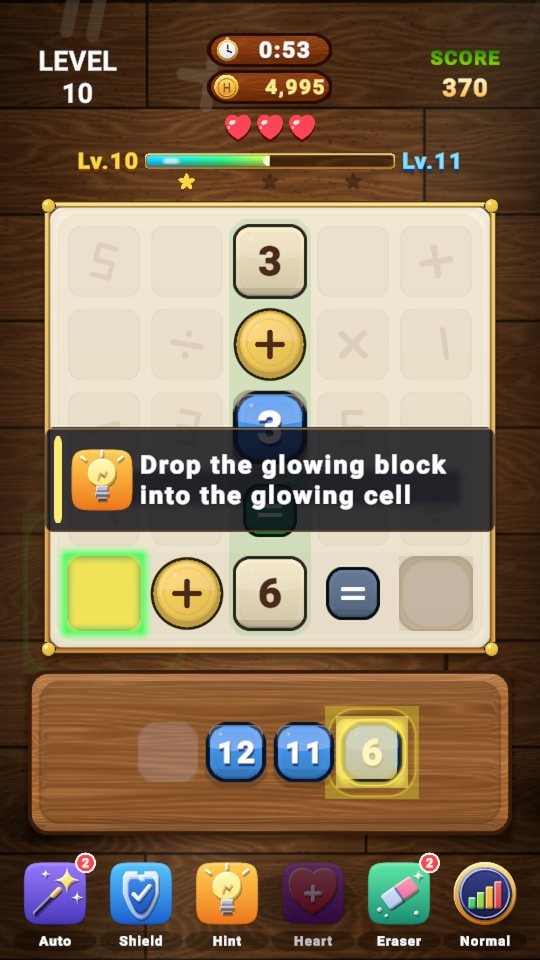 The hint screen. A glowing tile and a glowing cell appear as a pair. Because there is only one answer, the pair is fixed.
The final checker (PuzzleChecker) looks at the board separately from the part that built it, a second pair of eyes for mistakes the builder missed. The development test tools also include a cross-check that recounts, by permutation, a puzzle the solver called “unique”.
One last line
In MathMaster’s cross math puzzles you may get stuck, but you should never be cheated by a second answer. That is what all of these checks are for. If you are stuck, look again for a place where another tile could go. The board came out only after it was confirmed to have exactly one solution.

Play MathMaster now
Playing it is much faster than reading about it.
Find the other Master Series games all in one place at hanilab.app.
More from this game
 MathMaster Decoy Tiles — Five Rules for Mixing In Deliberately Wrong Tiles
 One Line Becomes the Clue — MathMaster Boss Puzzle: ‘Every Result Is EVEN’
 Following One Problem Step by Step — How MathMaster Advanced Mode Plays
 MathMaster Operators — A Field Guide to G, L, C, P, log, |a-b| and %
🌌 Universe stories
 Roddy Universe, Part 2 — Fallen Down, Only One Step Back at the Roadside
 Roddy Universe, Part 1 — One Beat Before Crossing, the Empty Road Between the Cars
 Bombi Universe, Part 2 — Behind You: The Reaper That Walks Through Walls
Try other games
 FindMaster
 LottoMaster
 TakMaster