

15 s at Level 1, 10 s at Level 100, x0.45 at Level 400: SliceMaster Difficulty in Numbers

Ask anyone about SliceMaster difficulty and you get “it gets harder later.” So instead of a feeling, I read the formulas and constants in the source and built a table from my own calculations. The only number you ever see in the game is the timer at the top of the screen, so every figure below comes from the source, not from the screen.
| Level | Time limit | Target piece range | Allowed ratio (5 pieces or fewer) | Allowed ratio (6-9 pieces) | Unlocked objects |
|---|---|---|---|---|---|
| 1 | 15.00 s | 2 (fixed) | 3.00 | 4.00 | 10 |
| 10 | 14.55 s | 2-9 | 3.00 | 4.00 | 11 |
| 25 | 13.79 s | 3-9 | 3.00 | 4.00 | 23 |
| 50 | 12.53 s | 4-9 | 3.00 | 4.00 | 42 |
| 75 | 11.26 s | 5-9 | 3.00 | 4.00 | 50 |
| 100 | 10.00 s | 6-9 | 3.00 | 4.00 | 59 |
| 150 | 10.00 s | 5-9 | 2.73 | 3.64 | 59 |
| 200 | 10.00 s | 5-9 | 2.45 | 3.27 | 59 |
| 300 | 10.00 s | 5-9 | 1.90 | 2.54 | 59 |
| 400 and up | 10.00 s | 5-9 | 1.60 (floor) | 1.80 | 59 |
* My own calculation. Time, piece range and allowed ratio come from the formulas and constants in DifficultyManager; the unlocked-object count comes from counting the unlock levels in the object data. The object count assumes a player who has climbed to that level. The allowed ratio means the largest piece’s area divided by the smallest piece’s area must be at or below this value to pass.
The time stops shrinking at level 100
The time limit starts at 15 seconds on level 1 and falls in a straight line to 10 seconds at level 100. As a formula it is 15 – 5 x (level – 1) / 99 seconds, which gives 12.53 s at level 50 and 10.05 s at level 99. From level 101 it is pinned at 10 seconds. A comment in the source explains why: shrinking the time as well would stack on top of the evenness check as a “double penalty” and make it feel like a different game, so after feedback the time axis was frozen.
 Level 1. The time limit starts at 15 seconds here. The timer in this picture was caught mid-countdown, so don’t read it against the table.
The piece range climbs, then steps back at level 101
The target piece count is decided by the level. The same level always gets the same target, and the same value never comes up twice in a row. The lower bound of the range rises as you go: 2-9 for levels 2-10, 3-9 for levels 11-30, 4-9 for levels 31-50, 5-9 for levels 51-80 and 6-9 for levels 81-100. Then from level 101 it is 5-9, so the lower bound drops back down. According to the source comment, raising the floor to 7 would leave only 7, 8 and 9, and 9 pieces would come up far too often, so it was lowered to 5. That is why, looking only at piece counts, level 150 (5-9) mixes more widely than level 100 (6-9).

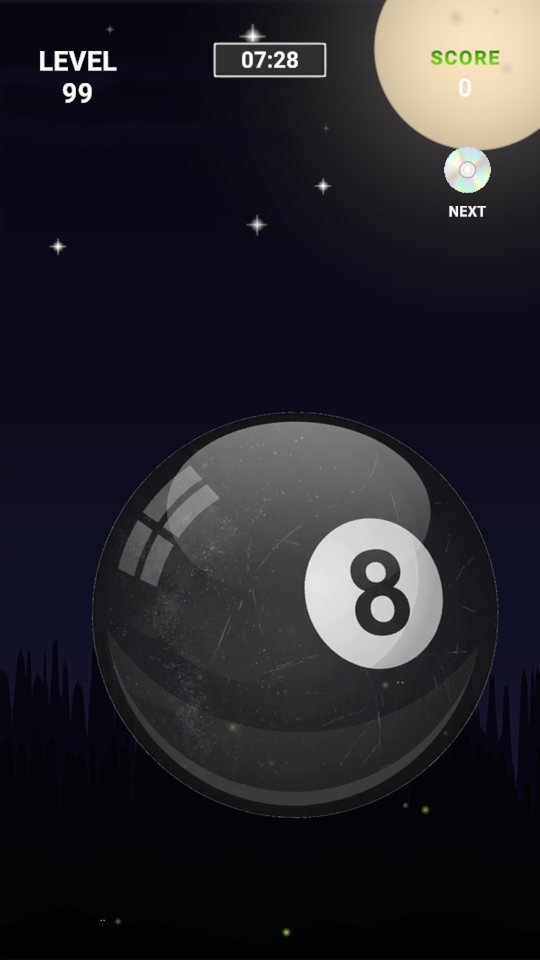
Level 49, in the 31-50 range. / Level 99, where the time reduction is almost over.
From level 101 it is about “more precise,” not “faster”
The base allowed ratio is set by the target piece count: 3.0 for 5 pieces or fewer and 4.0 for 6-9 pieces. From level 101 a tightening factor is multiplied in, falling in a straight line from 1.0 at level 101 to 0.45 at level 400. The formula is base x (1 – 0.55 x (level – 101) / 299). For 9 pieces, that takes 4.0 down to 1.8 at level 400.
3.0 x 0.45 would be 1.35, but the source has a lower limit so the ratio never drops below 1.6 however much it tightens. By my calculation the 5-pieces-or-fewer ratio reaches this 1.6 floor at about level 355 and stays there past level 400. For 6-9 pieces the value at level 400 is 1.8, so it never touches the floor.


Level 149, just after the tightening has begun. / Level 499, where the tightening finished back at level 400.
Let’s turn that into a feel. With 6-9 pieces, an allowed ratio of 4.0 forgives a largest piece up to 4 times the smallest. The 2.54 at level 300 forgives only a little over 2.5 times. A line drawn by eye that passes at level 100 can fail at level 300. The time stays at 10 seconds; only the precision demanded of your hand goes up.
The PERFECT (1.15 or less, x2.0), GREAT (1.40 or less, x1.5) and GOOD (1.80 or less, x1.2) thresholds are always the same, whatever the level. The allowed ratio is the passing line; the grade is the reward for a round that passed. So the passing line of 1.8 at level 400 equals the GOOD line. By this calculation, once you reach level 400, merely passing already means GOOD or better.
The numbers shrink to three lines
The time stops at level 100, the piece range loosens to 5-9 at level 101, and the allowed ratio tightens from level 101 to level 400. One table tells you nearly everything about what changes at which level. Next time a round stalls you, start from this table and ask whether it is the clock or the precision.

Play SliceMaster now
Playing it is much faster than reading about it.
Find the other Master Series games all in one place at hanilab.app.

More from this game
 Team Done Button vs. Team Wait — a SliceMaster Done Button Broadcast
 SliceMaster First Run: Why the Line Vanishes When You Lift, in 5 Steps
 SliceMaster Bottom Bar: A Guidebook to the 6 Tabs, HOME to MORE
 Why Does the Broom Only Appear at Level 52? The SliceMaster Object Pokedex
🌌 Universe stories
 Roddy Universe, Part 2 — Fallen Down, Only One Step Back at the Roadside
 Roddy Universe, Part 1 — One Beat Before Crossing, the Empty Road Between the Cars
 Bombi Universe, Part 2 — Behind You: The Reaper That Walks Through Walls
Try other games
 FanMaster
 BurstMaster
 WingMaster