
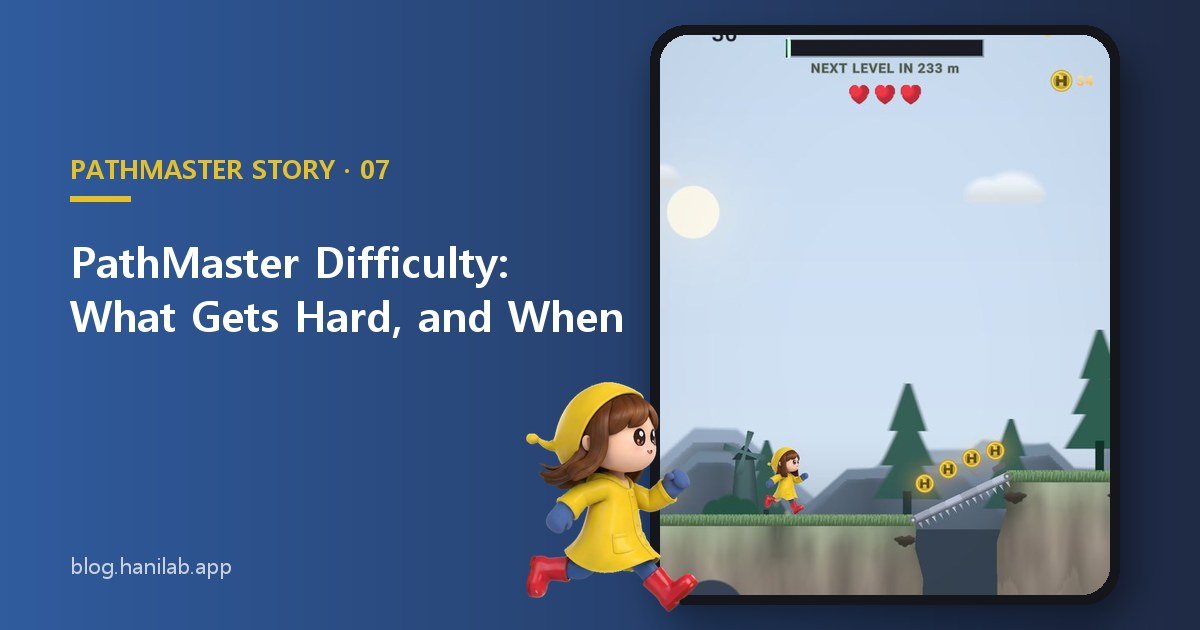

When the level number goes up,
speed is not the only thing that changes
The girl at level 1 jogs along at ease; at level 60 she is out of breath. But does the game really just get faster? Open the code and you will see that new rules switch on one at a time as the level rises, and a few things even go the other way and become easier.

This post is about PathMaster difficulty: at which levels monsters, wide gaps, old bridges, obstacles, narrow platforms and ice switch on, how speed and the length of a level grow, and why the drawer cooldown actually gets shorter. We follow it from level 1 to level 120 with the numbers in the game code and real screenshots.
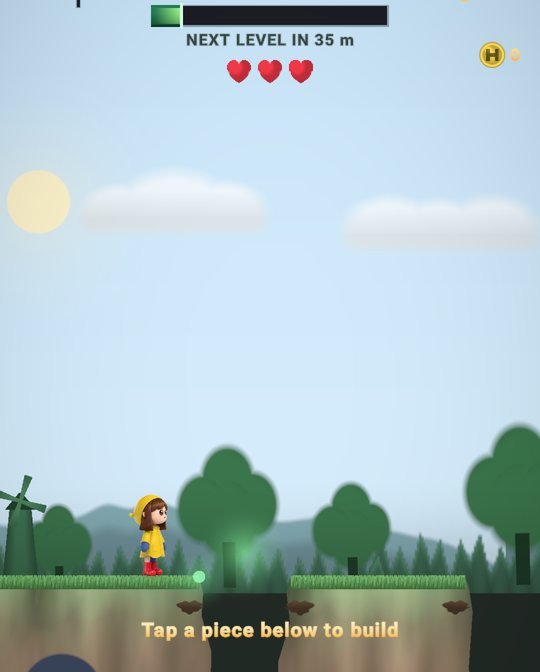 Level 1: no obstacles, no ice, just a level for learning, with the hint at the bottom of the screen
What Switches On, and When: a Level Timeline
Nearly every difficulty number is produced in one place. From level 1 to level 60 they climb along a smooth curve, and some rules suddenly switch on at fixed levels.
| Level | What switches on |
|---|---|
| 1 | All four drawer slots (flat, uphill, downhill, spiked board), small pits, and a practice monster in the fourth gap of level 1 |
| 3 | Monsters start appearing at random (20% per gap) |
| 4 | The wide gap that needs two pieces joined (about 10% at first) |
| 5 | Broken old bridge remnants (about 13% at first) |
| 6~9 | No new terrain, only more kinds of monsters |
| 10 | Obstacles: rocks, logs, birds and bee swarms |
| 12 | Narrow platforms (about 12% at first) |
| 24 | Ice platforms (about 14% at first) |
| After 60 | A second curve: difficulty comes from combinations (Chapter 5) |
On levels 1 to 5, obstacles, narrow platforms and ice are blocked from switching on. All four drawer slots are open from the start, and the terrain itself teaches you which slot to use.
 Level 30: one level is 235 m with 42 gaps, the longest stretch
Inside One Level: Start Slow, Get Faster
Speed rises within a level, not between levels. Every level starts at a relaxed pace and gets faster the longer you run, and the higher the level, the higher both the starting speed and the top speed. The distance one level asks for keeps growing until level 23, then stops.
| Level | Start → top speed | Level distance | Gaps | Time taken (approx.) |
|---|---|---|---|---|
| 1 | 2.45 → 3.90 | 39m | 7 | 13 s |
| 10 | 2.56 → 4.27 | 118m | 21 | 35 s |
| 30 | 2.79 → 5.08 | 235m | 42 | 61 s |
| 60 | 3.15 → 6.30 | 235m | 42 | 52 s |
| 120 | 3.15 → 6.80 | 235m | 42 | 50 s |
The interesting part is that the longest level is around level 30. The distance stops growing while the speed keeps climbing, so after level 60 a single level actually gets a little shorter. The difficulty grows not toward “longer” but toward “denser”.
The visible distance ahead (about 9.4 tiles) divided by the top speed is the time you have to see a gap and react: 2.4 s at level 1, 1.8 s at level 30, 1.5 s at level 60, 1.4 s at level 120. The game has a safeguard that trims the speed so this value never drops below 1.25 s, but with the current numbers even level 120 never reaches it, so it never kicks in.
Terrain Odds: How Often Each Kind Appears
Every time a gap is built, the game rolls the dice. Below are the odds per level (per platform or gap). A slope is a platform you walk along as its height changes, so it needs no piece.
| Type | 5 | 12 | 24 | 40 | 60 |
|---|---|---|---|---|---|
| Monster gap | 21% | 23% | 26% | 31% | 36% |
| Two-piece wide gap | 10% | 13% | 18% | 25% | 34% |
| Old bridge remnant | 13% | 15% | 19% | 24% | 30% |
| Narrow pit | 19% | 20% | 23% | 26% | 30% |
| Narrow platform | 0 | 12% | 17% | 23% | 30% |
| Ice platform | 0 | 0 | 14% | 19% | 26% |
| Slope platform | 19% | 21% | 24% | 29% | 34% |
| Platform length (tiles) | 2.6~4.4 | 2.5~4.3 | 2.4~4.1 | 2.3~3.8 | 2.2~3.4 |
* The wide-gap figure is a share of all gaps. Old bridge remnants appear only in gaps 2.4 tiles wide or more, and narrow pits appear only in flat gaps.


And one surprising fact: the width of a gap has nothing to do with the level. The code has a calculation that raises the gap width and height-difference limits with the level, but the place that builds the terrain never reads that value; it always draws from 1.15 to 3.6 tiles (0.85 to 1.5 for pits, up to about 7.9 for wide gaps). Levels do not get harder because gaps are wider, but because things come more often, faster, and in more mixed kinds.
Numbers Near Your Hand: The Drawer Gets More Forgiving
The numbers your hand touches directly move the other way.
| Level | Flat | Uphill / downhill | Spiked board | Angle tolerance | Snap distance |
|---|---|---|---|---|---|
| 1 | 0.98 s | 1.10 s | 1.61 s | 12° | 1.55 |
| 12 | 1.04 s | 1.18 s | 1.72 s | 11.4° | 1.39 |
| 24 | 0.93 s | 1.05 s | 1.53 s | 10.8° | 1.22 |
| 40 | 0.79 s | 0.89 s | 1.30 s | 10.0° | 0.99 |
| 60 | 0.65 s | 0.74 s | 1.08 s | 9.0° | 0.70 |
The angle tolerance gets steadily tighter (from 12° to 9°), and the distance at which a plank snaps into place shrinks from 1.55 to 0.70, so you have to place pieces precisely. Yet the drawer cooldown peaks around level 12 and then gets shorter again, because the code does not let the cooldown exceed 90% of the interval between gaps. As the speed rises and the gap interval shrinks, the cooldown shrinks with it. It is there so that you never face a run of same-angle gaps with no matching piece ready in the drawer.
A code comment says that “at higher levels the same piece takes longer to come back”, but at high levels the cooldown actually gets shorter because of that cap. The numbers in the table above already include the cap.
Beyond Level 60: The Second Curve
The first curve ends at level 60. After that, levels 60 to 120 ride a second curve, and beyond level 120 the values stop where they are. Here is what gets added.
From 6.30 to 6.80.
Expected rate from 0.55 to 0.80 per second. Spacing 1.25 s.
From 34% to 49%. One gap in two needs two pieces joined.
From 0.70 to 0.62. You have to be more precise.
Six Lines for Reading the Difficulty
- Levels 1 to 5 are for learning. Obstacles, narrow platforms and ice cannot switch on.
- New rules arrive one at a time at levels 3, 4, 5, 10, 12 and 24. Nothing to fear, just one at a time.
- Speed rises inside a level. The start is always relaxed, and the top speed only goes up as the level goes up.
- Gap width does not change. What is hard is not the width but how much is mixed together.
- Rain Boots for ice, a Sandbag for fast levels. Gear gives the numbers back to you.
- From level 60, precision is skill. The snap distance shrinks.
Now that you know the curves hiding behind the level number, it is time to open the drawer. Which gear gives back which number is a story for the gear-combination post.

Know the numbers,
see the path.

Play PathMaster now
Playing it is much faster than reading about it.
Find the other Master Series games all in one place at hanilab.app.

More from this game
 PathMaster Judging Script: Perfect, Open End and No Fit, Three Traffic-Light Judges Score One Plank
 No Name, No Brakes: Why the Raincoat Girl Runs Down Broken Roads
 PathMaster Item Guide: Ten Welcome Orbs, Six Gears to Watch Out For
 PathMaster World Tour: Thirty Landscapes, and How Weather and Wind Change the Run
🌌 Universe stories
 Roddy Universe, Part 2 — Fallen Down, Only One Step Back at the Roadside
 Roddy Universe, Part 1 — One Beat Before Crossing, the Empty Road Between the Cars
 Bombi Universe, Part 2 — Behind You: The Reaper That Walks Through Walls
Try other games
 TwistMaster
 BalanceMaster
 BoingMaster


